

Uber’s exit exposes a central weakness of platform work: workers can finance the productive assets while another company controls the digital infrastructure connecting those assets to customers.
Uber has stopped operating in Nigeria after 12 years in the country. A day later, the company confirmed that it had also ceased operations in Uganda.
The immediate story is about a multinational ride-hailing company leaving two African markets.
The economics underneath it are about something more fundamental:
What does it mean to own the asset that produces the income when somebody else owns access to the customer?
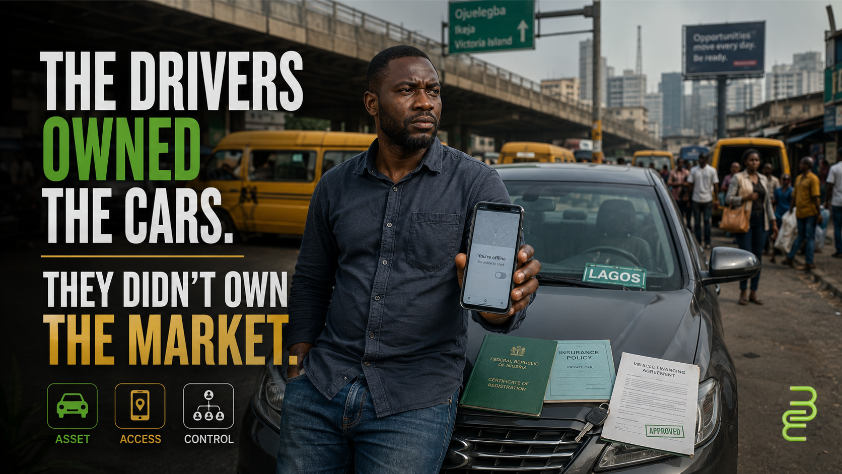
For thousands of ride-hailing drivers, the car may be theirs. The fuel bill is theirs. Maintenance, depreciation and potentially vehicle financing remain theirs.
But the marketplace connecting that vehicle to a stream of passengers can disappear from their phone almost overnight.
That is the economic distinction Uber’s departure puts into unusually sharp focus.
Uber ends a 12-year run in Nigeria
Uber told customers that it would wind down its Nigerian operations effective September 2 following a review of the business.
The company entered Nigeria through Lagos in 2014 before expanding into additional cities.
Uber did not provide detailed reasons for the decision or disclose how many drivers or riders would be affected.
Nigeria’s ride-hailing market has faced significant economic pressure. Rising fuel costs, inflation and currency volatility have increased operating expenses for both platforms and drivers, while competition among ride-hailing services has intensified.
Uber said its Nigerian help center would remain available through September 23 for unresolved account issues.
On September 3, an Uber spokesperson also confirmed that the company had stopped operating in Uganda.
The company has not disclosed the number of workers, contractors or riders affected across the two markets.
The cars did not leave with Uber
That is where the ownership question gets interesting.
A traditional transportation company might own a substantial fleet of vehicles, employ drivers and carry the cost of maintaining those assets.
The platform model distributes much of that capital requirement elsewhere.
Ride-hailing drivers typically provide the vehicle necessary to perform the work. They absorb fuel costs, maintenance, depreciation and other operating expenses associated with keeping that asset productive.
Uber provides something different: the digital marketplace that connects drivers with customers.
That distinction matters because when the platform leaves, most of the physical productive capacity does not disappear.
The cars are still in Nigeria. The drivers are still there. The potential passengers are still there.
What disappears is one system that connected them.
That makes distribution—not merely physical ownership—the scarce economic asset in this story.
Owning an asset is not the same as controlling its income
A driver can hold legal ownership of a vehicle while remaining economically dependent on infrastructure owned by someone else.
The vehicle creates potential productive capacity.
The platform helps convert that capacity into transactions.
That distinction extends far beyond ride-hailing.
- Creators can own cameras while platforms control audience discovery.
- Restaurants can own kitchens while delivery apps control significant channels for customer acquisition.
- Merchants can own inventory while marketplaces control search visibility and access to buyers.
- Independent workers can own their tools while digital platforms determine how easily customers can find them.
In each case, physical ownership provides some economic independence.
But distribution control creates another layer of power.
Uber’s exit demonstrates what happens when those two forms of ownership are separated.
Drivers retain their vehicles and their operating costs. Uber can withdraw its marketplace.
The capital stays local. The distribution system does not have to.
Who carries the risk when the platform exits?
The risk is distributed differently from the ownership.
A driver with a vehicle loan still owes the lender after an app stops generating rides.
The car continues depreciating.
Fuel, insurance and maintenance costs do not disappear.
A driver may migrate to another ride-hailing service or develop direct customer relationships, but that transition can create friction and income uncertainty.
Riders also lose a transportation option.
Uber, meanwhile, can make a corporate decision to stop serving a market without having to dispose of a massive locally owned vehicle fleet.
Reuters reported that Uber did not say whether any assets would be sold as part of the Nigerian closure.
That is one of the structural advantages of the platform model: much of the productive capital required to deliver the service sits outside the company itself.
The opportunity now shifts to whoever controls the next marketplace
Uber’s departure does not mean demand for transportation disappears.
It means that demand is available to be reorganized.
That creates an opening for competing ride-hailing companies and potentially local or regional platforms to attract drivers and riders who previously used Uber.
But simply replacing one app with another does not answer the larger economic question.
The more important issue is whether African businesses can capture more of the infrastructure surrounding the transaction: customer relationships, payments, data, software, dispatch systems, brand value and ultimately the economics of distribution.
If drivers simply move from one externally controlled marketplace to another, their immediate income problem may be reduced while the underlying ownership structure remains largely unchanged.
If locally owned platforms can capture more of that marketplace, however, Uber’s departure could create an opportunity for a different distribution structure to emerge.
Whether that happens remains an open question.
Uber is also restructuring globally—but the connection is unclear
The African exits come as Uber is making broader organizational changes.
On September 2, CEO Dara Khosrowshahi told employees that Uber was removing management layers, simplifying teams, refining its global location strategy and reducing its workforce by about 10%.
Uber said it was concentrating people and investment around what it sees as its biggest opportunities.
The company has not publicly established that those restructuring decisions caused the Nigeria or Uganda closures.
That distinction matters.
The simultaneous moves do, however, underline an important feature of global platform economics: capital and corporate attention can be redirected toward markets a company considers more attractive, while workers operating on the platform remain tied to assets and expenses located where they live.
The economics behind it
Uber’s departure from Nigeria and Uganda creates a clean distinction between productive ownership and distribution ownership.
Drivers may own the equipment required to provide the service.
They do not necessarily own the system that reliably turns that equipment into customers and revenue.
That means economic independence requires asking more than, “Who owns the asset?”
It also requires asking:
Who controls access to the market?
For Black workers, entrepreneurs and businesses increasingly operating through digital platforms, that question will matter well beyond ride-hailing.
Owning the car matters.
Owning—or at least having durable access to—the road connecting that car to the customer may matter just as much.
The economic implication
Platform businesses can shift capital costs toward individual workers while retaining control of valuable digital infrastructure: customer access, marketplace coordination and distribution.
That structure can give workers ownership of productive assets without giving them equivalent control over the revenue those assets generate.
Why it matters
The lesson is not that platform work has no value. Platforms can solve a real economic problem by aggregating demand and making customers easier to reach.
The issue is dependency.
When access to income depends heavily on infrastructure that workers neither own nor control, ownership of the physical tool alone does not guarantee economic resilience.
Uber’s exits make the question concrete:
How economically independent is a worker who owns the asset but depends on somebody else’s platform to monetize it?

Latest posts by normbond (see all)
- Uber Left Nigeria and Uganda. The Drivers Owned the Cars, Not the Market. - September 3, 2026
- Black Athletes Earn the Capital. Who Influences Where It Gets Invested? - September 3, 2026
- Black Culture Builds the Crowd. The Bigger Money May Be in Who Controls Access to It - September 2, 2026