


Professional sports economics usually starts with the contract.
How much did the player sign for?
How much is guaranteed?
How large is the endorsement deal?
Philadelphia 76ers star Jaylen Brown is raising a different question:
What happens after the athlete gets paid?
During a recent livestream, Brown said he wants more athletes to invest in the communities they come from and alleged that some people surrounding influential players steer them away from doing so.
Brown framed the issue in economic terms.
He said people representing athletes may see little benefit for themselves when players direct time, money and influence toward their communities.
Jaylen Brown exposing the behind-the-scenes realities of the NBA. He says most players have handlers who won’t let them invest in their communities, and help build the next Black Wall Street. Once you start doing that, he says, they begin attacking you media personalities like… pic.twitter.com/QD5s9bVj4R
— NBA Hoops (@Thechat101) August 31, 2026
Those are Brown’s claims. They do not establish that agents, advisers or corporations broadly discourage community investment.
But they raise a legitimate economic question that goes beyond one player’s frustration:
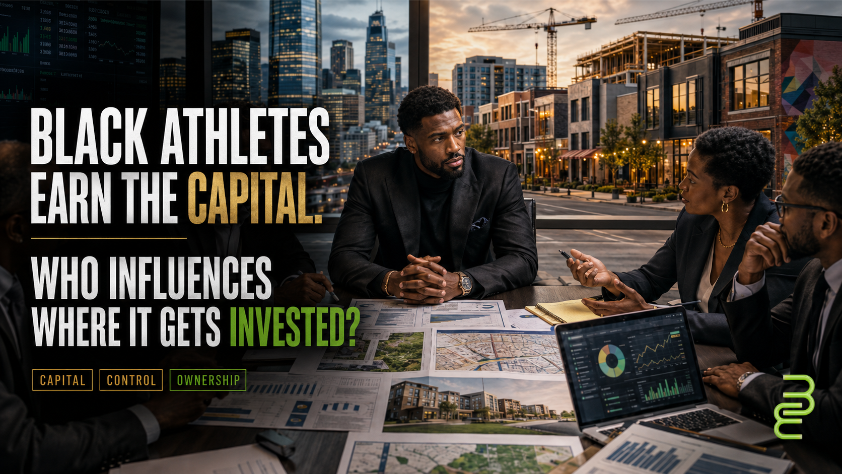
Who influences where athlete capital ultimately accumulates?
The contract is only the beginning
Brown knows what large-scale athlete capital looks like.
In 2023, while still with the Boston Celtics, he signed a five-year, $304 million contract extension. At the time, Brown publicly connected the deal to a broader ambition: reducing Boston’s racial wealth gap and helping create what he described as a Black Wall Street in the city.
Brown has since been traded to Philadelphia and is now a member of the 76ers. He has said his community work in Boston will continue despite the move.
His existing efforts include the 7uice Foundation, the Bridge program and Boston XChange, an initiative focused on creating additional net wealth in historically marginalized communities.
That context matters because Brown is not merely talking about charitable giving.
He is talking about capital allocation.
And that is a different economic conversation.
High income is not the same thing as economic control
An NBA player can earn tens or hundreds of millions of dollars.
But money rarely moves directly from:
team -> athlete -> community.
There is an entire financial ecosystem around an elite athlete.
- Agents negotiate contracts.
- Managers coordinate commercial opportunities.
- Financial advisers construct portfolios.
- Banks custody assets.
- Asset managers allocate capital.
- Lawyers structure entities and transactions.
- Brands create endorsement incentives.
- Investment professionals evaluate deals.
None of that is inherently problematic.
In fact, athletes need professional advice. Wealth preservation, tax planning, diversification, governance and due diligence all matter when someone suddenly controls extraordinary amounts of capital.
But it means the ownership question does not end when the paycheck reaches the player’s account.
Who helps determine what happens next?
You don’t have to own the money to influence it
This is the control issue underneath Brown’s comments.
An adviser does not need to legally own an athlete’s capital to influence:
- which investment opportunities reach the athlete;
- which deals are considered credible;
- which risks are considered unacceptable;
- how much money remains liquid;
- how much is allocated to public markets;
- how much moves into private businesses;
- whether local investment is treated as opportunity or exposure;
- whether community projects receive serious financial consideration.
That influence can be useful.
It can also shape where wealth compounds.
Brown’s allegation is that some influential athletes are being pushed away from deeper community involvement by people around them.
BEDC cannot establish from his comments alone how often that happens or why.
But the economic mechanism he is pointing toward is real enough to examine:
capital can be owned by one person while its allocation is heavily influenced by an intermediary network.
From giving back to owning something
There is also an important difference between philanthropy and investment.
When athletes donate to schools, nonprofits or neighborhood programs, communities can benefit immediately.
But community wealth requires something additional:
assets.
- Businesses.
- Real estate.
- Equity.
- Intellectual property.
- Financial institutions.
- Revenue-producing infrastructure.
- Supplier networks.
- Investment vehicles.
Brown’s Black Wall Street language is important because it implies a shift from simply giving money away toward creating structures through which capital can continue producing value.
Boston XChange has been described as targeting the creation of $5 billion in additional net wealth for marginalized communities in Boston. Brown and his mother, Mechalle Brown, have been involved in that effort through his broader community work.
The question is whether athlete wealth can become one source of patient, disciplined capital for that kind of ownership.
There are real risks
Community investment should not be romanticized.
A hometown connection does not automatically make an investment sound.
Local businesses can fail.
Real estate can lose value.
Private investments can be illiquid.
Entrepreneurs can be inexperienced.
Governance can be weak.
Personal relationships can complicate due diligence.
An adviser warning an athlete away from a particular community investment may sometimes be doing exactly what that adviser was hired to do: protect the client’s wealth.
That is why the useful question is not whether athletes should ignore professional advice.
It is whether the financial system surrounding them can distinguish between:
bad local investments
and
credible ownership opportunities that happen to be local.
Those are not the same thing.
The access problem runs in both directions
Black communities often face well-documented challenges accessing capital.
Meanwhile, elite Black athletes can become unusually well-capitalized individuals with personal connections to places that conventional investors may overlook.
That creates a potential bridge.
Athletes can bring more than money.
They can bring:
- visibility;
- networks;
- credibility;
- anchor capital;
- relationships with institutions;
- access to other investors;
- the ability to convene.
But the bridge only works if there are credible structures on the other side.
An athlete should not have to become a banker, venture capitalist, real estate developer and economic-development agency simply because they want their wealth to produce more local ownership.
That creates a routing question:
Where are the trusted intermediaries capable of converting athlete capital into disciplined community investment?
Brown is really asking what wealth is for
Brown’s remarks are provocative because they challenge the conventional endpoint of the professional-athlete wealth story.
Usually, success means:
- Get the contract.
- Protect the money.
- Diversify the portfolio.
- Build generational wealth.
Brown is adding another question:
What does that wealth build outside the household that owns it?
That does not mean athletes owe their communities every dollar they earn.
It does mean a group of highly compensated Black workers can eventually become something economically different:
capital allocators.
That distinction matters.
A player who earns $100 million has income.
A player who controls businesses, real estate, investment vehicles or productive community assets has something more durable:
ownership.
Who owns the upside?
Brown’s comments arrive in a broader moment when Black economic participation and Black economic control are not always the same thing.
Black athletes can be among the highest-paid workers in America.
Black entertainers can command enormous audiences.
Black consumers can drive demand.
Black creators can move culture.
But high income, visibility and commercial value do not automatically determine where the resulting assets accumulate.
That is the economic question underneath Brown’s argument.
Not simply whether Black athletes get paid.
But:
Once Black labor produces capital, who influences where that capital goes next?
And when athletes want some of it to become businesses, property and institutions in the communities they care about, does the financial infrastructure around them help make that possible—or make it harder?
That is a question worth following long after the livestream ends.
Economic implication
The value chain here is:
elite Black labor -> high income -> adviser/intermediary network -> capital allocation -> investment -> asset ownership -> long-term wealth
The central BEDC question is:
Who influences each transition between earning the money and owning the asset?
A salary can create wealth for an athlete.
Capital allocation determines where that wealth compounds.
Why It Matters
Black economic progress cannot be measured only by how many Black athletes sign large contracts.
The deeper measure is what those earnings eventually become.
Income becomes durable economic power when it turns into assets, equity, businesses, institutions and other forms of ownership.
Brown’s comments invite a question beyond sports:
Are the systems surrounding high-income Black professionals designed only to preserve individual wealth—or can they also help convert some of that capital into broader ownership?
Capital
Advice
Allocation
Investment
Ownership
You don’t have to own someone’s money to influence where it ultimately compounds.

Latest posts by normbond (see all)
- Rihanna Turned a TikTok Live Into a Storefront. That Changes the Economics of Celebrity Attention. - October 14, 2026
- The Atlanta Dream Built the Demand. The Arena Calendar Still Controls the Opportunity. - October 13, 2026
- Black-Founded Vurt Is Taking Vertical Video to TV. The Bigger Question Is Who Controls Distribution. - October 12, 2026