


College football fans watching ESPN’s College GameDay at the University of Florida saw Sen. Ted Cruz step directly into one of the biggest fights in college sports.
But the real story is not the crowd reaction.
It is the money.
The Senate is debating the Protect College Sports Act, a bipartisan proposal that would create national rules around athlete compensation, NIL deals, transfers, eligibility, health protections, media rights and conference structure.
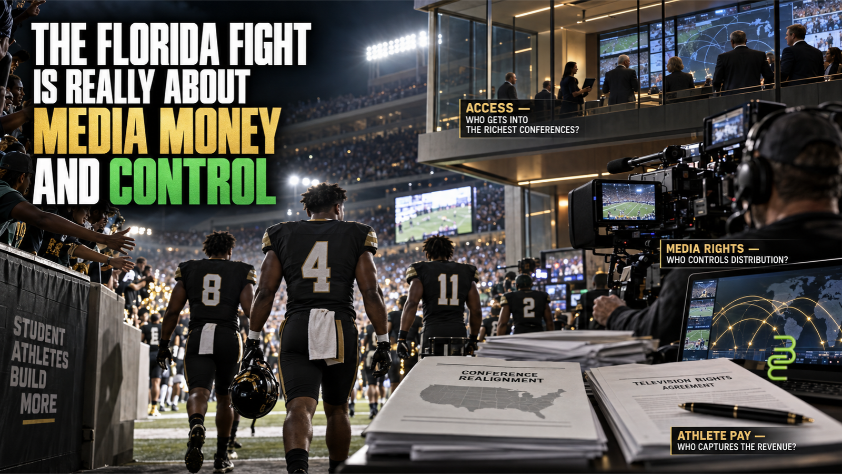
And Florida has become one of the pressure points because the legislation could affect something enormously valuable in modern college athletics: access to the richest conferences in the country.
Florida State and Miami are among the schools concerned about provisions governing movement between major conferences.
South Florida has raised concerns about limits on conference expansion. Other schools have also questioned whether Congress should restrict how quickly universities can change conferences.
That makes this more than a fight over where teams play football.
It is a fight over media money, market access and control of the college sports economy.
Conference Membership Has Become an Economic Asset
The biggest college athletic conferences are no longer simply collections of schools that play one another.
They are media businesses.
Conference membership can determine access to national television exposure, media-rights distributions, postseason revenue, sponsorship opportunities and the recruiting advantages that come with playing on college sports’ largest stages.
That is why conference realignment has become so consequential.
The Big Ten, SEC, ACC and Big 12 are competing not just for championships, but for schools, television markets, audiences and media inventory.
The Protect College Sports Act would place federal rules around that marketplace.
The latest Senate version shortens a proposed waiting period for certain schools moving between Power Four conferences from five years to three years. That requirement would expire six years after enactment.
The legislation also retains restrictions aimed at preventing further consolidation into a college football “super league.”
Earlier revisions established a 19-school limit for large conferences.
For schools trying to improve their financial position through conference membership, those details matter.
A conference invitation can change an athletic department’s economics for years.
Congress is now considering how much freedom schools should have to pursue those opportunities.
The Media Rights Question Is Even Bigger
Conference realignment is only one part of the bill.
The legislation also creates a framework allowing colleges and conferences to voluntarily pool media rights and negotiate them collectively.
Supporters argue that kind of arrangement could help schools generate more revenue and reduce the widening financial gap between the most powerful athletic programs and everyone else.
Participation would be voluntary, and existing media contracts would remain protected. The proposal would also require participating football and basketball programs to make games available to at least one local television outlet in their home markets.
That provision reveals how much of the modern college sports economy ultimately comes back to distribution.
The teams may play the games.
The athletes may generate the highlights.
The fans may create the demand.
But the value becomes money through television contracts, streaming platforms, sponsorship inventory and control of audience access.
Who controls those rights determines who can monetize the attention.
Athletes Are Also at the Center of the Economic Rewrite
The Protect College Sports Act would also establish national rules for athlete compensation.
The proposal codifies athletes’ ability to earn money from their name, image and likeness while adopting the revenue-sharing structure created through the House v. NCAA settlement.
It would also create a $22.5 million athlete retention fund for schools, with the potential to rise to $27.5 million when schools increase NIL spending on women’s and Olympic sports.
NIL contracts would face new disclosure and agent requirements, while the legislation would establish federal rules governing transfers, eligibility, scholarships, medical coverage and other athlete protections.
Supporters say those rules would bring predictability to a system that has been transformed by court decisions, NIL payments, transfer mobility and direct revenue sharing.
Critics see a different economic problem.
The NAACP, members of the Congressional Black Caucus and several Black senators have raised concerns that parts of the legislation could reinforce an institutional structure in which universities, conferences and athletic governing bodies retain substantial power over athlete compensation and mobility.
AP reported that those critics have argued the consequences could fall particularly heavily on Black athletes in major revenue-generating sports.
Support for the bill also crosses political and institutional lines.
The legislation has received backing from hundreds of colleges and universities, numerous athletic conferences and professional sports organizations. Prominent coaches including Deion Sanders have also supported the measure.
The disagreement is therefore not simply over whether athletes deserve protections.
It is over how the economic system surrounding those athletes should be structured.
Who Gets Access—and Who Sets the Rules?
That is what makes the Florida dispute worth watching.
A rule limiting conference movement can be described as a measure protecting stability.
It can also affect which universities get an opportunity to enter conferences with stronger media economics.
A revenue-sharing limit can create predictable financial rules.
It can also determine how much of the revenue generated by college athletics can flow directly to athletes.
Collective media negotiations could strengthen smaller programs.
They could also create a new layer of institutional control over some of college sports’ most valuable commercial rights.
None of those outcomes can be understood by looking only at wins, losses or conference logos.
They are questions about access and ownership.
- Who controls entry into the most lucrative conferences?
- Who negotiates the television rights?
- Who controls the audience?
- How much revenue reaches the athletes whose performances create much of the product?
- And who gets to change those rules when the economics change again?
Those are increasingly the defining questions in college sports.
Congress Is Moving From Referee to Rulemaker
The Senate has already moved the legislation through major procedural hurdles.
Senators voted 74-24 on Sept. 15 to advance consideration of the bill. Two days later, the Senate voted 77-22 to move it forward again, setting up further debate and possible final passage.
If enacted, the Protect College Sports Act would represent something larger than a federal NIL law.
Congress would be helping establish the economic architecture governing athlete compensation, conference mobility, media distribution and institutional competition.
That means the stakes extend far beyond Florida.
College sports is being reorganized around television contracts, athlete payments, conference consolidation and new forms of commercial leverage.
The question now is not whether money has changed college athletics.
It already has.
The question is who gets access to that money, who controls the system around it and who captures the upside when the next era of college sports takes shape.
College conference membership has become a form of economic access. Federal rules governing realignment, media rights and athlete compensation could influence which institutions reach the most valuable television markets, how much revenue reaches athletes and how much control remains with conferences and universities.
The crucial question is: Who gets access to college sports’ growing wealth, who controls the rules, and how much of the upside reaches the athletes whose labor creates the value?
College sports sits at the intersection of Black athletic labor, university economics, media ownership and public policy.
As Congress considers national rules for the industry, the distribution of money and negotiating power deserves as much attention as the games themselves.
The games bring the audience. The economics determine who captures the value. Subscribe to The Economics Behind It for more reporting on ownership, work, money and control behind the headlines.