

Part 3 of the Black Creators, AI, and Ownership series
First came the harm.
AI-generated Black women are going viral while real Black women’s faces, dances, styling, movement, audience behavior, and cultural identity are being used as unpaid inputs for synthetic media.
A Glamour investigation described how AI-generated Black female personas have appeared across social platforms, with some accounts allegedly built from real creators’ content without consent and connected to subscriber or adult-content ecosystems.
Then came the response.
Black creators cannot afford to only react after their work is copied. They need AI literacy, workflow knowledge, IP awareness, and better tools for documenting originality.
Now comes the action step.
Before posting more content online, creators need a protection routine.
Not because every post will be stolen.
Not because AI should stop people from creating.
But because the creator economy has changed.
Every video, image, caption, voice note, dance, tutorial, livestream, podcast, and behind-the-scenes clip can become more than content.
It can become training material.
It can become a reference asset.
It can become a synthetic media input.
It can become someone else’s monetized product.
That is why protection has to become part of the workflow.
Visibility is not enough
For years, creators were told to post more.
Post consistently.
Post daily.
Post across platforms.
Build an audience.
Feed the algorithm.
That advice worked for visibility.
But visibility alone does not equal ownership.
- A creator can be visible and still be underpaid.
- A creator can be influential and still lack legal protection.
- A creator can go viral and still have no direct access to the audience.
- A creator can shape culture and still lose the economic upside to platforms, brands, scrapers, impersonators and synthetic media accounts.
That is the shift this series has been about.
Black culture creates value. BlackEconomicDevelopment.com’s role is to explain who owns, controls, funds, profits from, or is exposed by that value.
The next step is helping creators act before the harm arrives.
The checklist starts with one question
Before posting, ask:
What value am I putting into the market, and how am I protecting it?
That value may include your face.
Your voice.
Your body movement.
Your teaching method.
Your client framework.
Your creative process.
Your visual style.
Your community language.
Your customer trust.
Your audience behavior.
Your archive.
Your intellectual property.
In the AI economy, these are not just expressions of identity or creativity.
They are assets.
And assets need protection.
1. Audit your public content
Start by reviewing what is already online.
Look at your TikTok, Instagram, YouTube, LinkedIn, podcast clips, newsletters, websites, livestream replays, sales pages, and digital products.
Ask:
What content shows my face clearly?
What content features my voice?
What content shows my body movement, choreography, teaching style, or performance?
What content contains original frameworks, templates, scripts, slides, or business processes?
What content would be valuable if someone copied it?
The goal is not to delete everything.
The goal is to understand your exposure.
You cannot protect what you have not identified.
2. Document your original work
- Keep records.
- Save raw files.
- Save drafts.
- Save timestamps.
- Save project files.
- Save screenshots of publication dates.
- Save contracts and collaboration agreements.
- Save outlines, scripts, mood boards, prompts, call sheets, editing timelines, and source materials.
If your work is copied, you will need evidence.
A platform complaint is stronger when you can show the original source.
A legal conversation is stronger when you can show authorship.
A brand negotiation is stronger when you can show that your framework, content, or style has market value.
Documentation turns creative memory into proof.
3. Separate personal identity from monetized brand assets
Creators often blend personal life, identity, work, family, expertise, and brand into one public feed.
That can build trust.
It can also create risk.
Decide what belongs to your public brand and what should remain private.
Create boundaries around your children, home, location, family members, client information, private rituals, and sensitive personal details.
Also decide which parts of your identity are available for commercial use.
Your face may be part of your brand.
Your voice may be part of your brand.
Your teaching method may be part of your brand.
Your likeness should not be treated as an open-source asset.
Make the boundary clear before someone else monetizes the confusion.
4. Add ownership language to your contracts
If you work with brands, agencies, clients, collaborators, photographers, video editors, podcast producers, or event organizers, review the language around usage rights.
Watch for broad terms like:
“in perpetuity”
“all media”
“derivative works”
“AI training”
“synthetic media”
“digital replicas”
“voice cloning”
“likeness”
“unlimited usage”
“transfer of rights”
Many creators focus only on the fee.
But the fee is only part of the deal.
The rights may be worth more than the post.
Creators should ask whether their content can be used to train AI systems, create synthetic ads, generate lookalike content, clone their voice, alter their likeness, or produce derivative media.
Do not sign away tomorrow’s value for today’s invoice.
5. Read platform AI and likeness policies
Platforms control distribution.
That means creators need to understand the rules.
Review the policies for the platforms where you post most often.
Look for language around AI-generated content, impersonation, likeness, deepfakes, adult content, copyright, privacy, and reporting procedures.
Glamour’s reporting noted that TikTok said it prohibits posting AI-generated content of private individuals without consent and removes spam and impersonation accounts; Meta also said it removed certain accounts that violated its policies.
Policies are not perfect protection.
But knowing the policy helps you report faster, document better, and use the platform’s own language when requesting removal.
6. Create an AI misuse response folder
Do this before something happens.
Create a folder with:
Profile screenshots.
Government ID or business documentation where appropriate.
Original content files.
Publication links.
Screenshots of copied content.
Side-by-side comparisons.
Platform reporting links.
Contact information for an attorney or trusted advisor.
A short statement explaining the misuse.
Evidence of monetization, if present.
When harm happens, speed matters.
A prepared folder reduces panic and helps you respond with clarity.
7. Build an owned audience outside social platforms
Social platforms are powerful, but they are rented land.
They control reach.
They control monetization rules.
They control the algorithm.
They control access to audience data.
They can suspend, demonetize, suppress, or remove content.
That is why creators need owned audience channels.
Email lists.
Websites.
Membership communities.
Text lists.
Private communities.
Podcasts with subscriber relationships.
Customer databases.
Events.
Digital product buyers.
An owned audience gives creators more control when platform rules change or synthetic accounts compete for attention.
The audience is one of the most important assets in the creator economy.
Do not leave all of it inside someone else’s platform.
8. Turn content into IP
A post is temporary.
IP can compound.
Look at your content and ask:
- Can this become a checklist?
- A guide?
- A workshop?
- A course?
- A book?
- A licensing package?
- A consulting framework?
- A paid template?
- A media series?
- A documentary concept?
- A curriculum?
- A keynote?
- A brand partnership?
- A short film?
- A training program?
This is where AI can become a tool for ownership instead of extraction.
Use AI to organize your archive, outline products, repurpose responsibly, summarize your own ideas, develop workflows, and package your expertise.
The goal is not to flood the internet with more content.
The goal is to convert your value into assets you can own.
9. Learn enough AI to recognize the risk
You do not need to master every tool.
But you should understand the basics of how AI media is created.
- Learn what prompts do.
- Learn how image generators work.
- Learn how voice cloning works.
- Learn how face swapping works.
- Learn how video synthesis works.
- Learn how AI avatars are built.
- Learn how synthetic influencer accounts operate.
- Learn how scraping and training data are discussed.
- Learn how AI outputs can imitate a style without copying a file exactly.
That knowledge changes your posture.
You become harder to exploit when you understand the workflow.
10. Use AI with judgment, not blind automation
This is the most important step.
AI can help creators produce faster.
But speed without judgment can weaken trust.
- Do not let AI flatten your voice.
- Do not let AI replace your point of view.
- Do not use AI to imitate other creators.
- Do not upload sensitive client work without permission.
- Do not generate images that exploit racial, gendered, or cultural stereotypes.
- Do not publish AI content you cannot explain, defend, or stand behind.
For independent operators, the AI advantage is not simply automation.
It is judgment.
Knowing when to use AI.
When not to use it.
What to protect.
What to disclose.
What to own.
What to license.
What to keep human.
That is the deeper message behind The AI Judgment Advantage: use AI to build leverage without losing trust, voice, or control.
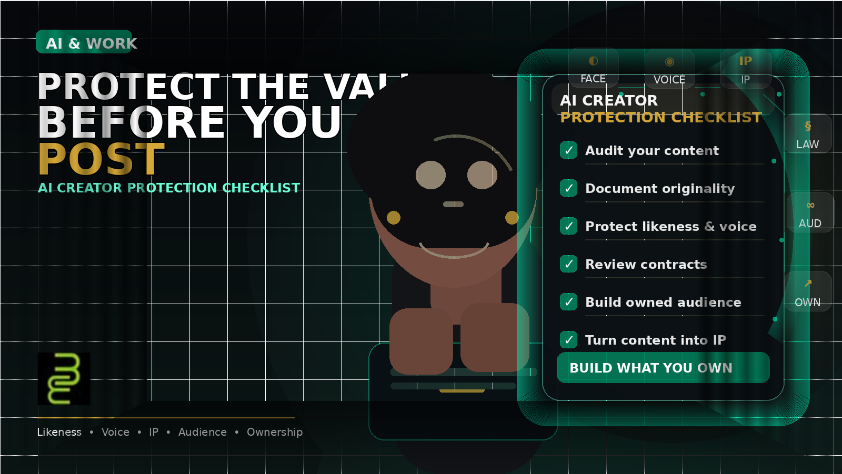
The creator protection checklist
Here is the condensed version:
Audit your public content.
Know what is already exposed.
Document your original work.
Save raw files, timestamps, drafts, links, and screenshots.
Separate personal identity from brand assets.
Decide what is public, private, commercial, or off-limits.
Add AI and likeness language to contracts.
Protect your face, voice, image, style, and derivative use.
Review platform policies.
Know how AI, impersonation, privacy, and takedown rules work.
Prepare a misuse response folder.
Have evidence ready before you need it.
Build an owned audience.
Move people from platforms to email, websites, memberships, or communities.
Turn content into IP.
Convert posts into products, frameworks, guides, workshops, media, and licensing assets.
Learn basic AI workflows.
Understand how synthetic media is made and how misuse can happen.
Use AI with judgment.
Protect trust, voice, cultural value, and long-term ownership.
Where BlackEconomicDevelopment.com goes next
This series started with extraction.
It moved to education.
Now it points toward infrastructure.
Black creators need more than warnings.
They need tools.
They need attorneys.
They need educators.
They need media labs.
They need responsible AI trainers.
They need digital safety advocates.
They need business strategists.
They need platforms that respect consent.
They need partners who understand that Black culture is not free raw material for everyone else’s monetization.
BlackEconomicDevelopment.com is building that pathway through its resources for economic builders and partner ecosystem.
The goal is simple:
Help creators, operators, and institutions protect cultural value and build ownership in the AI economy.
Partner activation
For organizations working on AI literacy, creator protection, IP rights, Black-owned media, digital safety, or economic empowerment, this is where the work connects.
BlackEconomicDevelopment.com is building a resource pathway for creators, operators, and institutions that want to protect cultural value and build ownership in the AI economy.
That includes educators, attorneys, technology providers, media trainers, creator organizations, business coaches, digital safety groups, and institutions helping Black communities move from exposure to ownership.
This is not about selling fear.
It is about building capacity.
The bottom line
AI growth is likely to continue.
Synthetic media will get better.
AI influencer accounts will become more convincing.
Platforms will keep competing for attention.
Brands will keep looking for cheaper content.
And creators who do not understand the new rules may continue to feed systems they do not control.
But Black creators are not powerless.
They can document.
They can protect.
They can learn.
They can license.
They can build owned audiences.
They can turn content into IP.
They can use AI with judgment.
They can move from unpaid input to economic builder.
That is the action step.
Not panic.
Preparation.
Because in the AI economy, the choice is becoming clearer:
Learn the tools, protect the value, and build what you own.
Economic implication
AI is creating new risks around likeness, voice, image, motion, content scraping, platform dependency, and synthetic media monetization.
For Black creators, the practical response is not only awareness. It is building a protection workflow that turns visibility into assets, content into IP, and audience attention into owned economic leverage.
Why it matters
Black creators help shape digital culture, but cultural influence does not automatically produce ownership.
The AI era raises the stakes.
Without documentation, contracts, owned audiences, workflow literacy, and judgment, Black creators risk becoming unpaid inputs for systems that monetize their identity, creativity, and audience behavior.
Ownership question
What part of your creative value are you protecting before you post: your face, your voice, your content, your audience, your IP, or all of it?
Action Steps
Download the checklist, explore resources for economic builders, or partner with BlackEconomicDevelopment.com to help creators protect and build value.
This article closes the Black Creators, AI, and Ownership series: the harm, the response, and the action step.
Our next move is building the resource pathway: tools, partners, education, and ownership strategies that help Black creators protect cultural value in the AI economy.
Latest posts by normbond (see all)
- NC A&T Students Marched 45 Minutes to Vote. The Bigger Story Is Who Controls Access. - October 17, 2026
- Black Family Wealth Fell 25%. The Ownership Gap Is the Bigger Story. - October 16, 2026
- Rihanna Turned a TikTok Live Into a Storefront. That Changes the Economics of Celebrity Attention. - October 14, 2026



Brilliant. I’ll be reposting this article.