


A developing shift at the Equal Employment Opportunity Commission (EEOC) could change more than workplace compliance paperwork.
It could change who has access to the evidence.
According to Associated Press reporting, former EEOC commissioner Jocelyn Samuels dropped her lawsuit challenging her dismissal after a recent Supreme Court ruling expanded presidential control over independent agencies.
Samuels was one of two Democratic commissioners fired from the agency in the early days of Trump’s second term as part of an initial crackdown on diversity, equity and inclusion (DEI) initiatives.
AP also reported that the EEOC’s new regulatory agenda includes proposals to end annual employer workforce demographic-data collection, rescind guidance on English-only workplace rules, and reverse affirmative-action guidance.
That may sound procedural.
It is not.
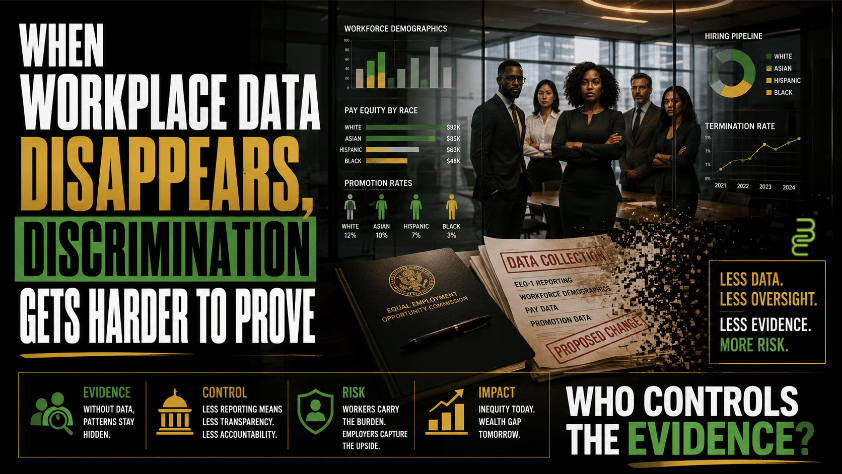
Workplace data is enforcement infrastructure. Without demographic reporting, patterns in hiring, pay, promotion, discipline, and termination become harder to see, harder to audit, and harder to prove.
For Black workers, immigrant workers, women, and other employees who face discrimination, this is not just a legal story. It is an economic power story.
The Money Is In The Evidence
Civil-rights enforcement depends on proof.
A single worker may know they were treated unfairly. But workplace discrimination often becomes legally visible through patterns: who gets hired, who gets promoted, who is concentrated in lower-paying roles, who gets disciplined, and who gets pushed out.
That is why employer demographic data matters.
For decades, certain private-sector employers have been required to file EEO-1 reports showing workforce demographic data, including race, ethnicity, and sex across job categories. One employment-law analysis notes that private-sector employers with 100 or more employees, and certain federal contractors with more than 50 employees, have been required to file EEO-1 reports annually.
The economic issue is simple: what cannot be measured becomes easier to deny.
If a company’s leadership pipeline is overwhelmingly white while Black workers are concentrated in lower-paid roles, data helps expose that pattern. If layoffs, terminations, or promotions repeatedly disadvantage certain groups, data helps turn suspicion into evidence.
Without that layer, workers may still have rights on paper. But the path to proving structural harm becomes steeper.
Who Owns The Workplace Story?
The ownership question here is not about stock shares.
It is about who controls the workplace narrative.
If employers hold the data, employers control much of the evidence. If regulators collect and analyze that data, workers and enforcement agencies have a stronger chance of identifying patterns across industries, regions, and job categories.
That is why this rollback matters.
The Associated Press reported that the EEOC’s new regulatory plan includes ending annual collection of workplace demographic data and rescinding longstanding guidance that warned English-only workplace requirements may be discriminatory.
The EEOC has also publicly announced action to rescind affirmative-action interpretive guidelines and related compliance guidance, saying the move reflects its view that Title VII protections apply equally to all workers.
Supporters of the rollback may frame this as reducing outdated guidance, removing compliance burdens, or aligning agency policy with a different legal interpretation.
But the economic effect deserves closer attention.
When reporting requirements shrink, employers may face less compliance exposure. When demographic visibility shrinks, workers may carry more of the burden of proving discrimination.
Who Captures The Upside?
The most immediate upside goes to employers seeking fewer reporting obligations and lower compliance risk.
For large companies, workforce reporting is not just paperwork. It can create legal, reputational, and operational pressure. Once demographic patterns are visible, companies may face questions from regulators, employees, investors, journalists, unions, and the public.
Reducing that visibility can lower exposure.
It can also shift power back toward internal management systems that workers may never see.
That matters because labor markets are not neutral. Hiring, promotion, pay, scheduling, discipline, and termination decisions shape lifetime earnings, household wealth, retirement security, and access to opportunity.
For Black workers, the workplace is not only where income is earned. It is where economic mobility is either opened or blocked.
A rollback in reporting does not automatically legalize discrimination. Employers still have obligations under civil-rights law. But enforcement becomes weaker when the evidence layer becomes thinner.
Who Carries The Risk?
The risk falls on workers least likely to have internal power.
That includes Black workers, immigrant workers, women, pregnant workers, disabled workers, older workers, and employees in low-wage or unstable roles.
Workers often do not have access to companywide data. They may know what happened to them, but not whether the same thing happened across a department, a region, or a job category.
That information gap matters.
A worker can say they were passed over. A data pattern can show who keeps getting passed over.
A worker can say a workplace rule is discriminatory. A data pattern can show whether that rule disproportionately affects certain groups.
A worker can say promotions are unfair. A data pattern can show whether Black employees are consistently blocked before reaching management.
That is the difference between an individual complaint and a structural case.
Why This Is An AI & Work Story
This story belongs in the AI & Work category because workplace decisions are increasingly mediated by data systems.
Hiring software, productivity dashboards, scheduling tools, performance scoring, résumé filters, and workplace surveillance systems are becoming part of everyday employment. In that environment, demographic data becomes even more important, not less.
If companies use automated systems to sort applicants, monitor workers, assign shifts, or evaluate performance, enforcement agencies need visibility into outcomes.
The question is not only whether a manager discriminated.
The question is whether workplace systems produce unequal results.
Without demographic reporting, it becomes harder to know whether AI-enabled hiring tools, automated screening systems, or performance algorithms are reproducing racial disparities under the appearance of neutrality.
That is the deeper economic issue.
The future of work is being shaped by platforms, data, and automation. If civil-rights agencies collect less demographic information at the same time employers collect more worker data internally, the imbalance grows.
Employers see more.
Workers and regulators may see less.
The Policy-To-Pocket Impact
This is where policy becomes pocketbook reality.
A worker denied promotion loses income.
A worker pushed into lower-paying roles loses retirement contributions, credit access, homebuying power, and wealth-building capacity.
A worker terminated unfairly may lose health insurance, savings, and career momentum.
Civil-rights enforcement is not only about dignity in the abstract. It is about wages, wealth, benefits, mobility, and economic security.
For Black communities, workplace discrimination has always had a wealth consequence. Unequal access to hiring, pay, leadership, and stable employment compounds across families and generations.
That is why data matters.
It gives enforcement agencies a tool to identify patterns. It gives workers a stronger foundation for claims. It gives policymakers a clearer view of where inequity is happening. It gives the public a way to see whether opportunity is real or only promised.
The Power Shift
The Supreme Court ruling that influenced Samuels’ decision to drop her lawsuit is part of a broader power shift over independent agencies. Reuters reported earlier that a federal judge had signaled Samuels’ case could be undermined by a Supreme Court ruling expanding presidential authority over regulatory agencies.
That matters because agency independence affects enforcement.
If the executive branch has greater control over agencies like the EEOC, enforcement priorities can shift more quickly with presidential politics. One administration may emphasize systemic discrimination. Another may emphasize reducing DEI-related practices or narrowing guidance.
For workers, that means civil-rights protection can become more dependent on who controls the agency.
For employers, it means compliance expectations can change rapidly.
For Black communities, it raises a hard question: if the agency responsible for workplace discrimination enforcement collects less data and operates with less independence, who is left with enough evidence and power to challenge structural harm?
The Bottom Line
The EEOC rollback is not only a regulatory story.
It is an economic visibility story.
It asks who controls workplace data, who gets to interpret it, who benefits when it disappears, and who pays when discrimination becomes harder to prove.
Employers may gain less paperwork and lower exposure.
Workers may lose one of the clearest tools for showing patterns of inequity.
That is the economic stakes behind the policy shift.
When workplace data disappears, discrimination does not disappear with it.
It just becomes harder to prove.

Latest posts by normbond (see all)
- NC A&T Students Marched 45 Minutes to Vote. The Bigger Story Is Who Controls Access. - October 17, 2026
- Black Family Wealth Fell 25%. The Ownership Gap Is the Bigger Story. - October 16, 2026
- Rihanna Turned a TikTok Live Into a Storefront. That Changes the Economics of Celebrity Attention. - October 14, 2026