


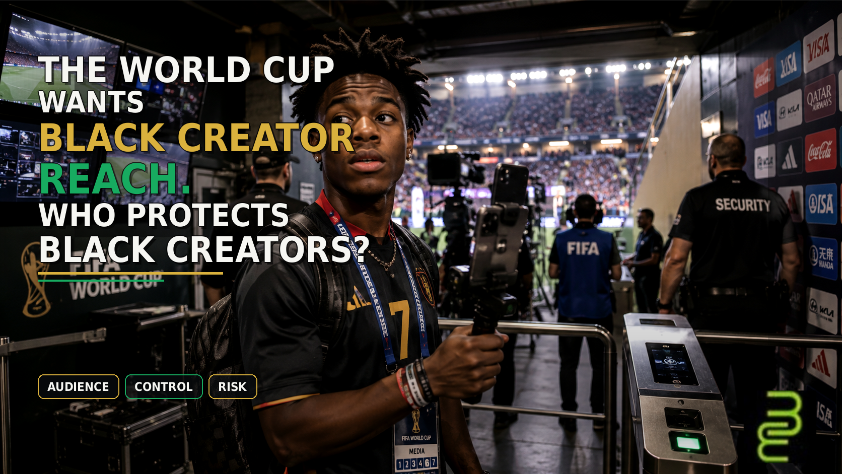
FIFA is investigating an alleged racist incident involving streamer and YouTuber IShowSpeed during the Argentina-Cape Verde World Cup match in Miami Gardens.
According to the Associated Press, FIFA said it opened an investigation after becoming aware of an incident involving IShowSpeed and a supporter during the July 3 match. AP reported that the streamer, whose real name is Darren Jason Watkins Jr., appeared to be targeted with a racist remark while livestreaming from the stands.
IShowSpeed, a 21-year-old African American, has more than 56 million YouTube subscribers, 50 million Instagram followers and 53 million on TikTok.
That makes this more than a sports discipline story.
It is a creator economy story.
It is a platform governance story.
And it is a reminder that Black visibility often becomes monetizable before Black safety becomes enforceable.
The World Cup Is No Longer Just a Broadcast Product
For decades, global sports events were distributed primarily through television rights, official media partners, stadium attendance, and sponsor campaigns.
That model still matters. But it is no longer the whole system.
The modern World Cup also moves through livestreams, reaction videos, TikTok clips, Instagram posts, YouTube commentary, X posts, podcasts, fan cams, and creator-led coverage.
That is why IShowSpeed matters in this story.
He is not just a celebrity fan in the seats. He is a mobile media channel with a massive young audience. His presence turns a match into content. His stream extends the event beyond the stadium and beyond the official broadcast.
That reach has economic value.
It benefits the tournament. It benefits platforms. It benefits sponsors. It benefits the broader football attention economy.
But when racist abuse enters that same content stream, the question becomes clear: who carries the cost?
The Abuse Is Part of a Larger Pattern
The incident did not happen in isolation.
FIFPRO, the global players’ union, warned days earlier that World Cup players have faced a growing pattern of online and in-person abuse, much of it racist and discriminatory. FIFPRO said monitoring and reporting are not enough, and called for meaningful consequences for those responsible.
FIFA’s own Social Media Protection Service reported that during the 2026 World Cup group stage it scanned more than 6 million posts and comments, verified more than 89,000 abusive posts, and found that racially motivated attacks accounted for 11 percent of detected online abuse. FIFA said this represented a major increase from the equivalent stage of the 2022 tournament.
That matters because sports racism is often treated as a reputational problem.
But it is also a labor problem.
Players are workers. Creators are workers. Broadcasters, journalists, stadium staff, security teams, fan-facing employees, and media partners all operate inside the same commercial environment.
When Black people help create the attention that makes the event valuable, safety cannot be treated as an afterthought.
Where the Money Is Moving
The money in this story moves through several channels.
FIFA controls the tournament infrastructure, venue standards, disciplinary framework, and global commercial system.
Platforms control distribution, visibility, monetization, audience data, and content moderation.
Sponsors attach their brands to the reach, energy, and cultural relevance of the tournament.
Creators like IShowSpeed bring audiences that traditional sports media often struggles to reach.
The upside is distributed across the ecosystem.
But the risk is not.
If a Black creator is racially abused in a stadium while livestreaming, the harm lands first on the creator.
It also lands on Black fans and Black athletes who see the message clearly: your presence can be monetized, but your protection may still be conditional.
That is the economic imbalance underneath the story.
Who Owns the Audience?
The ownership question here is not only about FIFA.
It is about audience control.
IShowSpeed brings his own audience. Platforms host that audience. FIFA benefits from the attention. Sponsors benefit from the cultural reach. Media outlets benefit from the viral follow-up coverage.
But the creator does not control the stadium. The creator does not control venue enforcement. The creator does not control the tournament’s disciplinary system. The creator does not control platform policy.
That gap matters.
Black creators are often invited into major cultural and sports moments because they deliver attention. But attention is not the same as power.
Power is the ability to set the terms.
Power is the ability to demand protection.
Power is the ability to define what happens when harm occurs.
Creator Safety Is Business Infrastructure
Too often, creator safety is treated as a public relations concern.
It should be treated as business infrastructure.
If creators are now part of sports distribution, then creator protection should be part of sports operations.
That includes clear venue response protocols, platform escalation systems, sponsor accountability, fan consequences, and transparent reporting after incidents.
This is especially important for Black creators because racism can travel across both physical and digital spaces. A comment in the stands can become content. A livestream moment can become a viral clip. A racial attack can be replayed, remixed, monetized, debated, and distributed long after the original harm.
The creator economy does not erase racism. It can amplify it.
That is why safety cannot stop at security guards and generic statements.
Why This Matters for Black Communities
Black creators have become major drivers of culture, sports attention, music discovery, gaming trends, fashion influence, and media engagement.
- Their audiences are valuable.
- Their labor is valuable.
- Their cultural fluency is valuable.
But value without protection is extraction.
The IShowSpeed incident raises a larger question for Black digital workers: when your presence increases the value of an event, do institutions owe you protections equal to the value you bring?
For global sports, that question is only getting bigger.
The 2026 World Cup is taking place across North America, where creator culture, Black sports culture, immigrant fan communities, and platform media all overlap. That creates enormous opportunity for new audiences and new revenue.
It also creates responsibility.
The Economics Behind It
The economic issue is not whether one racist fan represents an entire tournament.
The economic issue is whether the institutions monetizing Black visibility have built systems strong enough to protect Black people inside that visibility.
FIFA controls the venue standards.
Platforms control distribution.
Sponsors control brand pressure.
Creators control audience energy, but not the safety infrastructure around the event.
That is the imbalance.
The World Cup wants global attention. Black creators help deliver it.
Now the question is whether the protection follows the profit.
Latest posts by normbond (see all)
- NC A&T Students Marched 45 Minutes to Vote. The Bigger Story Is Who Controls Access. - October 17, 2026
- Black Family Wealth Fell 25%. The Ownership Gap Is the Bigger Story. - October 16, 2026
- Rihanna Turned a TikTok Live Into a Storefront. That Changes the Economics of Celebrity Attention. - October 14, 2026