


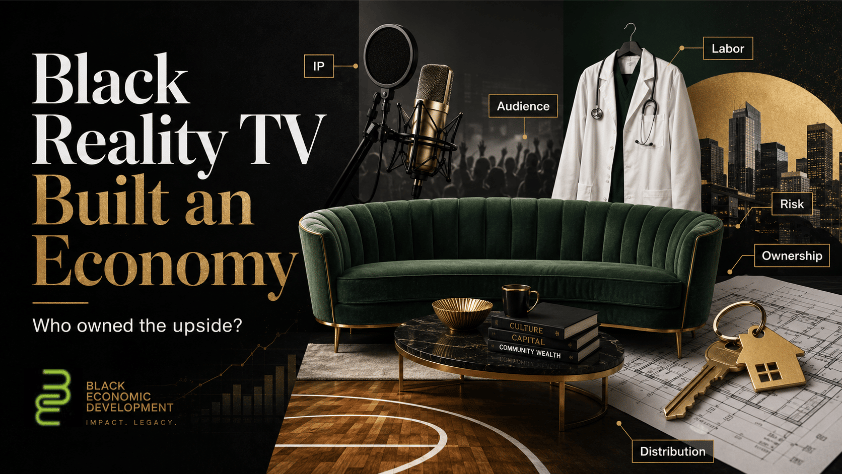
From Love & Hip Hop to Basketball Wives and Love & Marriage: Huntsville, Black reality TV turned relationships, ambition, culture, conflict and proximity to wealth into long-running media assets.
For years, Black reality TV was treated as drama.
That was always too small.
The bigger story is economic.
Shows like Real Housewives of Atlanta, Love & Hip Hop Atlanta, Basketball Wives, Black Ink Crew, Married to Medicine, and Love & Marriage: Huntsville did more than entertain.
They turned Black culture, relationships, entrepreneurship, status, professional ambition, beauty labor, music scenes, sports proximity and family conflict into repeatable media assets.
The audience saw reunions, confessionals, arguments, weddings, divorces, business launches, betrayals and comeback arcs.
Networks saw something else: loyal viewers, social media conversation, advertising inventory, streaming-library value, reunion specials, spin-offs, and cast members who could keep attention moving long after the episode ended.
That is the hidden economics of Black reality TV.
The market is shifting, not disappearing
Two recent programming moves show how the market is changing.
Paramount is ending the long-running Love & Hip Hop franchise, including Love & Hip Hop: Atlanta, with a six-part limited series called Love & Hip Hop: The Final Chapter.
WABE reported that the special will feature interviews with cast members, producers, and executives from across the franchise while looking at its legacy and cultural impact. (WABE)
At the same time, OWN is moving in the opposite direction with Love & Marriage: Huntsville.
Variety reported that OWN renewed the series for Season 12 and ordered 30 additional episodes expected to roll out across 2026 and 2027. (Variety)
That contrast matters.
One era of Black reality TV is closing. Another model is still being funded.
The question is not whether Black reality TV is over.
The better question is which forms of Black life remain valuable to networks, streamers, advertisers and production companies.
Black reality TV built an economy of proximity
Each franchise monetized a different form of proximity.
Love & Hip Hop monetized proximity to music culture.
Basketball Wives monetized proximity to professional sports wealth.
Real Housewives of Atlanta monetized proximity to Black social status, friendship networks, entrepreneurship, luxury, marriage and personality-driven influence.
Married to Medicine monetized proximity to Black professional-class life, healthcare status, marriage and social hierarchy.
Black Ink Crew monetized proximity to urban creative labor, tattoo culture, neighborhood business and workplace conflict.
Love & Marriage: Huntsville monetizes proximity to Black entrepreneurship, real estate ambition, marriage, friendship, family pressure and Southern upward mobility.
That is the formula.
The shows are not only selling personalities. They are selling access to worlds that audiences recognize, debate, aspire to, judge and emotionally invest in.
The cast gets visibility. The network gets IP.
Reality TV can create opportunity.
Cast members can turn airtime into paid appearances, podcasts, books, beauty brands, boutiques, restaurants, fashion lines, speaking gigs, influencer campaigns and event bookings.
That is real.
But visibility is not the same as ownership.
The network or production company usually controls the format, footage, editing, distribution, archive, reunion platform, episode packaging and advertising environment.
The cast member may own a business outside the show, but the show often owns the media machine that turns that business into a storyline.
That distinction is central.
A cast member may get followers.
The network gets scalable intellectual property.
A cast member may get attention.
The platform gets data, ads, engagement and streaming value.
A cast member may get a catchphrase.
The network gets another clip.
Basketball Wives and the sports economy without the athletes
Basketball Wives is especially useful for understanding this economy because the title gives away the business model.
The show is not primarily about basketball games.
It is about the world around basketball wealth.
The value comes from proximity: proximity to athletes, luxury, divorce, motherhood, dating, public status, social conflict and women trying to build their own names around or beyond the men they were linked to.
That makes Basketball Wives a sports-adjacent media product.
The athletes’ labor created one kind of value on the court. The women’s relationships, reputations, visibility, beauty, conflict and business ambitions created another kind of value on television.
The show monetized the world around the sport.
That is why it belongs in any serious conversation about sports economics, gendered labor and Black women’s visibility.
Love & Marriage: Huntsville and the business of Black aspiration
Love & Marriage: Huntsville represents a different reality TV economy.
It is not centered on rappers, athletes or celebrity-adjacent nightlife.
It is built around couples, entrepreneurship, real estate, family, friendship, marriage, ambition and the pressure to perform success in public.
That makes the show economically important.
It turns Black upward mobility into content.
The homes, businesses, partnerships, divorces, friendship breakdowns, community status and local ambitions are not just background details. They are the product.
OWN’s renewal signals that Black aspirational reality TV still has durable value. At a time when Love & Hip Hop is being wrapped into a final chapter, Love & Marriage: Huntsville is being extended.
That is a business signal.
Black reality TV is being re-sorted by platform, audience, brand safety and ownership strategy.
The labor underneath the drama
The business works because reality TV is efficient.
A research paper on the reality TV economy argues that the genre has often relied on low-cost, non-union production structures while shifting psychological, physical and reputational risk onto participants.
That framework applies directly to Black reality franchises.
The “work” is not only showing up for filming.
It is being emotionally available on camera.
It is reliving private conflict in confessionals. It is letting marriages, friendships, family businesses, professional reputation and personal trauma become serialized content.
It is absorbing social media judgment after edited scenes circulate online.
The labor is emotional.
The risk is personal.
The product is attention.
Editing is economic power
Reality TV is not simply filmed reality.
It is produced reality.
Contracts and production structures can give producers enormous power over how participants are portrayed.
Research on the genre points to the role of editing, narrative control, NDAs, arbitration clauses and limited participant protections in shaping what audiences eventually see.
That matters because editing shapes market value.
- A fan favorite can become a brand.
- A villain can become a liability.
- A marriage conflict can become a season arc.
- A business dispute can become a public reputation issue.
- A friendship breakdown can become reunion inventory.
The edit does not just shape the story. It shapes who can monetize afterward.
Black women carried much of the value
Many of these franchises were built on Black women’s presence.
Their style, language, humor, conflict, vulnerability, friendship, beauty, business ambition, motherhood, marriage, divorce and resilience became the center of the product.
That should not be dismissed.
Black women used these platforms to build businesses, audiences and cultural influence.
But the economics remain uneven.
When Black women’s lives become programming, who owns the archive?
Who controls the reunion stage? Who sells the ads?
Who licenses the show?
Who benefits from the clips?
Who profits when controversy trends?
Who protects the cast when backlash becomes harassment?
Those are ownership questions.
They are also labor questions.
Atlanta was not just a backdrop
Atlanta deserves special attention.
Real Housewives of Atlanta and Love & Hip Hop Atlanta did not merely use the city as scenery. They helped package Atlanta as a national reality TV economy.
The city supplied music culture, beauty culture, nightlife, fashion, slang, business ambition, relationship drama, Southern status and Black creative energy.
Networks turned that into content.
The unresolved question is whether Atlanta’s Black creative ecosystem captured enough ownership from the value it helped generate.
Representation gave the city visibility.
Ownership determines whether that visibility compounds into lasting economic power.
The real product was attention
Black reality TV has always been about more than individual shows.
The real product is attention.
- Attention becomes advertising.
- Attention becomes streaming value.
- Attention becomes social media engagement.
- Attention becomes brand deals.
- Attention becomes cast businesses.
- Attention becomes podcasts, tours, events, reunion specials and spin-offs.
But attention is only powerful when it can be converted into ownership.
That is the lesson for cast members, creators, producers and Black media entrepreneurs.
The goal should not only be to get on camera.
The goal should be to build leverage beyond the camera.
Owned audiences, production credits, backend participation, business infrastructure, legal protection, intellectual property, distribution partnerships and brand equity that survives the season.
The ownership question
Black reality TV helped prove that Black culture is commercially valuable.
But the next question is sharper:
Who owns the value when Black families, couples, entrepreneurs, doctors, artists, athletes’ partners, tattoo workers and friendship networks become entertainment IP?
The cast may create the moments.
The audience may create the buzz.
But networks, production companies, streamers, advertisers and platforms often control the systems where the money compounds.
That is why this is not just culture news.
- It is business news.
- It is labor news.
- It is ownership news.
And for BlackEconomicDevelopment.com, that is the story behind the story.
Economic implication
Black reality TV franchises convert social life into media value.
The money moves through advertising, streaming libraries, licensing, reunion specials, social clips, influencer deals, cast businesses, event bookings and platform engagement.
The upside is uneven.
Networks and production companies usually control the format, footage, distribution, edit and archive. Cast members may build brands and businesses, but they often do so inside systems they do not own.
Why it matters
Black reality TV did not just document culture. It packaged Black proximity, labor, relationships and aspiration into repeatable media assets.
For Black communities, these shows are not only representation debates.
They are ownership debates.
Black culture, Black women’s labor, Black marriages, Black friendships, Black businesses, Black professional status, Black Southern cities and Black relationship networks have all become monetizable content.
The question is whether that visibility becomes durable ownership — or temporary attention rented from cable, streaming and social platforms.
Over to You
Is Black reality TV culture news, business news, or labor news.. and who captured the most value from it?
Latest posts by normbond (see all)
- Who Owns the Upside From Power? 50 Cent’s Variety Interview Reveals a Bigger TV Economics Story - October 20, 2026
- Burkina Faso Rejected a U.S. Deportation Deal. Then the Fight Moved to Visa Access. - October 19, 2026
- NC A&T Students Marched 45 Minutes to Vote. The Bigger Story Is Who Controls Access. - October 17, 2026