


The Supreme Court’s decision allowing Alabama to use a congressional map that reduces majority-Black representation is being covered mostly as a voting rights story.
It is also an economic story.
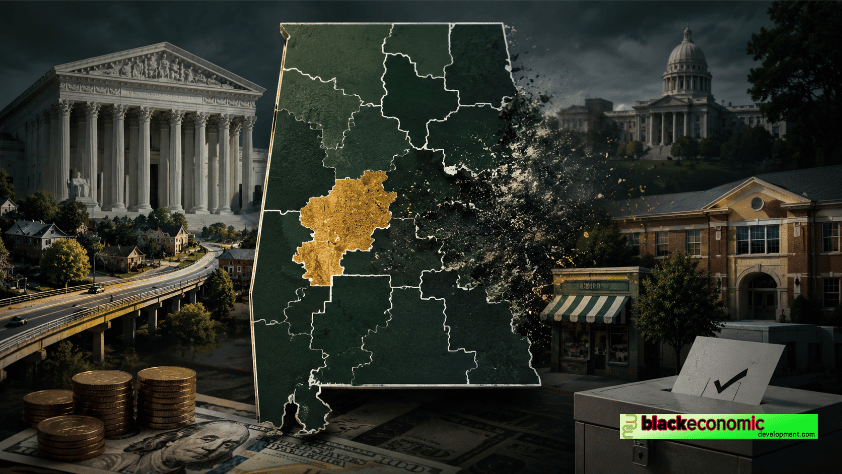
The Court allowed Alabama to move forward with a Republican-favored congressional map for this year’s elections, blocking a lower court ruling that had found the plan intentionally discriminated against Black voters.
The map reduces the number of districts where Black voters are a majority or close to it from two to one out of Alabama’s seven congressional districts.
That matters because congressional districts are not just lines on a map.
They are channels of power.
Representation affects resource flow
Members of Congress influence how communities are represented in debates over infrastructure, housing, health care, transportation, agriculture, disaster recovery, small business support, workforce programs, and federal grants.
When a majority-Black district is dismantled or weakened, the question is not only whether Black voters can still cast ballots.
The economic question is whether Black communities retain enough concentrated political power to elect representatives who are directly accountable to their needs.
That includes communities in Alabama’s Black Belt, Gulf Coast, rural towns, urban centers and local economies. Here federal policy can shape jobs, public investment, broadband access, hospitals, schools, roads, and business opportunity.
The map is about more than party control
The immediate political impact is clear.
The new map is expected to improve Republican chances of gaining an additional House seat in Alabama, potentially shifting the state’s congressional delegation from a 5-2 Republican advantage to a likely 6-1 advantage.
But the deeper issue is not only which party benefits.
The deeper issue is who controls the political infrastructure that helps decide where public resources go.
District maps influence who gets heard, who gets ignored, and whose economic priorities become negotiable.
They shape which communities have access to congressional staff, constituent service, grant support, appropriations advocacy, committee visibility and policy attention.
That is why redistricting has a direct connection to Black economic development.
The ownership question
The ownership question in this story is not about a company, brand or celebrity asset.
It is about who controls the political machinery that helps distribute public power.
- Who controls the map?
- Who benefits from the new lines?
- Who loses leverage?
- Who carries the cost when Black political power is diluted?
A lower federal court had blocked Alabama’s map after finding that it intentionally discriminated against Black voters.
The Supreme Court majority allowed the state to use the map while the legal fight continues, with the three liberal justices dissenting.
Alabama leaders defended the decision as a victory for the state’s authority over its elections. Civil rights advocates condemned it as a setback for fair representation.
BlackEconomicDevelopment.com’s lens is this:
Political boundaries can become economic boundaries.
Why this matters beyond Alabama
This ruling comes during a larger redistricting fight across the South.
The Supreme Court recently issued a Louisiana voting rights decision that narrowed how race can be considered in redistricting disputes. Since then, Republican-led states including Alabama, Louisiana, and Tennessee have moved to reshape districts in ways that reduce Black voter influence.
That signals a broader shift.
If majority-Black districts are reduced across Southern states, the impact could extend beyond the next election cycle.
It could affect the pipeline of Black elected officials.
It could weaken the ability of Black communities to translate population strength into institutional power.
It could also change who advocates for public investment in places where Black residents have long faced gaps in wealth, land ownership, health care access, business capital, school funding, and infrastructure.
Representation does not automatically solve those problems.
But weakened representation can make it harder to fight for resources, oversight, and accountability.
Voting power is economic power
Black economic development is often discussed through entrepreneurship, homeownership, investing and jobs.
Those issues matter.
But public policy also shapes wealth.
Congress helps decide how federal dollars move.
It influences transportation funding, farm policy, disaster aid, small business programs, housing rules, health care access, tax priorities, education funding and workforce investment.
That means political representation is not separate from economic opportunity.
It is one of the systems that helps determine it.
When district lines reduce Black political leverage, the economic consequences may not show up immediately. They may show up later in which roads get funded, which hospitals stay open, which small businesses receive support, which colleges are prioritized, which communities get disaster recovery help, and which local needs never make it onto the agenda.
The economic implication
The immediate implication is one possible additional House seat for Republicans.
The deeper economic implication is that Black political power is part of Black economic power.
Voting districts help determine who sits at the table when federal dollars are debated. They influence which communities receive attention, advocacy, protection and investment.
For Black communities, this is about more than symbolic representation.
It is about leverage.
Why it matters
This story shows how legal decisions can reshape the economics of democracy.
When district lines change, the flow of power can change with them. That power can affect public investment, business opportunity, disaster recovery, housing policy, health funding, infrastructure, and long-term community wealth.
The central question is not only who wins the next election.
It is who gets enough political power to fight for the economic future of Black communities.

Latest posts by normbond (see all)
- Who Owns the Upside From Power? 50 Cent’s Variety Interview Reveals a Bigger TV Economics Story - October 20, 2026
- Burkina Faso Rejected a U.S. Deportation Deal. Then the Fight Moved to Visa Access. - October 19, 2026
- NC A&T Students Marched 45 Minutes to Vote. The Bigger Story Is Who Controls Access. - October 17, 2026