



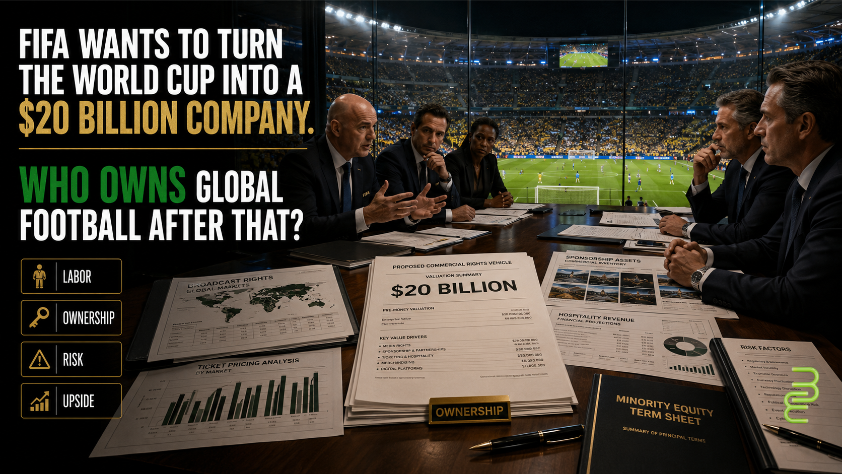
FIFA is proposing something larger than a new sponsorship deal or television contract.
It wants to turn the commercial engine behind the World Cup into a company valued at $20 billion. And sell part of that company to private investors.
The proposed subsidiary, FIFA Forward Enterprise, would combine FIFA’s commercial rights across broadcasting, sponsorship, ticketing and licensing with the operational delivery of tournaments. FIFA says the company could raise as much as $4.2 billion by selling minority, non-controlling stakes.
FIFA would remain the majority owner.
But the economics of global football would change.
Private capital would gain a direct ownership claim on the future revenue generated by the World Cup, Club World Cup and other FIFA competitions.
That makes this more than sports news.
FIFA’s proposed commercial company could bring private investors into the economics of the World Cup, raising questions about ownership, control and who captures football’s future commercial upside.
FIFA is turning tournament revenue into equity
Today, FIFA earns money from broadcasting rights, sponsorships, tickets, hospitality, licensing and tournament operations.
Under the proposed structure, those revenue streams would sit inside a commercial subsidiary whose shares could appreciate in value.
Investors would not simply be purchasing advertising exposure. They would own part of the company managing one of the most valuable recurring events in global sports.
FIFA says outside investors would hold minority interests, play no operational role and have no authority over competition rules, calendars or sporting decisions. FIFA would retain majority board representation and exclusive authority over football governance.
That distinction matters.
But it does not eliminate the central economic tension.
Investors put money into a company because they expect a return. Those returns would depend on the subsidiary increasing revenue, protecting margins and raising its long-term valuation.
The question is whether commercial influence can remain completely separate from sporting decisions when the value of the investment depends on how the competitions are packaged, expanded and sold.
Investors may lack formal control but still possess leverage
FIFA’s proposal presents governance and commerce as two separate systems.
FIFA would control the sport.
Investors would provide capital and participate in the commercial upside.
On paper, that creates a boundary between sporting authority and financial ownership.
In practice, the boundary may be harder to maintain.
A company valued on future tournament revenue could face pressure to create more inventory. That might include more teams, more matches, additional competitions, premium ticket categories, new advertising placements or media packages designed around the highest-paying markets.
The Associated Press reported concerns that investor incentives could encourage FIFA to commercialize the World Cup further through measures such as dynamic pricing or additional monetized breaks. AP also noted that continental organizations fear FIFA could stage its competitions more frequently or expand them in ways that compete with existing regional events.
Investors would not need authority over team selection or match rules to influence the economic direction of the tournament.
Their leverage could come from the expectations attached to their capital.
Who captures the upside?
The clearest beneficiaries would be the investors receiving equity.
Subject to final approval, Thrive Eternal—a permanent-capital company associated with Joshua Kushner—(younger brother of Jared Kushner) is expected to lead the proposed investor group.
J.P. Morgan is working with FIFA on the process, while FIFA says other prospective investors have expressed interest from Africa, Asia, Europe and the Americas.
If the company’s revenue and valuation increase, those investors could benefit through distributions, asset appreciation or a future sale of their positions.
Banks, advisers and deal specialists would also be positioned to collect fees for structuring, financing and managing the transaction.
FIFA’s 211 member associations are being offered a more immediate benefit.
FIFA says each association could receive an optional $20 million in special-project funding, followed by $20 million in development funding during the 2027–2030 cycle, $22 million in the next cycle and $24 million for 2035–2038. The structure requires support from a majority of the associations and approval of regulatory changes by the FIFA Council.
AP reported that FIFA President Gianni Infantino set a September 19 deadline for associations to accept the initial $20 million offer. Associations rejecting the plan would receive substantially less under the existing funding structure.
For smaller federations, that is not an abstract incentive.
It could finance training facilities, youth programs, women’s football, coaching, national teams and local competition infrastructure.
But the money also creates a difficult choice.
Federations are being asked to weigh immediate development funding against the long-term value of selling part of the commercial enterprise supporting global football.
Who carries the cost?
Fans could carry the most visible costs.
An investor-backed operating company may pursue higher ticket prices, premium hospitality, more sponsorship inventory and scheduling that prioritizes global media revenue over supporter convenience.
Players could face additional demands if increasing the company’s value requires more games or larger competitions.
Regional football bodies could also lose leverage if FIFA’s tournaments expand into time, audience and sponsorship markets currently occupied by continental competitions.
UEFA has objected forcefully to the proposal, arguing that governing institutions should not sell ownership interests in the competitions they administer. It has also criticized the process for its limited consultation and compressed decision timeline.
That objection contains its own institutional self-interest. UEFA operates valuable tournaments and commercial partnerships that could face stronger competition from an expanded FIFA business.
Still, the underlying question remains valid:
Should the institution regulating global football also sell private investors a claim on the financial returns produced by its regulatory and scheduling decisions?
What this means for African and Caribbean federations
The proposal could deliver meaningful capital to football associations across Africa and the Caribbean.
Many federations operate with limited commercial income and depend heavily on FIFA development funding. New money could improve pitches, training centers, coaching systems, women’s programs and youth development.
That is the strongest argument in FIFA’s favor.
Global football creates enormous commercial value, but that value is unevenly distributed. FIFA says the new structure would allow more revenue to reach smaller and less wealthy associations.
The ownership trade-off cannot be ignored, however.
African and Caribbean federations would receive cash now while investors acquire an ownership claim on the company monetizing future tournaments.
Players from Africa, the Caribbean and the broader Black diaspora help generate the World Cup’s athletic, cultural and audience value. Supporters across those regions also expand FIFA’s global reach.
Yet the opportunity to own the commercial platform itself would remain concentrated among FIFA and a selected group of investors.
Development funding is valuable.
It is not the same as equity.
One provides resources that can be spent.
The other provides a continuing claim on future growth.
The real ownership question
FIFA says investors will remain passive, non-controlling partners.
That may be legally and structurally accurate.
But capital is rarely economically passive.
Investors monitor performance. They expect growth. They seek protections. They influence priorities through contracts, board relationships, reporting requirements and the continuing need for financing.
The most important issue is therefore not whether investors will choose the World Cup host or rewrite the rules of play.
It is whether their required returns will gradually shape the commercial environment in which those decisions are made.
A larger tournament creates more broadcast inventory.
More games create more sponsorship placements.
Premium pricing creates more revenue.
Expanded competitions increase the value of the company.
Those incentives do not automatically make the proposal harmful. They do mean that FIFA’s commercial promises should be evaluated against enforceable governance protections—not simply assurances that “nothing changes.”
Because something would change.
For the first time under this structure, outside investors would own part of the machinery that turns the World Cup into money.
Economic implication
FIFA is attempting to convert future tournament income into capital today.
That could accelerate development spending and provide smaller federations with resources they may not otherwise receive. It would also transfer part of football’s long-term commercial appreciation to private shareholders.
The transaction effectively exchanges a share of future upside for immediate liquidity.
Why it matters
“Development funding provides money that can be spent. Equity provides a continuing claim on future growth.”
The World Cup is built through collective participation: players provide the labor, federations provide teams and governance, host communities provide infrastructure, and supporters provide the audience.
The proposed company could concentrate ownership of the resulting commercial value among FIFA and a limited investor group.
For Black communities and the global diaspora, the lesson extends beyond football:
Participation creates value, but ownership determines who continues getting paid after the event is over.
Should national federations accept immediate development funding in exchange for private ownership inside FIFA’s commercial company?

Latest posts by normbond (see all)
- Burkina Faso Rejected a U.S. Deportation Deal. Then the Fight Moved to Visa Access. - October 19, 2026
- NC A&T Students Marched 45 Minutes to Vote. The Bigger Story Is Who Controls Access. - October 17, 2026
- Black Family Wealth Fell 25%. The Ownership Gap Is the Bigger Story. - October 16, 2026





FIFA President Gianni Infantino called senior officials to a crisis meeting in Morocco following the permanent abandonment of the proposed $20 billion World Cup commercial company. European associations have withdrawn support for his reelection, while senior FIFA officials have publicly or internally distanced themselves from the plan.