



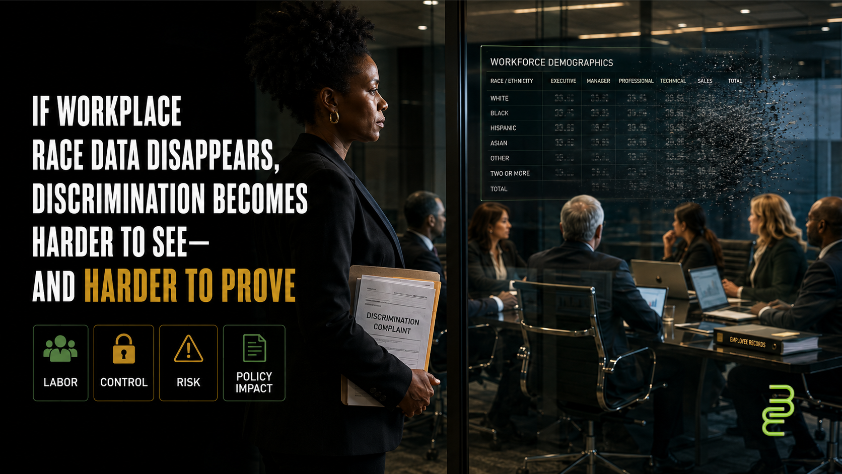
The federal government may stop requiring tens of thousands of employers and other institutions to submit standardized information showing where workers of different races, ethnicities and sexes are positioned across the workforce.
That may sound like a paperwork change.
Economically, it is a change in who controls the evidence.
On July 21, the Equal Employment Opportunity Commission voted 2–1 to advance a proposed rule rescinding the EEO-1 and related demographic-reporting systems. These reports provide aggregated information about employees’ race, ethnicity and sex across occupational categories.
The rule is not final. It must go through public comment, and the EEOC has scheduled a public hearing for August 11.
But the proposal raises an immediate question:
When employers control hiring, promotion, pay and termination decisions, who should control the information needed to evaluate the results?
What the reporting system does
The EEO-1 system has required covered private employers with at least 100 employees—and certain federal contractors with at least 50—to report workforce information by demographic group and job category.
Other EEO reports apply to labor unions, state and local governments, public schools, apprenticeship programs and additional covered entities.
These reports do not, by themselves, prove that an employer discriminated.
They can, however, reveal patterns that deserve closer examination.
A company may claim that its hiring and promotion systems are neutral. But standardized demographic information can help investigators determine whether Black workers are consistently concentrated in lower-paid positions, excluded from management or promoted at different rates.
The data can also help distinguish an individual workplace dispute from a broader institutional pattern.
That distinction matters because discrimination is not always announced through an explicitly racist email or statement. It can appear through repeated outcomes across hiring, evaluation, promotion, compensation, discipline or termination decisions.
Employment data is enforcement infrastructure
Civil rights protections depend on more than the language written into federal law.
They also depend on institutions capable of measuring what employers actually do.
The EEO reporting system functions as a form of enforcement infrastructure. It gives the EEOC a standardized view across employers, industries and occupational categories.
The agency and its state counterparts have used the information to help investigate worker complaints, identify possible patterns and determine where enforcement resources may be needed.
The reports also create continuity over time. Investigators can examine whether disparities are isolated, improving or persistent.
Eliminating standardized reporting would not make workplace discrimination disappear.
It could make discriminatory outcomes more difficult to detect, compare and document.
The proposal’s economic argument
EEOC Chair Andrea Lucas and the commission’s majority argue that the reporting requirements are costly, outdated and potentially in tension with employment law’s prohibition against making decisions based on race or sex.
The agency estimates that rescinding the reporting rules could save employers approximately $275 million annually.
Those savings represent a real economic benefit for covered organizations.
Employers would spend less money collecting, organizing, reviewing and submitting demographic reports to the federal government. Some organizations may also reduce legal, compliance and administrative expenses associated with the reporting process.
The question is what the public receives—or loses—in exchange for those savings.
A lower compliance burden for employers may produce a higher evidence burden for workers.
Who controls the evidence?
Employers remain closest to the underlying information.
They control job applications, personnel files, compensation systems, performance reviews, promotion decisions, disciplinary records and termination documentation.
They also control many of the technologies increasingly used to make employment decisions, including applicant-tracking systems, productivity-monitoring tools and algorithmic screening platforms.
Under a system of mandatory standardized reporting, employers must convert portions of their internal information into a comparable format and provide it to a civil rights enforcement agency.
Without that requirement, relevant information may remain fragmented across private systems.
Workers generally do not have access to a companywide view of who applied, who was selected, who advanced, who received favorable evaluations or who was dismissed.
A worker may know what happened to them. They may not be able to see what happened to hundreds or thousands of colleagues.
That information imbalance is an economic form of power.
Who captures the upside?
Large employers and other covered institutions would capture the most direct financial benefit.
They could avoid reporting costs and some of the administrative work associated with preparing EEO submissions.
Employers facing discrimination complaints could receive another, less visible advantage: investigators and workers may have less immediate access to a standardized historical record showing demographic outcomes.
That does not prevent the EEOC or a court from requesting records during a specific investigation. Federal law may still require employers to make and retain relevant employment records, and organizations would remain subject to anti-discrimination law.
But reactive access is not the same as continuous standardized reporting.
An investigator who must reconstruct a workforce pattern company by company, record by record, faces a different task from an agency already holding comparable annual submissions.
The financial savings would accrue primarily to employers.
The informational cost would be distributed among workers, regulators, attorneys and the public.
Who carries the risk?
Black workers, women and other protected groups could carry the greatest risk.
A person alleging discrimination already faces a basic evidence problem: the employer usually possesses more information about the decision than the employee challenging it.
Removing a national reporting structure could widen that gap.
The EEOC would also lose a dataset that can help it identify industries, occupations and employers requiring closer attention.
Civil rights enforcement could become more dependent on individual complaints. But individual complaints only capture what workers recognize, can document and are willing or able to report.
Fear of retaliation, limited legal resources and lack of access to companywide information can all prevent workers from pursuing claims.
When systemic evidence becomes harder to assemble, enforcement may shift away from patterns and toward isolated incidents.
That shift can benefit institutions with the resources to control records, hire counsel and defend each case separately.
Why this matters to Black workers
Black workers do not only need formal protection from discrimination.
They need systems capable of measuring whether those protections are working.
The existence of a legal right does not automatically create equal access to the evidence needed to enforce it.
Consider a company where Black employees are hired in substantial numbers but remain concentrated in service, labor or lower-management positions.
Without demographic reporting across occupational categories, the company may still say it has a diverse workforce.
The missing question would be where workers are positioned inside that workforce—and who has access to authority, compensation and advancement.
That is why employment data is connected to wealth.
Hiring determines access to income. Promotion affects lifetime earnings. Occupational segregation influences retirement savings, homeownership, health coverage and the ability to transfer wealth to the next generation.
The numbers are not separate from economic opportunity.
They document how opportunity is distributed.
The proposal is not final
The EEOC’s vote begins the federal rulemaking process. It does not immediately cancel the reporting system.
The proposal must be published in the Federal Register, followed by a 30-day public-comment period.
The commission has also scheduled a public hearing for August 11, 2026. Organizations and individuals seeking to testify must submit requests by August 7.
Employers should not assume that existing obligations have already disappeared. Until a final rule takes effect, covered organizations must evaluate their responsibilities under current law and applicable reporting instructions.
State laws, federal contracting requirements, litigation-preservation duties and other recordkeeping obligations may also remain relevant even if the EEOC finalizes its proposal.
The economics behind it
This debate is not only about whether employers should complete a government form.
It is about whether standardized information about workplace opportunity should exist outside the organizations making the decisions.
The proposed rule would produce an immediate and measurable benefit for employers: lower compliance costs.
The potential cost is harder to place on a balance sheet.
It may appear through investigations that take longer, patterns that remain hidden, claims that become more difficult to support and disparities that receive less public scrutiny.
When one side controls both the decision and most of the evidence, accountability becomes more expensive for everyone else.
A right that becomes harder to measure can become harder to enforce.
And when workplace outcomes become less visible, the economic consequences do not disappear.
They become easier to deny.