


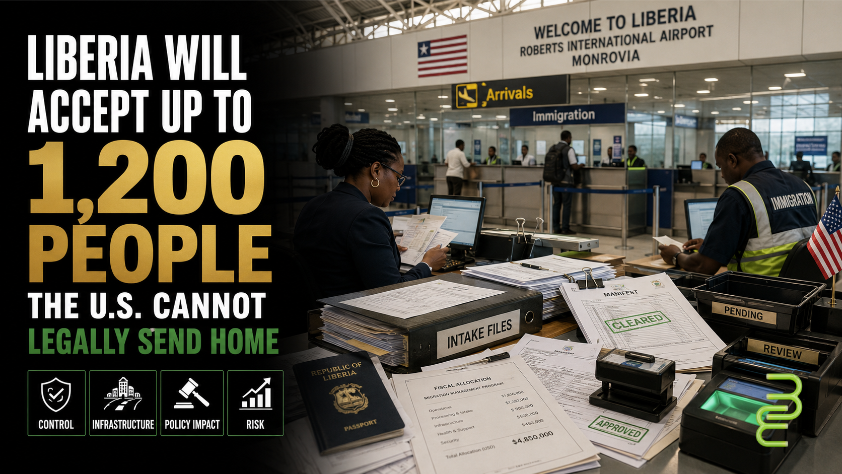
Liberia has agreed to receive as many as 1,200 people deported from the United States over the next year. The unanswered economic question is what it will cost Liberia to administer a function Washington can no longer complete by simply sending many of those people home.
The United States has found another destination for people it wants to deport but, in many cases, cannot return to their countries of origin.
This time, that destination is Liberia.
Liberia has agreed to accept as many as 1,200 third-country deportees from the United States over the next 12 months, according to a Liberian government statement reported by Reuters.
An initial group of 20 is expected to arrive Thursday.
Many people involved in such third-country removals have obtained legal protection from being returned to their home countries after U.S. immigration judges determined they could face torture or other abuse there.
Reuters reports that the Trump administration has established several arrangements with African governments as it seeks additional routes for carrying out deportations.
Liberia says the people it receives will be treated as “guests,” will be free to leave voluntarily and will be allowed to seek asylum in the country. Monrovia also says the agreement is not a quid pro quo and that it did not demand compensation from Washington.
But that does not mean the arrangement has no economic cost.
And it does not mean no money will move.
The key detail is the support package we cannot see
The Liberian government says the United States will provide support to help Liberia administer the program and strengthen its migration system more broadly.
According to Reuters, the government offered no further details about that support.
That missing information is where the economics of the agreement begin.
Receiving hundreds or potentially more than a thousand people is not simply a diplomatic gesture. Depending on how the program operates, it can require immigration processing, security, legal administration, temporary accommodation, transportation, healthcare coordination and other public services.
If people seek asylum or remain in Liberia for extended periods, additional questions emerge around legal status, employment, housing and integration.
The available reporting does not establish how much any of those responsibilities will cost, which government will pay each expense, or what resources Washington has committed.
That distinction matters.
Liberia can accurately say it did not demand compensation while still receiving U.S. funding, technical assistance or other support associated with implementing the agreement. Reuters reports both claims: no requested compensation and an unspecified U.S. support commitment.
Until the terms are disclosed, the public cannot evaluate whether that support reflects the actual cost Liberia is assuming.
This is immigration enforcement outsourcing
The policy story is about deportation.
The economic story is about who performs the work and who carries the cost when one government shifts part of an enforcement function beyond its own borders.
Washington determines whom it seeks to remove from the United States.
But once a person is transferred to Liberia, the responsibilities change hands.
Liberian authorities control admission into Liberia, asylum procedures and treatment after arrival. Liberian institutions could also become responsible for administering the consequences of how long those individuals stay.
That makes Liberia more than a destination on a flight itinerary.
It makes the country part of the operating infrastructure of U.S. immigration enforcement.
The arrangement therefore raises a basic economic question: What is the value of the administrative capacity Liberia is providing to the United States?
Washington gains something measurable even if no conventional purchase price has been announced: another legal and operational pathway for executing removal orders.
Liberia may gain funding, migration-system capacity, training or diplomatic benefits. But the value of those benefits cannot yet be measured from the information publicly disclosed in the Reuters report.
Who controls the arrangement?
Control is divided unevenly.
The United States controls the initial deportation decision and selects the people it wants removed from U.S. territory.
Liberia controls what happens under Liberian law after those people arrive, including their ability to seek asylum.
But the deportees themselves enter the arrangement with the least leverage.
Their countries of origin may be places to which U.S. courts have determined they cannot safely be returned. Their next destination is instead being determined through an agreement between two governments.
That places the greatest personal risks — disrupted employment, housing instability, family separation and uncertainty over future legal status — on the people with the least ability to shape the agreement.
Why Liberia’s role deserves economic scrutiny
There is also a larger question for African governments.
Reuters reports that several African countries have accepted third-country deportees as the United States expands these arrangements.
That makes Liberia’s agreement worth examining beyond immigration politics.
If African governments increasingly provide receiving capacity for another country’s deportation system, those arrangements have an economic value.
Administrative capacity has a cost.
Housing has a cost.
Migration processing has a cost.
Healthcare has a cost.
Long-term residency has a cost.
And government attention itself is a scarce public resource.
The issue is therefore not whether Liberia should or should not participate. The available evidence does not establish that the government was coerced, nor does it establish the existence of secret compensation.
The issue is whether the full terms allow Liberians to understand what their government has agreed to provide, what Washington has agreed to fund and which costs remain with Liberia if the arrangement becomes longer or more complicated than anticipated.
The economics behind it
This agreement creates a new link between U.S. immigration enforcement and African public administration.
Money: The United States has promised unspecified support, but the amount and structure are not publicly clear from the available reporting.
Ownership and control: Washington controls removal from U.S. territory. Liberia controls admission and asylum administration once people arrive.
Access: Deportees may seek asylum in Liberia, according to the Liberian government.
Risk: Liberia assumes administrative exposure, while deportees carry the most direct personal and economic uncertainty.
Upside: The United States gains additional removal capacity. Liberia may gain resources or stronger migration infrastructure, but the value of that benefit has not been disclosed.
The unanswered question is the one that should determine whether this arrangement makes economic sense for Liberia:
Who has priced the burden?
Why It Matters
For BlackEconomicDevelopment.com, the significance is larger than a single deportation agreement.
A powerful country is transferring part of an immigration-enforcement problem to an African state. Liberia may have valid humanitarian, diplomatic or institutional reasons for participating.
But if Liberia is supplying administrative capacity to solve a U.S. policy problem, the financial terms matter.
That is especially true when those terms determine whether the cost ultimately lands with Washington, Liberia’s government, Liberian communities or the people being deported.
The next reporting step should be straightforward: disclose the support package and the operating responsibilities attached to it.
Without those details, the public knows the number of people Liberia may receive.
It still does not know the price of receiving them.
Follow The Economics Behind It for the policy decisions, ownership questions and economic terms that become clearer after the headline fades.

Latest posts by normbond (see all)
- NC A&T Students Marched 45 Minutes to Vote. The Bigger Story Is Who Controls Access. - October 17, 2026
- Black Family Wealth Fell 25%. The Ownership Gap Is the Bigger Story. - October 16, 2026
- Rihanna Turned a TikTok Live Into a Storefront. That Changes the Economics of Celebrity Attention. - October 14, 2026