


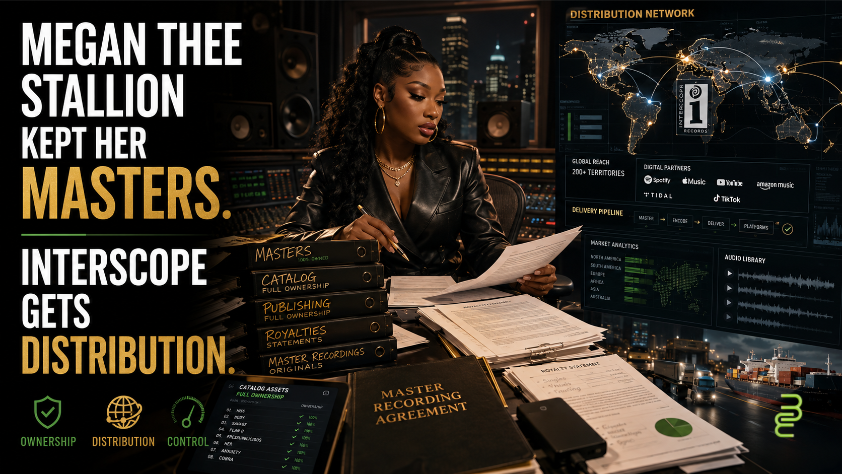
Megan Thee Stallion has a new global music partner. But she did not give that partner the asset at the center of the deal.
Megan’s Hot Girl Productions has entered a global distribution partnership with Interscope Records, which will provide distribution and strategic support for her upcoming releases.
Billboard reports that Megan will continue to own her masters and publishing while releasing music through Hot Girl Productions. Variety also confirmed Interscope’s distribution and strategic-support role.
That distinction matters.
This is not just another story about a major artist signing with a major music company. It is a story about separating ownership from infrastructure.
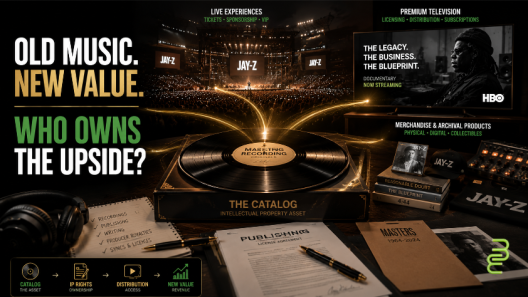
Megan owns the music.
Interscope helps move it through the marketplace.
And economically, those are two very different positions.
She is buying access to scale without giving up the core asset
A record company can provide an artist with valuable infrastructure: distribution, marketing expertise, industry relationships, international reach and the machinery required to turn a release into a global commercial campaign.
But that infrastructure does not necessarily have to come with ownership of the underlying intellectual property.
Megan’s announced structure demonstrates the difference.
Hot Girl Productions retains ownership of her masters and publishing while Interscope takes on global distribution and strategic support.
Think of it as the difference between selling an asset to gain access to infrastructure and hiring infrastructure to make the asset more valuable.
For creators, that distinction can become increasingly important as a catalog generates revenue long after the initial release cycle.
Recorded music can produce income through streaming, licensing and other uses. Publishing rights can generate another set of revenue opportunities tied to the composition itself.
Who owns those rights helps determine who participates in that value over time.
Megan’s arrangement keeps those ownership rights on her side of the relationship.
Interscope still controls something valuable: distribution
Ownership, however, is only one form of economic power.
Distribution is another.
Interscope is part of one of the largest music systems in the world, with the infrastructure and market relationships required to help releases reach audiences at global scale.
That means Megan’s structure does not eliminate institutional power.
It rearranges it.
Hot Girl Productions controls the underlying intellectual property. Interscope supplies distribution and strategic capacity.
Each party brings something the other values.
Megan brings an established artist brand, audience and creator-owned music operation.
Interscope brings scale.
That creates a useful ownership question well beyond the music industry:
What changes when the creator hires the distribution system instead of giving the distribution system ownership of the asset?
The upside looks different when you keep the asset
The economic importance of master ownership becomes clearer when a music catalog grows in value.
If future releases perform well, Megan retains the underlying intellectual property associated with those recordings under the announced structure. That gives her exposure to the long-term economics of the catalog rather than limiting her participation to compensation negotiated around someone else’s ownership.
It also preserves leverage.
Owned intellectual property can potentially support licensing opportunities, future commercial arrangements and negotiations that depend on control over how creative work is used.
Interscope can still benefit economically from successful releases through the terms of its distribution relationship.
But providing distribution is different from owning the asset being distributed.
That is the architecture worth watching.
Ownership also means carrying more responsibility
There is another side to independence that celebrity-business narratives can overlook.
Keeping more ownership can also mean assuming more responsibility.
Traditional record-company structures may provide financing, operating infrastructure and other resources while sharing or controlling important rights under the terms of the agreement.
An artist operating through an owned company has to build, finance, contract for or otherwise secure more of those capabilities.
The upside can be greater.
So can the entrepreneurial burden.
That makes Megan’s Interscope arrangement notable because it offers another possible model: own what is difficult to replace and partner for capabilities that can be contracted.
In this case, the scarce asset is not the ability to distribute a recording.
It is Megan Thee Stallion’s music, brand and intellectual property.
This follows an earlier shift toward ownership
The Interscope agreement is not Megan’s first attempt to separate ownership from traditional record-label economics.
After her earlier label disputes, she moved toward independently owned releases and subsequently entered a distribution arrangement with Warner Music Group. Billboard reported on that Warner distribution deal in 2023.
The move to Interscope continues that broader structure: creator ownership paired with major-company distribution capacity.
The distributor changed.
The ownership principle did not.
That may ultimately be the more consequential part of the story.
Why this matters beyond Megan Thee Stallion
Black artists have generated enormous economic value across the history of recorded music. But cultural influence and asset ownership are not the same thing.
A song can dominate culture while somebody else owns the master.
An artist can command attention while another company controls distribution.
A creator can generate an audience while another institution captures a substantial portion of the long-term economics attached to that audience.
That is why ownership matters.
Megan’s deal should not be treated as proof that every artist can—or should—follow the same model.
Her ability to negotiate from the position she occupies today reflects the value of an established brand, audience and commercial track record.
But the structure provides a useful case study in how creator economics can change once ownership becomes the starting point of the negotiation.
The question shifts from:
What will the company give the artist?
to:
What services does the artist-owned company need from the institution?
That is a very different negotiating posture.
And it is one with implications far beyond music.
Creators, athletes, media personalities and founders increasingly operate businesses built around intellectual property, audiences and brands. Distribution platforms remain powerful because they control access to markets.
But access and ownership do not always have to belong to the same party.
Megan Thee Stallion’s Interscope partnership makes that separation visible.
She kept the asset.
Now another company has the job of helping her distribute it.
For anyone trying to understand the economics behind Black cultural power, that may be the most important part of the deal.
The Economics Behind It
Money: Successful releases create revenue opportunities for both Hot Girl Productions and its distribution partner, according to their negotiated economics.
Ownership: Megan retains ownership of her masters and publishing under the announced arrangement.
Control: Hot Girl Productions controls the underlying IP while Interscope provides significant distribution and strategic infrastructure.
Access: The partnership gives an artist-owned operation access to major global distribution capabilities without transferring the announced ownership rights.
Risk: Greater ownership can bring greater entrepreneurial responsibility, including the need to secure capabilities that a conventional label structure might otherwise provide.
Upside: If Megan’s catalog increases in value, ownership positions her to participate directly in that appreciation and in future uses of the intellectual property.
Why It Matters
Black cultural influence does not automatically become Black-owned wealth.
The economic question is what happens after culture creates demand: Who owns the asset, who controls access to the market, and who participates in the value that accumulates over time?
Megan Thee Stallion’s deal offers one answer: keep ownership of the intellectual property and contract with a larger institution for scale.
Latest posts by normbond (see all)
- NC A&T Students Marched 45 Minutes to Vote. The Bigger Story Is Who Controls Access. - October 17, 2026
- Black Family Wealth Fell 25%. The Ownership Gap Is the Bigger Story. - October 16, 2026
- Rihanna Turned a TikTok Live Into a Storefront. That Changes the Economics of Celebrity Attention. - October 14, 2026