


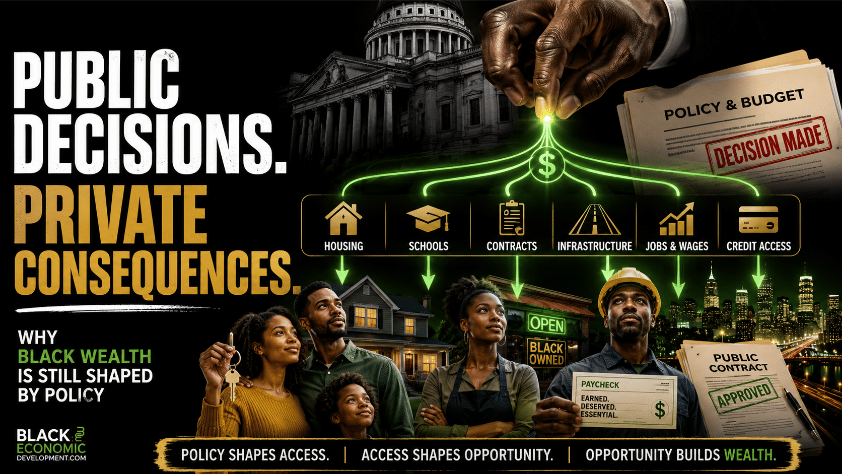
Black wealth is often discussed as personal finance. But housing, schools, contracts, credit, infrastructure, and labor markets are still shaped by public choices.
Black wealth is often talked about as a personal finance issue.
- Save more.
- Invest earlier.
- Buy property.
- Start a business.
- Improve credit.
- Build assets.
All of that matters.
But it is not the whole story.
Wealth is not built in a vacuum. It is built inside systems. And many of those systems are shaped by public decisions.
That is why policy is not distant from the pocket.
It helps decide who gets access, who builds equity, who absorbs risk and who gets left out of wealth-building systems.
Policy Is Not Abstract When It Reaches the Pocket
Budgets, zoning rules, school funding formulas, procurement policies, tax credits, transportation plans, labor regulations, lending standards, and infrastructure investments may sound technical.
But they shape everyday financial life.
They influence where homes are built, how neighborhoods are valued, which businesses win contracts, what jobs people can reach, what schools receive resources, and who has access to capital.
For Black families, workers, founders, homeowners, renters, creators, and institutions, these decisions can affect the path to ownership.
They can also shape the cost of being excluded from it.
The question is not only whether a public decision sounds good on paper.
The real question is:
What happens in people’s pockets?
The Wealth Conversation Often Starts Too Late
When people talk about the racial wealth gap, the conversation often turns personal.
Who saved?
Who invested?
Who bought property?
Who started a business?
Who made the right financial choices?
Those questions matter.
But they do not explain everything.
A family cannot build home equity without fair access to housing, lending, insurance, and neighborhood investment.
A founder cannot grow a business without capital, customers, contracts, cash flow and payment systems that work.
A worker cannot move up if wages, transportation, childcare, healthcare, training access, or automation risk block mobility.
A student cannot turn education into opportunity if the systems around them are underfunded, disconnected or unequal.
Personal choices matter.
But access matters too.
Where Public Decisions Shape Wealth
Public decisions move money in ways that are both visible and hidden.
Housing policy shapes who can buy, where they can buy, how neighborhoods are valued, and whether families can build home equity.
School funding shapes opportunity long before someone enters the job market.
Transportation decisions shape who can reach work, customers, healthcare, education, and business districts.
Procurement rules shape whether Black-owned businesses get a fair shot at public contracts.
Zoning and development decisions shape who benefits from neighborhood investment and who gets priced out.
Infrastructure spending can raise property values, support commerce, and improve quality of life.
But the upside depends on who owns the land, homes, and businesses when the investment arrives.
Credit policy, banking access, tax incentives, labor rules, and public budgets all affect what money reaches Black households and what money leaves.
That is the economics behind policy.
The Ownership Question Is the Real Test
The key issue is not only whether money enters a community.
The deeper question is:
Who owns what after the money arrives?
If public dollars support development but local residents are displaced, wealth does not stay rooted.
If infrastructure improves a neighborhood but Black homeowners and businesses are underrepresented, the gain is uneven.
If supplier diversity goals exist but Black firms cannot access bonding, financing, technical assistance, or timely payments, opportunity remains limited.
If workforce training is promised but the jobs created do not pay enough to build stability, the policy may create activity without mobility.
If AI and automation reshape public services and private workplaces without preparing workers, Black labor may carry the risk while platforms and institutions capture the productivity gains.
That is why every policy story needs an ownership lens.
- Who controls the land?
- Who owns the business?
- Who gets the contract?
- Who gains equity?
- Who holds the data?
- Who carries the debt?
- Who absorbs the disruption?
- Who captures the upside?
Those are not side questions.
They are the economic story.
Public Policy Can Build Wealth or Extract It
Policy can expand access.
It can support affordable homeownership, business formation, fair lending, public contracting, workforce mobility, infrastructure investment, and community ownership.
But policy can also extract value.
It can raise costs, accelerate displacement, underfund public goods, restrict access to capital, or direct subsidies toward outside investors without building local ownership.
That is why Black wealth cannot be separated from public decision-making.
The goal is not to treat every policy debate as partisan.
The goal is to treat public decisions as economic decisions.
Because they are.
They determine who gets financed, who gets protected, who gets taxed, who gets subsidized, who gets connected, and who gets left to carry the risk.
Why This Matters Now
Black communities do not need policy explained only in political language.
They need it translated into pocket-level consequences.
- What does this decision mean for rent?
- For homeownership?
- For wages?
- For business contracts?
- For credit access?
- For school quality?
- For transportation?
- For healthcare costs?
- For land ownership?
- For neighborhood control?
- For Black-owned firms?
- For future wealth?
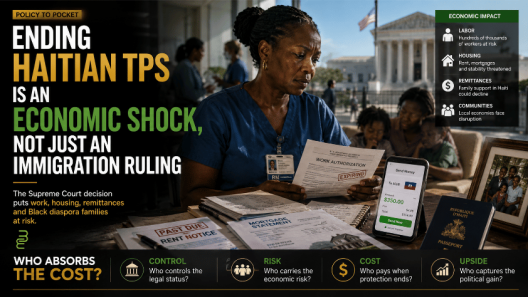
That is the heart of the Policy to Pocket lens.
It connects the public decision to the private consequence.
It turns policy from something distant into something measurable.
And it reminds us that wealth is not just about income.
It is about access, ownership, protection, mobility and control.
The Bottom Line
Black wealth is shaped by what people do.
But it is also shaped by the systems people must move through.
Public decisions help set the rules of those systems.
They influence who gets access to housing, capital, contracts, education, infrastructure, work, credit and ownership.
That does not remove agency from Black families, workers, founders, or institutions.
It makes the playing field visible.
For BlackEconomicDevelopment.com, the question is simple:
Who benefits, who pays, who owns and who is protected?
That is why public decisions still shape Black wealth.
Economic Implication
Public decisions influence access to the major systems that build wealth: housing, education, business ownership, infrastructure, credit, labor markets, and public contracts.
For Black communities, tracking policy through pocket-level impact reveals where wealth is being created, where risk is being shifted, and where ownership opportunities are being expanded or blocked.
Why It Matters
Black wealth conversations often focus on individual behavior. But many financial outcomes are shaped by systems before individual choices are made.
Understanding public decisions as economic decisions helps readers see where money, power, ownership and opportunity are moving.
Speak Your Local
What public decision has the biggest pocket-level impact in your local community: housing, schools, contracts, transportation, wages, or business capital?

Latest posts by normbond (see all)
- Who Owns the Upside From Power? 50 Cent’s Variety Interview Reveals a Bigger TV Economics Story - October 20, 2026
- Burkina Faso Rejected a U.S. Deportation Deal. Then the Fight Moved to Visa Access. - October 19, 2026
- NC A&T Students Marched 45 Minutes to Vote. The Bigger Story Is Who Controls Access. - October 17, 2026