


Donald Trump says he will ask the Supreme Court to rehear the birthright citizenship case after the Court struck down his executive order limiting citizenship for some children born in the United States.
Reuters reported that Trump called the ruling a “miscarriage of justice” and said his administration would seek another review.
The Supreme Court’s June 30, 2026 decision in Trump v. Barbara held that children born in the United States to parents who are unlawfully or temporarily present are “subject to the jurisdiction” of the United States and are citizens at birth under the 14th Amendment.
That makes this more than a legal headline.
It is an economic story about who gets access to the systems that shape American life. Legal identity, education, work, health care, housing, credit, public benefits, business formation, and long-term wealth-building are at stake.
Where The Money Is Moving
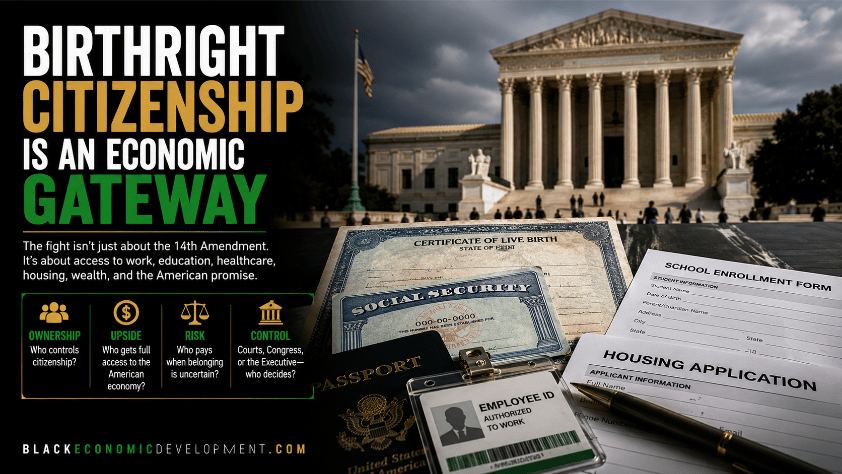
Citizenship is not only a status. It is an economic gateway.
A birth certificate, Social Security number, passport eligibility, school enrollment, lawful work access, banking access, tax records, and public documentation all connect people to the formal economy.
When citizenship is secure, families can plan. Children can enroll in school without a cloud over their legal identity. Parents can make long-term decisions about work, housing, health care, and education. Employers, school districts, hospitals, and state agencies operate with clearer rules.
When citizenship becomes uncertain, costs move through the system.
Families face legal expenses. States and cities face administrative burdens.
Hospitals, schools, and agencies face confusion over documentation.
Employers face uncertainty around future workforce participation.
Immigration attorneys, advocacy groups, and political fundraising operations become part of the economic chain.
The money does not disappear. It shifts from family stability into legal, administrative, political, and enforcement costs.
Who Owns Or Controls The Asset?
The asset at the center of this fight is legal belonging.
The Trump administration’s executive order, issued January 20, 2025, argued that the 14th Amendment does not automatically extend citizenship to everyone born in the United States. And directed federal agencies to deny recognition of citizenship in certain cases.
That means the ownership question is really a control question:
Who gets to define citizenship — the Constitution, Congress, the courts, or the executive branch?
The Supreme Court answered that question, at least for now, by reaffirming that children born in the U.S. to unlawfully or temporarily present parents are citizens at birth.
But Trump’s push for a rehearing shows the political fight is not over.
Who Captures The Upside?
The upside of secure birthright citizenship is broad.
Children born in the United States gain legal certainty. Families gain a clearer path to stability. Schools and local governments avoid creating parallel systems for children whose status is contested. Employers benefit from a future workforce whose legal identity is not in dispute.
There is also a national upside. A country that automatically recognizes children born on its soil creates a cleaner bridge between population growth, labor force participation, tax contribution, military service, entrepreneurship, and civic life.
For Black communities, the historical stakes are especially clear.
The 14th Amendment was born out of the struggle to reverse the logic of Dred Scott and establish that citizenship could not be denied to people born in the country because of race, ancestry, or inherited exclusion.
The Court’s ruling explicitly placed the Citizenship Clause in that historical context.
That history matters because Black citizenship in America has always been tied to economic rights: the right to work, own property, sign contracts, vote, attend school, build families, and claim public protection.
Who Carries The Risk?
Immigrant families carry the most immediate risk.
But the broader risk does not stop there.
When birthright citizenship becomes politically negotiable, every community with a history of exclusion should pay attention.
Black Americans know that legal status and economic status have never been separate in this country. Citizenship has always shaped access to land, wages, housing, education, credit, voting power, and protection under the law.
A narrower definition of citizenship could also create a larger underclass of U.S.-born people with uncertain legal recognition. That would affect labor markets, public schools, health systems, and local economies.
Employers could benefit from more vulnerable labor. Families would carry more legal risk. Public institutions would carry more administrative burden. Children would carry consequences for decisions they did not make.
Why This Matters To Black Economic Power
This story is not only about immigration policy.
It is about whether citizenship remains a stable constitutional floor or becomes a political tool.
For Black communities, the economic lesson is direct: rights that look abstract often determine who can build wealth in practice.
Citizenship affects access to work, education, business ownership, housing, banking, public investment, and political representation. When citizenship is weakened for one group, it can create precedent, infrastructure, and political permission to weaken belonging for others.
The economics behind this story are about control.
- Control over who counts.
- Control over who works with protection.
- Control over who can build wealth across generations.
- Control over who gets access to the American promise — and who is left paying the cost of exclusion.

Latest posts by normbond (see all)
- Burkina Faso Rejected a U.S. Deportation Deal. Then the Fight Moved to Visa Access. - October 19, 2026
- NC A&T Students Marched 45 Minutes to Vote. The Bigger Story Is Who Controls Access. - October 17, 2026
- Black Family Wealth Fell 25%. The Ownership Gap Is the Bigger Story. - October 16, 2026