



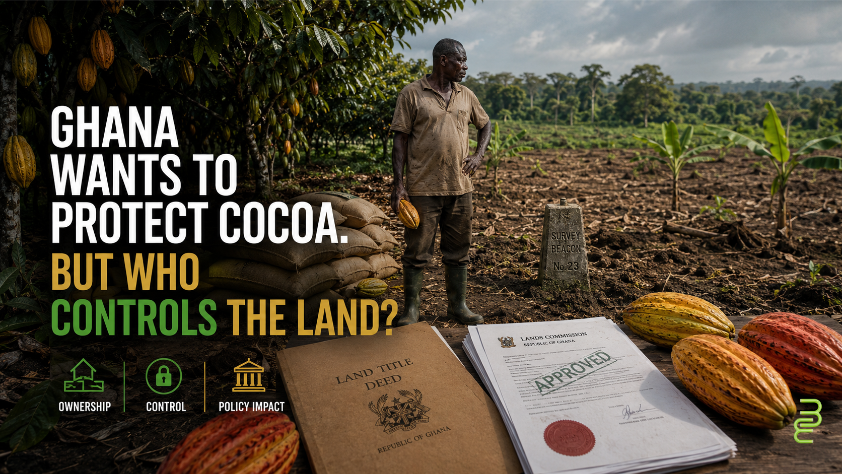
Ghana has a problem that goes well beyond the price of chocolate.
The country wants to protect the farmland behind one of its most important export industries.
But some cocoa farmers say legislation designed to preserve that industry could also reduce their authority over one of their most important economic assets: their land.
Ghana’s Parliament has passed the Ghana Cocoa Board Bill, 2026. Among its provisions are stronger protections for cocoa farms that would restrict their conversion to other uses without approval from the Ghana Cocoa Board, or COCOBOD.
Farmers who violate certain provisions could face substantial fines and, in some circumstances, prison sentences of up to 20 years. As of August 13, President John Dramani Mahama had not given the bill presidential assent.
COCOBOD says the broader legislation is intended to modernize regulation of the cocoa sector.
Its reforms also include a producer-pricing mechanism guaranteeing farmers at least 70% of the free-on-board price, stronger traceability, farmer-welfare provisions, new financing rules and increased protection of cocoa farms. The agency has begun stakeholder meetings ahead of presidential assent.
That makes this more complicated than a simple government-versus-farmers fight.
Ghana has a legitimate economic interest in preserving cocoa.
Farmers have a legitimate economic interest in controlling what happens to the land on which their livelihoods depend.
The economics behind the dispute begin where those two interests collide.
Ghana is protecting more than a crop
Cocoa is part of Ghana’s national economic infrastructure.
Ghana and neighboring Côte d’Ivoire together account for roughly half of global cocoa production, according to Reuters. Ghana is also dealing with pressure on its own supply: COCOBOD expects production to fall by at least 16% in the 2026-27 season, citing weather, disease and the cocoa tree’s production cycle, while illegal gold mining has also displaced farmland.
From the government’s perspective, allowing productive cocoa acreage to continually disappear creates a national problem.
Less cocoa can mean less export capacity, less supply for domestic processors and greater pressure on an industry that supports farmers and other businesses throughout the value chain.
The new bill attempts to respond by treating existing cocoa farms as assets worth protecting rather than simply acreage that can be switched freely from one economic use to another.
But that protection creates another question.
Protected for whom?
Owning an asset is not the same as controlling it
The legislation does not simply concern who possesses farmland.
The more consequential issue is who decides what that farmland can economically become.
Under the provisions generating farmer opposition, converting cocoa land to another use would require COCOBOD approval, aside from authorized rehabilitation.
That creates a separation between ownership and control.
A farmer may retain rights to a piece of land while facing legal limits on whether that land can be shifted from cocoa into another crop or economic activity.
That distinction matters.
An asset derives part of its economic value from optionality: the owner’s ability to decide how it will be used when circumstances change.
If a cocoa farm becomes diseased, yields collapse or another agricultural use becomes economically necessary, a restriction on conversion can reduce that optionality.
The farmer still has the asset.
But the state holds part of the decision-making power over what that asset can produce.
Farmers say the risk is not theoretical
The Ghana Cooperative Cocoa Farmers and Marketing Association has said it supports efforts to protect cocoa farms.
Its objection is narrower — and economically important.
The association wants further review and consultation over what happens when farms become commercially unproductive.
Administrator Moses Djan Asiedu has raised concerns about farmers who need to remove diseased or poorly producing cocoa and plant another crop capable of generating household income.
That is where the allocation of risk becomes clearer.
The country benefits when cocoa acreage is preserved.
Commodity buyers and processors benefit from a more dependable supply.
The wider cocoa system benefits if fewer farms disappear to mining or competing uses.
But when an individual farm stops generating sufficient income, the farmer is the one carrying the farm-level loss.
That produces an uncomfortable economic arrangement: society may want the farmer to preserve a strategically valuable crop even when preserving it may no longer be the farmer’s best use of the underlying asset.
Who pays for national economic strategy?
This is the question the legislation cannot resolve simply by declaring cocoa important.
If Ghana needs farmers to maintain cocoa production because the crop is strategically important to the country, what obligations come with that restriction?
Should farmers receive stronger rehabilitation support when disease destroys productivity?
How quickly can they obtain permission to change land use?
What criteria will COCOBOD use to approve or reject conversion?
Is there an appeal process?
And if a farmer is prevented from pursuing a more productive use of the land for the benefit of the national cocoa system, who absorbs that opportunity cost?
Those questions matter because regulation does not eliminate economic costs.
It decides where those costs land.
There is another side to the bill
The farmer-control controversy should not obscure provisions that could strengthen farmers’ economic position.
COCOBOD says the legislation guarantees producers at least 70% of the free-on-board cocoa price and introduces reforms involving financing, accountability, traceability and farmer welfare. The regulator describes the bill as a modernization of a legal framework dating to 1984.
That means the legislation simultaneously contains measures intended to improve farmers’ share of cocoa economics and provisions that could limit their freedom to redeploy land.
Both facts matter.
The policy question is therefore not whether cocoa deserves protection.
It is how much private economic control Ghana should require farmers to surrender in order to provide that protection — and what farmers receive in return.
Why this matters beyond Ghana
For BlackEconomicDevelopment.com, this is an ownership story because ownership is more than having your name attached to an asset.
Real economic ownership usually includes some combination of the ability to use, finance, transfer, improve and make strategic decisions about that asset.
Governments routinely restrict property use for environmental, zoning, safety and broader public-interest reasons. Ghana therefore is not unusual simply because it regulates land.
What makes this case economically significant is the tradeoff being exposed so clearly.
The state wants to protect the national value generated by cocoa. Individual farmers want to protect the economic flexibility embedded in their land.
Both sides are talking about preservation.
They are preserving different things.
Ghana is trying to preserve a commodity system.
Farmers are trying to preserve control over an asset.
Until President Mahama decides whether to assent to the legislation — and until the rules governing approvals become clearer — that ownership question remains unresolved.
The economics behind it: A farmer can possess an asset while another institution controls an increasingly important part of what that asset is allowed to do.
That is why Ghana’s cocoa debate is bigger than cocoa.
It is a debate over where private ownership ends and national economic strategy begins.
Economic implication
The bill demonstrates that ownership and control can diverge. Protecting Ghana’s cocoa supply may strengthen national export and commodity interests, but restrictions on land conversion can transfer part of farmers’ economic decision-making authority to the state.
Why It Matters
For farmers, the value of land is not simply its current crop. It also includes the ability to respond to disease, changing markets and household needs.
For Ghana, unrestricted conversion creates a different risk: the erosion of a commodity base that generates national economic value.
The central policy challenge is determining who should bear the cost of protecting that system.

Latest posts by normbond (see all)
- The Atlanta Dream Built the Demand. The Arena Calendar Still Controls the Opportunity. - October 13, 2026
- Black-Founded Vurt Is Taking Vertical Video to TV. The Bigger Question Is Who Controls Distribution. - October 12, 2026
- Owning the Asset Is Not the Same as Controlling the System - October 10, 2026