


BlackSun Private Equity has crossed a threshold that deserves more attention than another fundraising headline.
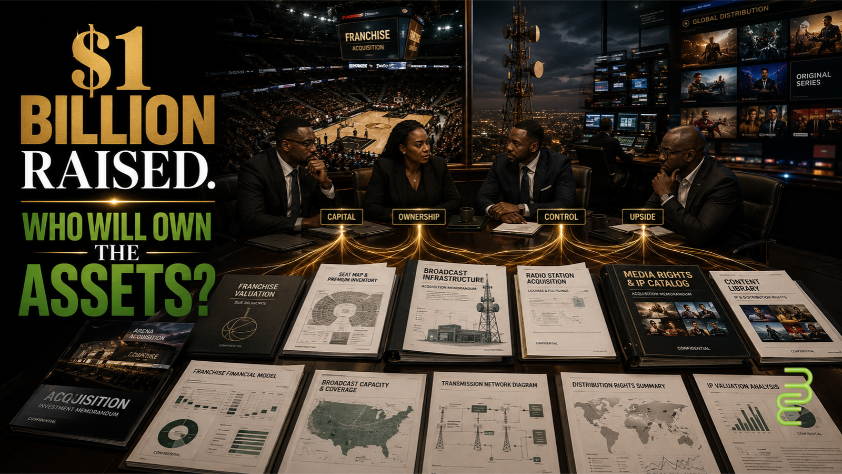
Bloomberg reported Thursday that the Black-led private-equity group has raised $1 billion for Mega Fund I, its inaugural investment vehicle, with a target of eventually reaching $7 billion for investments across sports, media, entertainment and technology.
For BlackEconomicDevelopment.com, the important number is not only $1 billion.
It is what that billion dollars eventually allows BlackSun to own and control.
Black athletes, artists, executives and audiences have long helped create enormous value across sports, media and entertainment.
The harder economic question has been who owns the teams, media infrastructure, intellectual property, distribution systems and investment vehicles through which that value compounds.
BlackSun is attempting to move closer to that ownership layer.
But there is an important distinction.
Managing capital is not the same thing as owning all the capital being managed. And raising a fund is not the same thing as owning the assets the fund intends to buy.
That distinction is where the economics behind this story begin.
$1 Billion Raised, With a Much Bigger Target
Bloomberg reported on Aug. 20 that BlackSun has raised $1 billion for Mega Fund I and is targeting $7 billion.
Nery Gomez, BlackSun’s founder, president and chief operating officer, told Bloomberg the firm has selected Greenstone Equity Partners as its global placement agent. Greenstone specializes in placing capital from investors in Saudi Arabia, Kuwait, Oman, Qatar and the United Arab Emirates.
BlackSun’s current leadership page identifies Atonn F. Muhammad as founder and CEO and Gomez as founder, president and COO.
The firm’s ambitions are already reaching beyond a conventional portfolio of private companies.
BlackSun and partners announced in August that they had assembled an ownership group seeking an NBA expansion franchise in Seattle. That effort comes as the NBA formally explores possible expansion into Seattle and Las Vegas.
BlackSun has also agreed to acquire 20 full-power AM and FM radio stations in Texas and Arkansas from bankrupt High Plains Radio Network for $1.75 million, according to Radio Ink. The proposed transaction still requires bankruptcy-court and Federal Communications Commission approval.
Put those pieces together and the strategy becomes clearer.
BlackSun is not simply looking for companies with cash flow.
It is positioning itself around scarce assets that can carry ownership, distribution, audience access and cultural influence.
The Asset Class Is the Real Story
Sports franchises, media properties, entertainment intellectual property and technology platforms can create several forms of value at once.
- They may produce operating revenue.
- They can hold intellectual property.
- They can control access to audiences.
- They can create sponsorship and advertising inventory.
- They can own distribution.
And some assets—particularly major professional sports franchises—are scarce enough that access to the ownership table is itself valuable.
That is why this story is economically different from another announcement about a Black executive being appointed to lead a company.
An executive may operate an asset.
A creator may generate value for an asset.
An athlete may become the public face of an asset.
A capital allocator can help decide which assets are bought, who receives investment, how businesses are combined, who sits at the ownership table and when an investment is eventually sold.
That is a different kind of leverage.
Black-Led Does Not Answer Every Ownership Question
BlackSun’s leadership matters.
But BEDC does not collapse several different forms of ownership into one phrase.
There are at least three layers worth tracking.
First: Who owns and controls BlackSun itself?
That determines who controls the investment-management platform and participates economically in the firm’s growth.
Second: Who supplies the capital to Mega Fund I?
Limited partners can provide much of a private-equity fund’s investable capital while the general partner makes investment decisions under the fund’s governing agreements.
That means a fund can be Black-led while much of its underlying investment capital comes from institutions, family offices or investors elsewhere.
Those things are not contradictory.
They are simply economically different.
Third: What ownership and voting rights does the fund ultimately obtain in the assets it purchases?
That may be the most consequential question of all.
A minority financial stake in a media company is different from controlling it.
A seat inside a sports ownership consortium is different from serving as its controlling owner.
Owning stations is different from controlling a national distribution platform.
The amount invested matters. The rights attached to that investment matter more.
Who Controls the Capital?
BlackSun potentially occupies one of the most powerful positions in the economic chain: capital allocator.
That matters even if outside limited partners supply much of the money.
Investment managers determine where capital is directed within the constraints of their agreements. They can decide what assets fit the strategy, which management teams receive backing, where additional capital is deployed and when an investment should be exited.
That is economic power.
But it is not unlimited power.
BlackSun’s use of a placement agent focused on Middle Eastern capital creates a legitimate question for future reporting—not because international capital is inherently problematic, but because the ownership structure matters.
If substantial outside capital finances the platform:
How much decision-making authority remains with BlackSun?
What rights do major limited partners receive?
Who participates in the economics if an asset appreciates sharply?
And ultimately:
Can Black-led investment management produce greater Black ownership even when much of the investable capital comes from outside the Black community?
The answer may be yes.
But the answer should be demonstrated through the structure and deployment of the capital, not assumed from the identity of the managers.
From Representation to the Capital Allocation Table
For decades, discussions about Black participation in sports and entertainment have often centered on representation.
- Who gets hired?
- Who gets promoted?
- Who gets a starring role?
- Who gets a coaching job?
- Who sits in the executive suite?
Those questions still matter.
But ownership asks something else.
Who owns the appreciation?
- If the value of a franchise doubles, who benefits?
- If a media property develops valuable audience data, who owns it?
- If a league secures new media rights, who participates in those economics?
- If intellectual property becomes a franchise, who owns the rights?
That is why BlackSun’s fund deserves attention even before we know what Mega Fund I ultimately buys.
The vehicle potentially moves Black economic participation one level upstream—from earning income inside sports and media to allocating investment capital across the industries themselves.
Potentially is the important word.
Access Is the Next Question
A Black-led investment firm does not automatically mean greater access to capital for Black entrepreneurs, creators, athletes or operators.
That has to be measured.
As BlackSun deploys its fund, BEDC will watch whether the platform creates pathways for Black founders and operators to participate alongside institutional capital.
- Does the firm acquire Black-owned businesses?
- Does it back Black media operators?
- Can athletes participate as co-investors rather than only endorsers or employees?
- Can creators retain meaningful intellectual-property ownership when institutional capital arrives?
- Are Black executives given opportunities to build equity in the assets they run?
- Or does the fund largely compete for the same scarce assets sought by other institutional investors without materially changing who participates downstream?
None of those outcomes should be assumed in advance.
They should be tracked.
Who Captures the Upside?
Private equity creates several possible layers of return.
Investors in the fund can participate in portfolio performance.
The investment manager can earn compensation associated with managing the fund and, depending on terms that have not been publicly established in the reporting reviewed by BEDC, may participate in investment gains.
Portfolio-company executives and co-investors may also accumulate equity.
Sellers receive acquisition capital.
Workers, creators and communities may benefit—or may not—depending on how the underlying businesses are operated.
That is why the most important question is not simply whether BlackSun eventually reaches $7 billion.
It is:
Where does the wealth created by that capital ultimately accumulate?
The Risk Sits in the Deployment
A large fund target creates expectations.
Sports and media assets can require enormous amounts of capital, complex partnerships and long holding periods. Major acquisitions may also require regulatory, league or other institutional approvals.
The Seattle NBA effort illustrates that uncertainty.
The NBA has formally authorized exploration of expansion into Seattle and Las Vegas, but an expansion franchise has not been awarded. BlackSun’s ownership group is pursuing an opportunity, not holding an NBA franchise today.
The radio transaction presents another form of execution risk. BlackSun has an agreement to acquire the High Plains stations, but the transaction requires regulatory and bankruptcy approval.
That distinction matters.
Announcements show intent.
Closed transactions show ownership.
And operating those assets successfully determines whether ownership creates durable economic value.
Why This Matters
Black talent has long been central to the economics of American sports, media and entertainment.
But participation in an industry and ownership of its appreciating assets are not the same thing.
If BlackSun successfully raises and deploys institutional-scale capital while retaining meaningful investment control, it could represent a different form of Black economic participation: not simply appearing inside the industries that monetize culture, but helping decide who owns pieces of those industries.
The $1 billion raise is therefore a meaningful signal.
It is not yet the conclusion.
The real test begins now.
- What will BlackSun buy?
- Who will finance those acquisitions?
- What voting and economic rights will it control?
- Will Black founders, operators, athletes and investors participate in the resulting equity?
And years from now, when those assets have either gained or lost value:
Who will own the upside?
That is the ownership record worth following.

Latest posts by normbond (see all)
- Who Owns the Upside From Power? 50 Cent’s Variety Interview Reveals a Bigger TV Economics Story - October 20, 2026
- Burkina Faso Rejected a U.S. Deportation Deal. Then the Fight Moved to Visa Access. - October 19, 2026
- NC A&T Students Marched 45 Minutes to Vote. The Bigger Story Is Who Controls Access. - October 17, 2026