



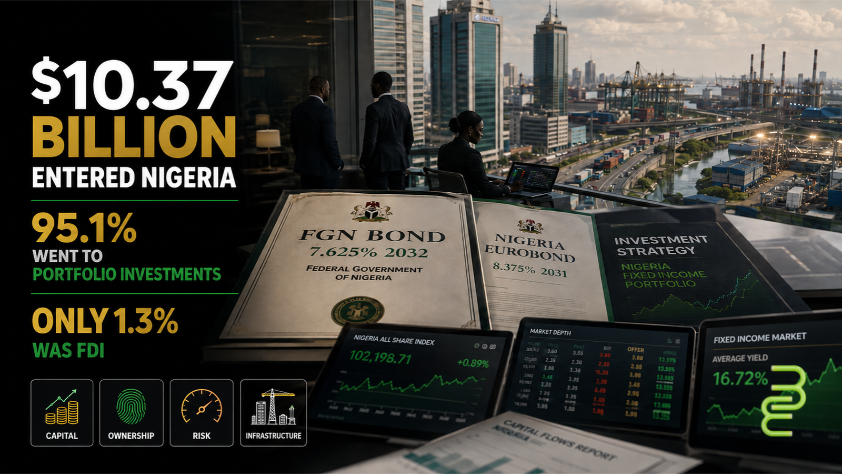
Foreign money is returning to Nigerian markets, but 95% of Q1 inflows went into portfolio investments. The gap between financial confidence and productive investment is where the economics gets more complicated.
Nigeria attracted $10.37 billion in foreign capital during the first quarter of 2026, an 83.8% increase from a year earlier.
That sounds like a straightforward vote of confidence in the Nigerian economy.
The composition of that money tells a more complicated story.
According to PwC Nigeria’s H2 2026 Nigeria Economic Outlook, $9.86 billion, or 95.1% of total capital inflows, came through foreign portfolio investment.
Foreign direct investment accounted for only 1.3% of the total. Secondary reporting on the PwC findings puts FDI at $135.08 million for the quarter.
That distinction matters.
Nigeria is attracting foreign money. But attracting capital is not the same thing as attracting capital that builds productive capacity.
Investors are buying Nigerian financial assets
Portfolio investment gives foreign investors exposure to Nigerian securities without requiring them to build a factory, establish a long-term operating business or finance physical infrastructure.
PwC said the surge in portfolio flows reflects renewed investor interest in Nigerian assets. Gatekeepers News, citing the outlook, reported that $6.5 billion flowed into money-market instruments and another $3.23 billion into bonds.
There are real benefits to that kind of investment.
Foreign participation can improve market liquidity. Capital inflows can reinforce confidence in financial markets and support foreign-exchange conditions. PwC reported that Nigeria entered the second half of 2026 with stronger foreign reserves, improved official foreign-exchange liquidity and a more stable naira.
But portfolio money and direct investment do different economic jobs.
Portfolio capital primarily buys claims on financial returns. FDI is more closely tied to businesses, operating assets, infrastructure and productive capacity.
That makes the central question bigger than whether investors are returning.
It is what they are investing in.
Capital inflow is not the same as capital formation
This is where the headline number can mislead.
A country can attract billions of dollars while still struggling to finance the businesses and infrastructure that increase productive capacity.
PwC makes essentially that distinction in its outlook.
The firm argues that Nigeria now needs to convert stronger investor confidence into long-term productive investment, including businesses, infrastructure, deeper supply chains and employment. It identifies policy certainty, bankable projects, land access, financing, foreign exchange and regulatory consistency as important pieces of that transition.
In other words, Nigeria appears to have made progress on one problem: convincing investors that Nigerian financial assets are worth buying.
It has not yet produced the same scale of commitment to productive assets.
That is an ownership question as much as an investment question.
Foreign investors can capture Nigerian yields without necessarily financing new Nigerian productive capacity.
And if most incoming capital remains concentrated in tradable securities, that money is also more mobile than investment embedded in a plant, supply chain, operating company or infrastructure project.
Nigerian businesses face a different capital market
There is another side to the story.
While foreign portfolio investors are allocating billions into Nigerian financial assets, PwC says domestic private-sector credit equals only 21.3% of GDP, compared with a 33% average across sub-Saharan Africa.
For smaller businesses, the financing problem is even more visible.
PwC identified a financing gap among many micro, small and medium-sized businesses seeking facilities between ?500,000 and ?30 million. Tight monetary conditions continue to raise borrowing costs, the firm said.
That creates an important capital-allocation contrast.
Nigeria can become increasingly attractive to international investors looking for financial returns while businesses operating inside Nigeria still struggle to obtain affordable capital.
Government financing needs add another pressure point. PwC warned that continued government borrowing and spending requirements could place additional demands on available financial resources.
So the economic question is not simply, “Is capital entering Nigeria?”
It is also:
Who can access that capital once it arrives?
Who captures the upside?
For foreign portfolio investors, the attraction is relatively clear: access to Nigerian financial assets offering potentially attractive returns.
For government, stronger investor demand can improve access to financing and reinforce broader market confidence.
Financial institutions and intermediaries also sit close to those flows.
But the connection to households, workers and smaller operating businesses is less automatic.
PwC says Nigeria’s stronger macroeconomic position has not yet translated fully into household welfare. Household affordability remains under pressure, access to financing is tight and growth remains uneven.
That is an important reminder about economic recoveries.
Improved reserves, currency stability and foreign capital inflows can create the conditions for broader growth.
They do not guarantee its distribution.
The risk is not that portfolio investment exists
Nigeria does not need to choose between portfolio investment and foreign direct investment.
A functioning economy can benefit from both.
The problem is imbalance.
When 95.1% of foreign capital inflows are portfolio investments and only 1.3% are FDI, the composition raises questions about how much of the apparent investment recovery is translating into productive assets that expand capacity and employment.
PwC’s own prescription is to turn investor interest into more productive investment.
That requires projects investors can finance, a competitive operating environment and fewer obstacles around land, approvals, financing and foreign exchange.
It also raises a longer-term question that extends beyond foreign investment:
What would it take for more productive assets inside Nigeria to be financed and owned by Nigerians themselves?
That question matters because economic power is not measured only by how much money crosses a border.
It is also measured by what gets built, who owns it, who can finance it, who works inside it and who continues capturing the returns after financial conditions change.
The economics behind it
Nigeria’s $10.37 billion capital-inflow figure is evidence of renewed investor interest.
But it is not yet evidence of an equivalent boom in long-term productive investment.
The next stage of the story is whether greater confidence in Nigerian financial assets becomes confidence in Nigerian productive capacity.
That means watching more than the total amount of foreign capital.
Watch the composition.
Watch access to credit.
Watch what gets financed.
And most importantly, watch who owns the assets created when the money moves.
Get The Economics Behind It newsletter for more on where capital is moving, who controls it and who captures the upside.

Latest posts by normbond (see all)
- Who Owns the Upside From Power? 50 Cent’s Variety Interview Reveals a Bigger TV Economics Story - October 20, 2026
- Burkina Faso Rejected a U.S. Deportation Deal. Then the Fight Moved to Visa Access. - October 19, 2026
- NC A&T Students Marched 45 Minutes to Vote. The Bigger Story Is Who Controls Access. - October 17, 2026