


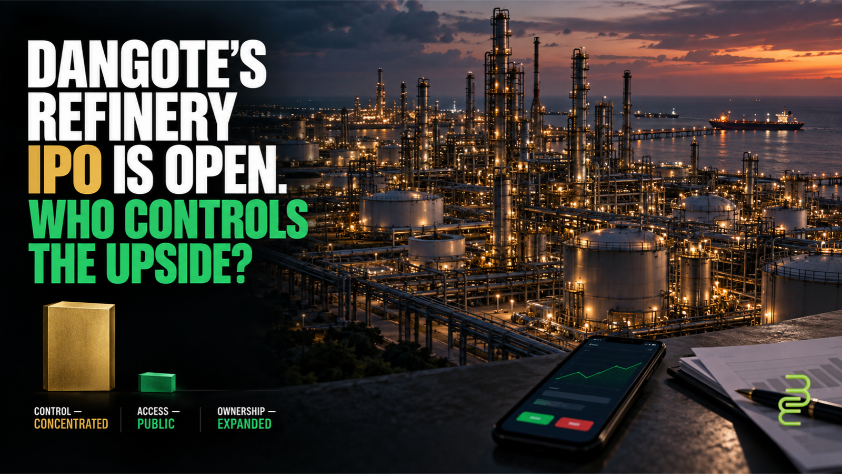
Africa’s largest share sale gives ordinary investors a direct path into one of the continent’s biggest industrial assets. But access to equity and control of the company remain two very different things.
For years, the Dangote Refinery story has been about industrial scale: building a massive African refinery, reducing dependence on imported fuel and creating a new center of refining power on the continent.
As of Monday, September 14, the story is also about who gets to own a piece of it.
Dangote Petroleum Refinery formally opened its initial public offering, putting 4.1 billion shares on the market at ?525 each.
The minimum purchase is 10 shares, meaning a retail investor can enter the offering with ?5,250. The offer is scheduled to remain open through October 13.
If fully subscribed, the base offering would raise about ?2.15 trillion, or roughly $1.6 billion. Reuters reported that the transaction could rise to approximately $2.1 billion if an additional allotment option is exercised.
It is the largest share sale in Africa’s history.
And it changes an important part of the Dangote story.
Ordinary investors can now buy into one of Africa’s largest industrial assets.
But buying the asset and controlling it are not the same thing.
The public can participate. Dangote still controls the refinery.
That distinction is the economics behind this IPO.
Public investors are gaining access to shares in the refinery and, with them, exposure to its future earnings, potential dividends and market value.
What they are not gaining is much control over the enterprise.
Only a small portion of the refinery is being offered through the IPO. The Associated Press reported that Aliko Dangote is expected to retain roughly 87% ownership after the transaction.
So while the shareholder base is expanding, the center of economic control is not changing substantially.
That matters because ownership has more than one layer.
A shareholder can own an economic interest in a company without having enough voting power to meaningfully influence its strategy.
Control determines who can ultimately shape leadership, expansion, financing and other major corporate decisions.
The Dangote IPO expands participation much more than it redistributes control.
Retail investors are entering after private capital
There is another important part of the transaction: when different investors enter the ownership structure.
The refinery was developed through years of founder-controlled investment, financing and private capital.
Before opening the refinery to retail investors, Dangote also raised $2.5 billion through a private placement earlier this year. Institutional investors including Africa Finance Corporation participated in that transaction.
Now public investors enter.
The progression looks like this:
Founder-controlled capital ? institutional private capital ? retail public capital ? further industrial expansion
That sequence matters because investors entering at different stages are accepting different levels of risk and different valuations.
The retail investor buying shares today is not investing in an early-stage refinery project.
The refinery is already operating.
Reuters reports that it is processing about 700,000 barrels per day and that the IPO values the company at approximately ?63 trillion, or about $47.6 billion.
The public is therefore buying into a functioning industrial business at a multibillion-dollar valuation.
The question is no longer simply whether Africans can participate.
It is also: At what price are they entering, and how much future upside remains at that price?
The upside comes with real execution risk
Dangote has much larger ambitions for the refinery.
The company plans to double processing capacity from about 700,000 barrels per day to 1.4 million barrels per day by 2029.
If completed, that expansion would place the refinery among the largest refining operations in the world.
But doubling an industrial complex of this size requires enormous amounts of capital.
Reuters has reported that the expansion is expected to cost approximately $14.3 billion—far more than the base proceeds from this IPO.
That means the public offering is one piece of a much larger capital strategy.
Future financing could include additional debt, equity or other forms of capital.
For shareholders, that creates both opportunity and exposure.
Successful expansion could increase production, revenue and the long-term value of the enterprise.
But investors also carry risk around construction costs, financing, refinery margins, crude supply, execution and future capital needs.
That is the tradeoff embedded in public equity.
Investors receive access to potential upside because they also accept exposure to downside.
This changes how Africans can participate in a major industrial asset
There is still something economically significant about what happened Monday.
For many people, participation in a major industrial company is usually limited to a few roles.
You can be a customer.
You can work for the company.
You can supply it.
Or you can live in an economy affected by its decisions.
Public equity adds another possibility:
You can own a financial interest in the business itself.
A retail investor who purchases Dangote Refinery shares is no longer participating only as a fuel consumer or worker somewhere in the supply chain.
That investor owns a piece—however small—of the company producing the product.
That distinction matters for Black economic development.
African economies contain enormous consumer markets, labor, natural resources and cultural influence. But long-term wealth is also shaped by who owns the companies, infrastructure, intellectual property and productive assets generating economic value.
The Dangote offering creates a direct pathway into one of those productive assets.
It does not mean the shares will necessarily prove to be a good investment.
Public shares can decline.
Valuations can prove too high.
Dividends are never guaranteed.
Expansion plans can miss their targets.
But the expansion of public access to large African-controlled industrial assets is itself worth watching.
Access is not the same as economic power
Dangote has promoted the transaction as a “people’s IPO.”
There is a clear reason for that positioning.
The minimum investment is 10 shares. Digital and fintech distribution makes participation easier for retail investors than a traditional institution-heavy offering would.
Reuters reported strong retail interest as the shares went on sale.
But broader access should not be confused with broader control.
After this IPO, significantly more people can own a financial interest in Dangote Refinery.
Aliko Dangote will still control the overwhelming majority of the company.
Both things can be true.
And that makes this transaction more than a story about Africa’s biggest IPO.
It is a useful case study in the difference between access, ownership and control.
Access asks: Can you get into the asset?
Ownership asks: Can you participate in the financial upside?
Control asks: Who ultimately sets the terms?
As of September 14, the answer to the first question has changed dramatically for retail investors.
The answer to the third has not.
That distinction will matter well beyond Dangote.
As African companies increasingly use public capital markets to finance infrastructure, technology, manufacturing and other productive assets, the economic question will not simply be whether the public is allowed to buy shares.
It will be how much of the continent’s future wealth—and how much power over the assets creating it—is actually being distributed.
The Economic Implication
The Dangote Refinery IPO broadens access to ownership without substantially redistributing control. Retail investors can now participate in the refinery’s potential financial upside, while its founder retains overwhelming influence over the enterprise.
Why It Matters
Black economic participation is not only about consuming from major companies or working for them. The ability to own productive assets matters. But the Dangote offering also demonstrates why ownership percentages, voting power, valuation and control deserve as much attention as access itself.
The ownership question: When the public can buy shares in an asset but one owner still controls nearly the entire enterprise, how much economic power has actually been distributed?

Latest posts by normbond (see all)
- Who Owns the Upside From Power? 50 Cent’s Variety Interview Reveals a Bigger TV Economics Story - October 20, 2026
- Burkina Faso Rejected a U.S. Deportation Deal. Then the Fight Moved to Visa Access. - October 19, 2026
- NC A&T Students Marched 45 Minutes to Vote. The Bigger Story Is Who Controls Access. - October 17, 2026