


The Democratic Republic of Congo is trying to move thousands of mining employees from the payroll to the capitalization table.
Mining companies operating in the country have until July 31, 2026, to demonstrate that Congolese workers hold 5% of their share capital. The requirement was reinforced in a January 30 circular from Mines Minister Louis Watum Kabamba.
The companies are pushing back.
Major operators, including Glencore, Ivanhoe Mines, CMOC and Eurasian Resources Group, coordinated a response through Congo’s Chamber of Mines seeking a delay while the government clarifies how the shares must be transferred.
A union leader told Reuters that no company had complied as of mid-June. Unions are pressing the government to enforce the deadline.
On the surface, this is a compliance dispute.
Economically, it is a fight over whether Congolese labor will receive a meaningful share of the mineral wealth it helps produce.
From earning wages to owning an asset
Most local-participation policies focus on employment, training, procurement or taxes.
Those measures matter, but they do not necessarily give workers ownership of the underlying asset.
A wage pays an employee for work already performed. Equity can provide a continuing claim on future profits and increases in company value.
That distinction is central to Congo’s policy.
The Democratic Republic of Congo is the world’s leading cobalt producer and its second-largest copper producer.
These minerals are critical to electric vehicles, electricity networks, electronics and the global energy transition.
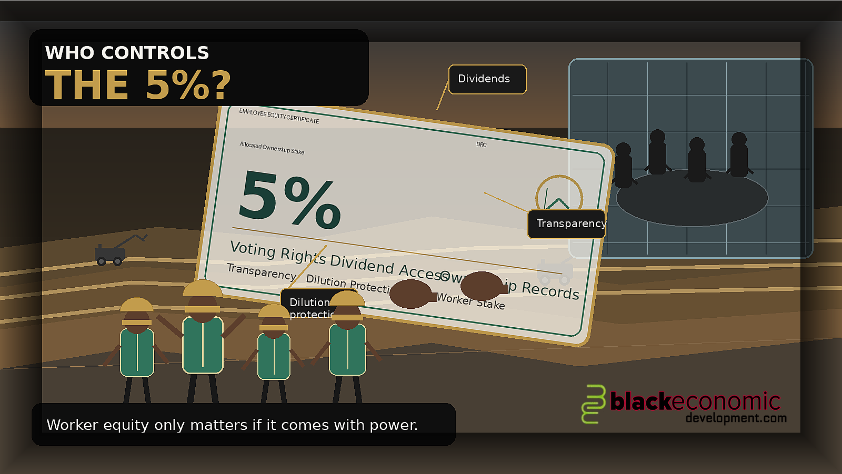
If the 5% requirement creates genuine share ownership, Congolese employees could receive dividends, participate in certain corporate decisions and build wealth as the mines generate value.
That would represent a significant change in how the benefits of mineral production are distributed.
Workers would no longer participate only as labor. They would also participate as owners.
The percentage does not tell the whole story
Five percent sounds precise.
But a percentage alone does not reveal how much economic power workers will actually receive.
The directive reportedly requires mining companies to provide legal proof of compliance, including updated corporate statutes, shareholder agreements and shareholder registers.
The requirement is tied to provisions in Congo’s Mining Code and regulations, including Article 71 bis and Article 144 bis, according to regional reporting on the circular.
What remains unclear is the share-transfer mechanism.
Several questions have not been publicly resolved:
Who gives up the shares?
Existing investors could transfer part of their holdings, or companies could issue new shares that dilute current shareholders.
Who legally owns the stake?
Workers could hold shares individually, through a union, through an employee association or through a collective trust.
Who controls the votes?
The workers may receive voting shares, nonvoting shares or a beneficial interest controlled by trustees.
Who receives the dividends?
Payments could go directly to employees, accumulate inside a collective vehicle or be subject to administrative deductions.
Can the shares be sold or inherited?
Transfer restrictions could protect the worker-ownership block, but they could also prevent employees from accessing the value of their property.
What happens when a worker leaves the company?
The rules must determine whether former employees retain their shares, sell them back or transfer them to current workers.
Until those questions are answered, it is difficult to know whether the policy creates enforceable ownership or symbolic participation.
Where the money is moving
The immediate economic transfer is potentially substantial.
A 5% stake in a profitable copper or cobalt operation could represent dividends and asset value that would otherwise remain with corporate shareholders.
That is why the implementation debate matters.
Foreign investors currently provide much of the capital, operational expertise and access to international mineral markets. They also control much of the governance and commercial infrastructure through which Congo’s mineral wealth reaches global buyers.
The worker-ownership requirement would redirect a defined portion of that economic interest to Congolese employees.
Existing shareholders would carry the direct cost through dilution or a transfer of shares. Companies may also face restructuring, valuation, legal and administrative costs.
Workers, however, carry a different kind of risk.
They could receive equity in a structure they cannot independently audit, vote, transfer or fully understand.
A stake without reliable information, governance rights or dividend transparency can have limited practical value.
Ownership is not the same as control
A worker can technically own part of a company while having little influence over it.
This often happens when employee shares are concentrated in a trust or holding entity controlled by company executives, government appointees or union officials.
Collective ownership vehicles are not inherently harmful. They can preserve a meaningful voting block, reduce administrative costs and prevent individual shares from being quickly sold to outside investors.
But the governing documents matter.
Workers need to know:
- Who appoints the trustees or representatives.
- How those representatives can be removed.
- Whether workers receive audited financial statements.
- How voting instructions are determined.
- When dividends must be distributed.
- What fees can be charged to the ownership vehicle.
- How conflicts of interest will be handled.
- How the 5% block will be protected during future financing or restructuring.
Without those protections, workers could be described as shareholders while someone else exercises the actual power.
The ownership question is therefore not simply whether 5% appears in a corporate filing.
It is whether Congolese employees become registered or clearly identified beneficial owners with enforceable rights.
Who captures the upside?
If designed properly, workers could capture three forms of economic value.
- The first is dividend income when a mining company distributes profits.
- The second is capital appreciation if the value of the company or mining operation increases.
- The third is governance leverage through voting rights, board representation or collective influence over major corporate decisions.
Mining communities could also benefit when dividend income is spent or invested locally. Worker ownership could support household savings, education, housing and locally owned businesses.
The Congolese government would gain leverage as it attempts to retain more value from its critical-minerals sector.
That broader effort already includes policies intended to influence mineral supply and revenue. Congo has recently used export restrictions and other regulatory tools to exert more control over cobalt markets.
But the potential benefits will depend on profitability and corporate structure.
A 5% holding does not guarantee regular income. A company can retain profits rather than pay dividends. Debt obligations, capital expenditures, related-party transactions and transfer pricing can also reduce the earnings available to shareholders.
Workers therefore need more than a share certificate.
They need access to understandable and independently verified financial information.
Why mining companies want more time
The industry’s concerns are not entirely procedural theater.
Companies say the government has not clarified whether the requirement applies retroactively, which corporate shareholder must transfer the equity or which ownership structure employees should use.
The companies have requested additional consultation but reportedly have not proposed a replacement deadline.
Those questions can affect corporate financing agreements, joint ventures and existing shareholder rights.
A mine may be held through several subsidiaries. Its lenders may have contractual claims over its assets or cash flow. Different classes of shares may carry different voting, dividend and liquidation rights.
Transferring 5% at the wrong level of the corporate structure could give workers ownership in an entity that holds little of the actual economic value.
For example, shares in a local operating subsidiary may be more economically meaningful than shares in a thinly capitalized administrative entity. The valuation method and corporate location of the stake must therefore be disclosed.
The lack of clarity is a legitimate implementation problem.
But delay also preserves the current distribution of ownership.
Every month without compliance is another month in which the intended worker stake remains with existing capital holders.
What strong implementation would require
A credible worker-ownership system should define the economic and governance rights before companies complete the transfers.
At minimum, the final rules should establish:
- The entity in which workers receive ownership.
The stake should connect employees to the company or operation where the mining value is actually created. - The type of shares workers receive.
Voting, dividend and liquidation rights should be clearly stated. - The valuation method.
Workers and the public should be able to understand what the 5% stake is worth. - The governance structure.
Employees should elect or directly oversee anyone voting shares on their behalf. - Dividend-distribution rules.
Payments, reserves, fees and withholding arrangements should be transparent. - Independent audits and reporting.
Workers should receive regular statements showing ownership, distributions and changes in value. - Protection against dilution.
Future share issuances should not quietly reduce the worker stake below 5%. - Rules for employees entering or leaving the workforce.
The system needs a fair process for allocating benefits across generations of workers.
These details will determine whether the requirement creates a durable asset or a politically attractive promise with limited financial substance.
Why this matters beyond Congo
The Congo dispute raises a larger question for mineral-producing countries across Africa and the Black diaspora:
Should communities participate in natural-resource development only through jobs and public revenue, or should they also own part of the companies extracting that wealth?
Jobs provide income.
Procurement can help local businesses.
Taxes can fund public services.
But equity creates a direct claim on the asset and its future cash flows.
That is why Congo’s policy could become an important model if it is implemented transparently.
It attempts to convert local participation from a labor-policy commitment into an ownership structure.
The risk is that the final system could place workers inside an opaque vehicle controlled by institutions that do not answer to them.
The opportunity is much larger: Congolese workers could gain an enforceable economic interest in some of the most strategically important mineral operations in the world.
The July 31 deadline will test more than the government’s willingness to confront large mining companies.
It will test whether Congo can build a worker-ownership model in which the word “equity” comes with actual economic rights.
“A 5% stake matters only if Congolese workers can see the accounts, receive the dividends and exercise the rights attached to the shares.”
Economic implication
Congo’s directive attempts to move local participation beyond wages and into capital ownership.
If the shares include transparent dividend, voting and information rights, workers could gain a long-term claim on mining profits and asset appreciation.
If the stake is placed in an opaque or weakly governed vehicle, workers may carry the label of ownership while companies, trustees or political institutions retain effective control.
The decisive issue is not the announced percentage. It is the bundle of rights attached to that percentage.
Why it matters
Congo supplies minerals that are essential to global technology and electrification, yet much of the financial and corporate power surrounding those resources remains outside the communities producing them.
Worker equity could establish a new model for African resource participation: labor receives wages for current production and an ownership claim on future value.
For Black workers, policymakers and institutions across the diaspora, the policy also raises a broader economic-development question: Can labor become a pathway into ownership rather than remaining permanently separate from it?

Latest posts by normbond (see all)
- Who Owns the Upside From Power? 50 Cent’s Variety Interview Reveals a Bigger TV Economics Story - October 20, 2026
- Burkina Faso Rejected a U.S. Deportation Deal. Then the Fight Moved to Visa Access. - October 19, 2026
- NC A&T Students Marched 45 Minutes to Vote. The Bigger Story Is Who Controls Access. - October 17, 2026