



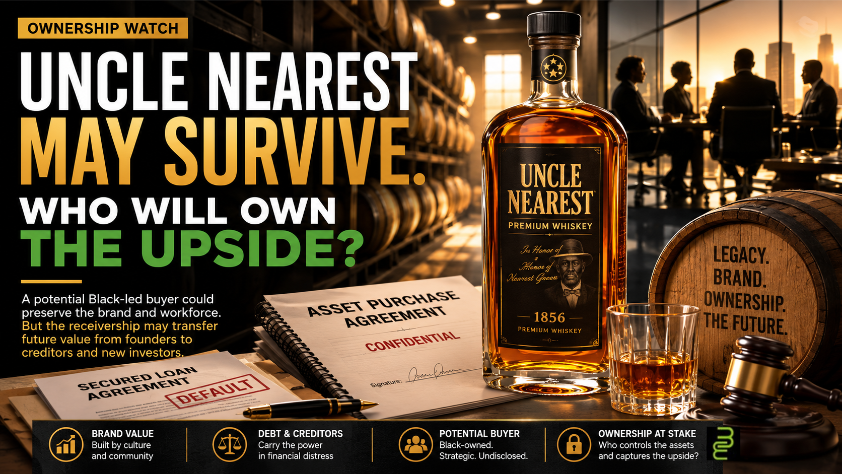
Uncle Nearest may survive its financial crisis.
That does not mean its current owners will.
A court-appointed receiver disclosed on June 1 that an unnamed investment firm had signed a non-binding letter of intent to acquire “substantially all” of Uncle Nearest’s assets.
Court filings describe the potential purchaser as having African American ownership and leadership.
The firm has also expressed an intention to preserve the existing workforce, honor the history of Nathan “Nearest” Green and strengthen the brand’s route to market through strategic partnerships.
Those commitments matter.
Uncle Nearest is one of the most visible Black-founded brands in the American spirits business.
Its rise turned the overlooked history of Nearest Green—the formerly enslaved distiller credited with teaching Jack Daniel how to make whiskey—into a nationally recognized commercial brand.
But the current court fight is no longer mainly about visibility.
It is about who will own the brand, control its assets and receive the financial upside if the company recovers.
A brand can survive while founder wealth disappears
Uncle Nearest has been under court-appointed control since August 2025, after Farm Credit Mid-America sued the company and its founders, Fawn and Keith Weaver. The lender alleges the company defaulted on more than $100 million in loans.
The receiver and Farm Credit have said the company is insolvent and owes nearly $200 million.
The Weavers dispute that assessment and have continued trying to regain control through litigation. A later court finding cited more than $200 million in debt.
This is where the ownership issue becomes more important than the scandal.
When a business enters receivership, founders can lose operational authority even if they remain shareholders on paper. The receiver’s job is generally to protect assets, stabilize the business and address creditor claims under the court’s supervision.
That means the people who created the company may no longer decide whether the brand is sold, which assets are included or who controls the next phase.
A sale could preserve Uncle Nearest as a product, employer and cultural institution while eliminating or sharply reducing the founders’ financial interest.
The name could remain on the bottle.
The ownership underneath it could change completely.
What the buyer may be acquiring
The proposed transaction reportedly involves most Uncle Nearest assets, although it would exclude a Martha’s Vineyard property, a property in Cognac, France, and assets belonging to Grant Sidney, a Weaver-controlled holding company.
The real value of the purchase would extend far beyond distillery buildings.
A buyer could gain control of:
- Uncle Nearest trademarks and intellectual property
- Whiskey inventory and aging barrels
- Production facilities and equipment
- Retail and distributor relationships
- National brand recognition
- Customer loyalty and audience data
- The commercial use of the Nearest Green story
- An experienced workforce
- Future licensing and international expansion opportunities
These assets do not all appear neatly on a balance sheet.
A brand rooted in Black history can possess cultural credibility, consumer goodwill and long-term commercial potential even while the company holding those assets is financially distressed.
That is what makes a receivership sale potentially attractive.
A new owner may be able to acquire the operating platform during a period of uncertainty, restructure its obligations and capture the upside if the company later regains momentum.
Culture created the demand. Capital controls the outcome.
Uncle Nearest’s growth required more than a compelling story.
The spirits industry is capital intensive. A whiskey company may spend heavily on land, production facilities, barrels, inventory, marketing and distribution years before some products generate revenue.
Debt can help founders scale without immediately surrendering equity.
But debt also carries contractual rights.
When a borrower defaults, lenders may be able to seize collateral, demand asset sales or seek the appointment of a receiver. In that situation, creditor rights can become more powerful than founder voting rights.
Farm Credit says Uncle Nearest defaulted repeatedly on its loans. The lender has also accused the Weavers of commingling assets and moving the proceeds of a separate $20 million loan involving MP-Tenn, an entity associated with MarcyPen, through Grant Sidney.
The Weavers dispute the lender’s broader account of the company’s condition and have blamed former financial executives for concealed debts and overstated inventory. Those allegations remain contested and should not be treated as final findings of fraud.
The ownership lesson, however, does not depend on choosing a side in every allegation.
Once the company became unable to satisfy its creditors, control shifted away from the founders and toward the court, the receiver and the parties with senior financial claims.
That is the economic story.
Black ownership may continue—but in a different form
The prospective purchaser’s reported African American ownership and leadership structure is significant.
A Black-led acquisition could keep one of the country’s best-known Black-founded spirits brands under Black control. It could protect jobs, maintain cultural stewardship and prevent the brand from immediately becoming another label inside a large multinational spirits portfolio.
But “Black-owned” is only the beginning of the analysis.
The public still does not know:
- The identity of the buyer
- The purchase price
- Who is financing the acquisition
- Whether outside investors will hold control rights
- How much debt the new company will carry
- Whether employees will receive equity
- Whether the Weavers will retain any ownership or leadership role
- Whether the buyer intends to hold the company long term or prepare it for resale
The receiver’s June 1 filing said the buyer had requested confidentiality until a formal asset-purchase agreement could be completed. It also said details about the purchaser, ownership structure and future strategy would be released when the receiver seeks court approval. The filing did not identify a future role for Fawn Weaver.
Those unanswered questions determine whether the sale represents a genuine preservation of Black economic power or simply a change in which investors own a culturally Black-facing asset.
Founder ownership and institutional ownership are not the same
A founder-led company and an investor-controlled company can both be Black-owned.
But they distribute power differently.
Founder ownership often concentrates vision, voting authority and financial upside in the people who built the enterprise.
Institutional ownership may bring deeper capital, professional management, stronger governance and more effective distribution. It can also shift decision-making toward investment committees, fund managers and return targets.
That shift is not automatically harmful.
A well-capitalized Black investment group could give Uncle Nearest the financial stability and industry access needed to remain competitive.
The buyer reportedly plans to improve sales and route-to-market capabilities through strategic partnerships.
That phrase matters because distribution is one of the most important forms of power in consumer goods.
A company can own a celebrated product and still struggle if it cannot secure shelf space, maintain distributor relationships or finance national expansion.
The central issue is not whether new investors deserve a return.
They would be contributing capital and assuming substantial risk.
The issue is whether the transaction preserves meaningful Black control and builds durable Black wealth. Or mainly uses Black history to create returns for a narrow ownership group.
Who captures the upside?
If the sale closes, several parties could benefit.
Secured creditors may recover part of the money they are owed from the sale proceeds.
The new buyer could gain a nationally recognized brand at a price shaped by financial distress, litigation and uncertainty.
Employees could benefit if the buyer follows through on its stated intention to maintain the workforce.
Distributors and retail partners could benefit from a better-capitalized company with more reliable inventory and stronger sales support.
But the largest long-term opportunity may belong to the investors who control the company after restructuring.
If the new owner stabilizes operations, expands distribution and restores growth, those investors would capture most of the increase in enterprise value.
Existing shareholders may receive little or nothing if the sale price does not exceed the claims of secured and other senior creditors.
This is why brand survival and wealth preservation are not the same outcome.
Who carries the risk?
The buyer would assume a complicated business with financial, legal and reputational challenges.
Creditors may recover less than they advanced.
Employees face uncertainty until the sale is finalized and a long-term operating plan is in place.
Suppliers and local businesses connected to the distillery could lose revenue if operations shrink.
The founders face the loss of both control and the future appreciation of the company they built.
There is also a cultural risk.
Nearest Green’s history could remain central to the company’s marketing even if the people who recovered and commercialized that story no longer participate in ownership.
That would create a familiar separation between Black cultural value and the ownership of the system monetizing it.
The larger Black business lesson
Uncle Nearest should not be reduced to a morality tale about one founder or one lender.
It reveals a structural problem many Black-owned companies face when trying to scale.
Founders need capital. But the available capital may come with short repayment timelines, collateral requirements, restrictive covenants or control rights that become decisive when performance weakens.
Equity financing can reduce debt pressure, but it requires founders to surrender ownership earlier.
Debt can preserve ownership during growth, but it can threaten that ownership later if cash flow cannot support repayment.
The strongest Black business ecosystem therefore needs more than startup grants and consumer enthusiasm.
It needs:
- Patient equity capital
- Industry-specific lenders
- Strong financial controls
- Independent boards
- Accurate and timely reporting
- Experienced operating executives
- Succession and crisis planning
- Black institutional investors capable of financing acquisitions
- Mechanisms for employees and communities to share in ownership
Uncle Nearest’s next chapter may demonstrate the importance of that institutional capacity.
If a Black-led investment firm can rescue, stabilize and grow the company, the transaction could represent a meaningful expansion of Black capital from entrepreneurship into acquisition and asset management.
But that outcome should be evaluated through the details—not the label.
The ownership question remains unanswered
The proposed buyer says it intends to honor Nearest Green’s history and preserve the workforce.
Those are encouraging commitments.
The more important questions will be answered in the asset-purchase agreement:
- Who supplies the capital?
- Who receives voting control?
- Who owns the intellectual property?
- Who benefits if the brand doubles in value?
- Will employees or community-aligned investors participate?
- Will the founders retain any stake?
- And will the company’s Black identity remain connected to meaningful Black equity?
Uncle Nearest may continue producing whiskey.
Its bottles may remain on store shelves.
Its marketing may continue celebrating Nearest Green.
But the receivership is deciding something deeper than whether the brand survives.
It is deciding who will own the value behind the story.
Uncle Nearest’s name may remain on the bottle. The receivership will determine who owns the value behind it.
Economic implication
Uncle Nearest shows how a company can build significant cultural relevance and brand equity while losing operational control because of its capital structure.
Debt helped finance growth, but secured creditor rights now influence the sale of the assets and the allocation of any remaining value.
The future upside could shift from the founders and existing shareholders to a buyer with enough capital to acquire the company during distress.
Ownership question
Who will ultimately own Uncle Nearest’s intellectual property, inventory, distillery operations, distribution relationships and rights to commercialize the Nearest Green legacy?
And will the founders, employees or broader Black investor community retain meaningful equity in the company’s future?
Why it matters
The case illustrates a wider Black economic-development challenge: creating a successful brand does not guarantee durable control over it.
Long-term ownership depends on financing terms, governance, cash flow, creditor priority, financial controls and access to patient capital.
The potential Black-led acquisition may preserve Black ownership, but the final deal structure will determine whether it also preserves Black wealth and economic power.






Uncle Nearest Has Trial Dates. The Founders Still Do Not Control the Company They Built.
What happened
The litigation surrounding Uncle Nearest now has a long court timetable, while control of the Black-founded whiskey company remains with court-appointed receiver Phillip Young rather than founders Fawn and Keith Weaver.
AfroTech reports the Weavers were terminated from their roles June 1. The receiver currently manages assets that include the Tennessee distillery, real estate, intellectual property and affiliated ventures. The lender alleges more than $108 million was owed; AfroTech cites the presiding judge as putting broader company debt at $207.9 million. These remain disputed proceedings, not final findings on all underlying allegations.
Federal court proceedings in Farm Credit Mid-America v. Uncle Nearest. The related Sixth Circuit docket independently confirms the continuing lender/receivership litigation.