


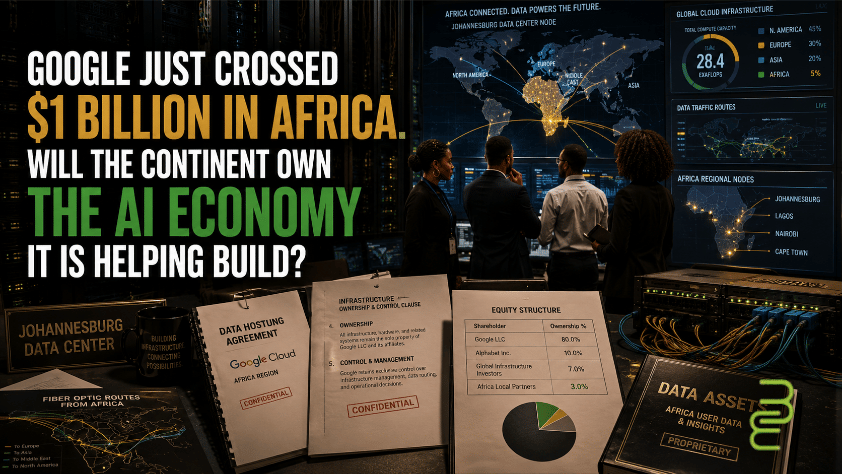
Google has surpassed the five-year, $1 billion Africa investment commitment it announced in 2021.
That is an important milestone. It is not, however, a new $1 billion investment announced all at once.
At the inaugural Africa Cloud Summit in Johannesburg on July 1, Google paired the milestone with new infrastructure, artificial intelligence, training and startup initiatives.
The plans include four connectivity hubs across Africa, beginning in South Africa’s Eastern Cape, and an applied AI laboratory in Ghana connecting startups with Google researchers and models.
The announcement shows where global technology capital is moving.
Cloud infrastructure, subsea cables, AI models, data centers and developer ecosystems are becoming the foundations of economic activity.
The companies controlling those foundations can collect revenue whenever businesses, governments, universities and consumers build on them.
That makes this more than a story about technology access.
It is an ownership story.
Where Google’s money is moving
Google says its cumulative investment has helped finance connectivity, products, research, skills and the infrastructure needed to support artificial intelligence.
The company is adding four strategic subsea-cable connectivity hubs in northern, southern, eastern and western Africa. The first, in the Eastern Cape, will connect with the Umoja cable route linking Africa and Australia, as well as a planned route toward India.
These projects build on Google’s existing African infrastructure footprint, including the Equiano cable along the continent’s western coast and its Johannesburg cloud region.
Google is also expanding access to its AI products.
College students in Egypt, Ghana, Kenya, Morocco, Nigeria, Rwanda, South Africa and Zimbabwe are scheduled to receive one-year Google AI Pro subscriptions. The company says it has trained seven million Africans and plans to train three million more students, teachers and young people by 2030.
Additional initiatives reported by Reuters include:
- An applied AI lab in Ghana.
- A program of more than $1 million with Idris Elba’s Akuna Group to train underrepresented creators in AI storytelling.
- A three-million-rand digital innovation center in Soweto with WeThinkCode.
- Accelerator support for 15 South African companies.
What the public announcements do not provide is a complete category-by-category accounting of the cumulative $1 billion.
That matters.
A dollar spent on a company-owned cable, a cloud facility, startup credits, university research or workforce training can produce very different forms of local ownership and long-term economic value.
The economic benefits are real
Africa needs more digital infrastructure.
President Cyril Ramaphosa spoke at the inaugural Google Cloud Summit. He added, “For far too long, Africa has had to play digital catch-up with the world’s leading and most industrialised economies. We are now presented with a unique opportunity to be in the driving seat of our own industrialisation and growth.”
The continent accounts for less than 1% of global data-center capacity. Even as its mobile-data usage has been growing at roughly 40% annually. Local hosting can improve speed, reduce some connectivity costs and give governments greater regulatory and cybersecurity control.
A regional cloud presence can also help African businesses build and deliver digital services without routing every workload through distant infrastructure.
That can support fintech, healthcare, agriculture, education, retail, media and public services.
Developers gain access to more capable tools. Startups can launch products faster. Universities can participate in advanced research. Businesses may be able to store and process more information closer to customers.
Google is also expanding datasets, evaluations and voice models for more than 40 African languages, with plans to cover more than 50. That could improve the usefulness of AI systems in markets and communities poorly served by English-first technology.
These are meaningful gains.
But they do not settle the ownership question.
Access can still produce dependency
Cloud computing changes how businesses purchase technology.
Instead of buying and controlling all their own servers and software, organizations pay a platform provider for storage, computing power, databases, security systems and AI models.
That can reduce upfront costs. It can also create recurring dependency.
Once an enterprise builds its data, applications and workflows around one provider, changing platforms may become expensive and operationally difficult. The provider can continue earning revenue as customer usage grows.
This is the economic model underneath the investment.
Google funds infrastructure that expands access to Google’s ecosystem. African organizations receive useful tools and capacity. Google gains potential long-term customers for its cloud and AI services.
Both sides can benefit. But the upside is not necessarily divided equally.
Data-center investment has become one of the world’s largest destinations for capital. UN Trade and Development estimated that announced foreign direct investment in data centers exceeded $270 billion in 2025 and represented more than one-fifth of global greenfield investment value. It also warned that the investment remains concentrated and can generate limited spillover benefits for host economies.
The decisive question is whether African participation extends beyond consumption, implementation and maintenance.
Who captures the upside?
Google and Alphabet can capture recurring cloud subscriptions, AI usage fees, enterprise contracts and deeper integration with governments, banks, telecommunications companies and startups.
African telecommunications providers, data-center operators, software companies, systems integrators, energy providers and developers can also benefit.
But durable local value will depend on the structure surrounding the investment.
- Are African companies receiving equity in infrastructure projects?
- Are local suppliers winning significant procurement contracts?
- Can startups build portable products, or will they become permanently tied to one company’s models and cloud services?
- Who owns the applications, datasets and intellectual property produced through sponsored laboratories and accelerator programs?
- Can public institutions move their information to another provider without prohibitive costs?
These questions determine whether Africa is developing an AI industry or primarily becoming a fast-growing customer market for foreign technology companies.
Who carries the risk?
Governments and businesses carry integration risk when essential services depend on an outside platform.
Workers carry the risk of disruption as AI changes administrative, professional and creative jobs.
Local communities can carry infrastructure costs when data centers increase demand for electricity, land and water.
The United Nations’ new scientific panel on AI has warned that access to AI tools does not automatically create equal benefits. Countries dependent on foreign models, cloud infrastructure and data pipelines may gain technical access without gaining meaningful control over standards, safeguards or local adaptation.
That warning applies directly to Africa’s emerging AI economy.
Skills programs are valuable. Model access is valuable. Connectivity is valuable.
Control is different.
Five tests for African economic leverage
Governments, universities, businesses and regional institutions should judge major technology investments against five questions:
1. Ownership: Do African investors, institutions or public entities hold equity in the underlying infrastructure?
2. Procurement: How much spending reaches African-owned construction, energy, software, cybersecurity and professional-service companies?
3. Data control: Who determines where information is stored, how it is used and whether it can be moved?
4. Intellectual property: Who owns the models, applications, language resources and commercial discoveries produced through local partnerships?
5. Workforce development: Are programs creating platform-specific users, or engineers and founders capable of building independent companies and infrastructure?
Public reporting against these tests would make it easier to distinguish genuine ecosystem development from customer acquisition presented as development policy.
What this means for Black economic power
Africa’s AI infrastructure will influence the economic position of Black communities far beyond the continent.
It will affect which languages are represented in AI, which cultural archives are digitized, which businesses can scale globally and which institutions control data generated by more than a billion people.
It may also shape whether African and diaspora creators own new storytelling tools—or supply their work, voices and audiences to platforms that capture most of the commercial value.
Google’s investment is evidence that Africa’s digital economy is valuable.
The continent should use that interest as leverage.
The goal cannot be to reject global capital or technology. The goal should be to negotiate from the understanding that Africa’s markets, talent, languages, data and future customers are economic assets.
Crossing $1 billion is a milestone for Google.
The more important milestone will come when African companies and institutions own a meaningful share of the infrastructure, intellectual property and recurring revenue generated by the AI economy being built around them.
Africa does not need to choose between foreign investment and local ownership. It needs investment structured to produce ownership.
Economic implication
Google’s infrastructure spending can reduce barriers to cloud and AI adoption, but it may also increase the number of African businesses and institutions paying recurring fees to a foreign-owned platform.
The lasting economic outcome will depend on local equity, procurement, intellectual-property rights, data portability and the growth of African-owned infrastructure providers.
Why it matters
Africa is still underrepresented in global computing infrastructure while becoming an increasingly important market for digital services.
Decisions being made now will determine whether the continent captures high-value ownership and platform revenue—or remains concentrated in lower-value implementation, labor and customer roles.

Latest posts by normbond (see all)
- The Atlanta Dream Built the Demand. The Arena Calendar Still Controls the Opportunity. - October 13, 2026
- Black-Founded Vurt Is Taking Vertical Video to TV. The Bigger Question Is Who Controls Distribution. - October 12, 2026
- Owning the Asset Is Not the Same as Controlling the System - October 10, 2026