


UEFA, AFC and CONCACAF now want an independent investigation into Gianni Infantino’s failed commercialization plan. With CAF still backing him, Africa’s question is no longer simply whom to support—but what its support should buy.
The fight over FIFA’s abandoned $20 billion commercial venture has entered a different phase.
UEFA (Union of European Football Associations), the Asian Football Confederation and CONCACAF (Confederation of North, Central America and Caribbean Association Football) have jointly called for an independent review of FIFA President Gianni Infantino’s handling of the proposal to place World Cup and other commercial operations into a new company and sell as much as 20% to outside investors.
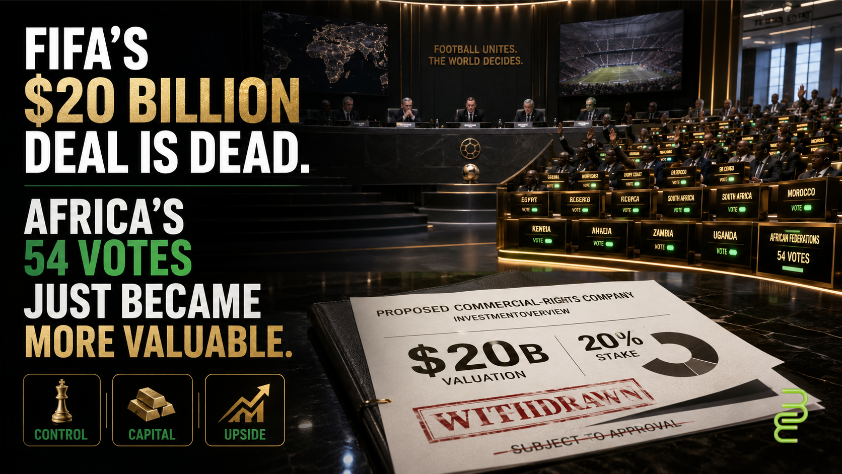
The proposed company was valued at roughly $20 billion, with the outside stake potentially raising about $4.2 billion.
That plan is now dead.
But the economics behind it are not.
The immediate question is no longer whether private investors will gain a stake in FIFA’s commercial machinery.
It is who gets to control that machinery after the deal’s collapse.
And that makes Africa increasingly important.
Africa possesses 54 FIFA votes. The economic question is whether those votes remain political support—or become bargaining power.
The Fight Has Moved From Money to Authority
The original proposal exposed a basic tension inside FIFA.
FIFA could design a corporate structure around some of world football’s most valuable commercial rights.
But it could not create the underlying economic value by itself.
That value depends on national federations supplying teams, players, competitions, supporters and institutional legitimacy.
In other words, FIFA may control the platform, but the product only works because member associations participate.
That distinction matters.
Commercial rights may sit on contracts and balance sheets, but their value ultimately comes from the football ecosystem beneath them.
Once major confederations resisted the proposed structure, the economics changed.
Now UEFA, AFC and CONCACAF have escalated the dispute by calling for a fully independent review and arguing that FIFA itself should not control the process examining what went wrong.
That moves the fight beyond one failed transaction.
It becomes a question of who gets to supervise the people controlling the commercial system.
Africa Controls 54 Pieces of the Political Equation
FIFA has 211 member associations.
CAF (Confederation of African Football) the regional group for Africa represents 54 of them.
That means African football accounts for more than one-quarter of FIFA’s formal membership.
CAF has continued backing Infantino while UEFA, AFC and CONCACAF leadership has moved toward confrontation.
That creates an important distinction between support and leverage.
Support is something an institution gives.
Leverage is what that institution can receive in return.
If African federations are a major part of the coalition capable of stabilizing FIFA’s leadership during a governance crisis, then their votes have acquired additional bargaining value.
The economic question is what Africa does with it.
Development Money Makes the Calculation More Complicated
This is not simply a story about choosing between independence and loyalty.
FIFA is also a major source of football-development capital for national associations.
That means federations can occupy two positions at once.
They have votes in FIFA governance.
They may also depend on FIFA-linked funding for infrastructure, administration, competitions and development.
That creates an imbalance.
A federation may formally possess political power while remaining financially exposed to the institution it is expected to challenge.
So the risk of opposing FIFA leadership is not purely political.
It can also be institutional and economic.
That is why Africa’s position should be evaluated as more than a question of loyalty to Gianni Infantino.
The more useful question is:
What institutional value should 54 votes command?
Voting Power Should Become Negotiating Power
Africa has repeatedly demonstrated its importance to global football through talent, audiences, national teams and commercial growth.
But participation is not the same as control.
And creating value is not the same as capturing it.
A governance crisis creates an opportunity to ask what African football actually owns inside the global commercial system.
Could African federations secure stronger representation over future commercialization decisions?
Could CAF demand more influence over how global football revenue is allocated?
Could member associations push for greater protection around development funding so political disagreement does not threaten financial relationships?
Could Africa negotiate stronger control over regional media rights, sponsorship inventory, intellectual property or commercial development?
There is no public evidence that those specific concessions are currently being negotiated.
But the current dispute reveals why they should be part of the conversation.
Africa possesses votes.
The larger question is whether those votes become durable economic authority.
The $20 Billion Failure Exposed Something Bigger
The most revealing part of the failed transaction may be what it demonstrated about ownership.
Putting FIFA’s commercial operations into a new company could have created an investable asset.
But investors would not have been buying value produced by that corporation alone.
They would have been buying access to a commercial ecosystem built from national federations, players, supporters, sponsors, broadcasters and tournaments.
That means the countries supplying the underlying football product have an economic stake in the governance question even if they do not directly own shares in the proposed company.
This distinction matters well beyond sports.
African and Black communities often participate in economic systems where they create substantial cultural or commercial value without controlling the institution that monetizes it.
Football provides a clear example.
- The talent can be African.
- The fans can be African.
- The markets can be African.
- The growth can be African.
Yet the central economic questions remain:
Who owns the commercial rights?
Who sets the terms?
Who controls distribution?
Who decides how much capital returns to the people and institutions creating the value?
That is why this FIFA fight matters beyond one executive or one failed deal.
It is another version of a much larger economic pattern.
Having something valuable is not the same as negotiating from the value of what you have.
CAF Now Faces Its Own Ownership Question
Supporting Infantino may prove strategically advantageous for CAF.
Opposing him may prove strategically advantageous.
The available public record does not establish which approach would produce better long-term outcomes for African football.
What is clear is that Africa’s bloc matters.
And valuable political capital should not be treated as if it were free.
If 54 African associations help provide the votes or institutional legitimacy needed to stabilize FIFA after one of its biggest recent governance disputes, the conversation should extend beyond loyalty to a president.
- It should include governance authority.
- Commercial participation.
- Revenue control.
- Protection from institutional dependency.
- And a larger voice in deciding how the value created by African football is monetized.
The $20 billion company may be dead.
The struggle over the economics behind it is not.
And before Africa’s institutional support becomes someone else’s political asset, there is a harder question worth asking:
Who owns the upside from Africa’s 54 votes?