



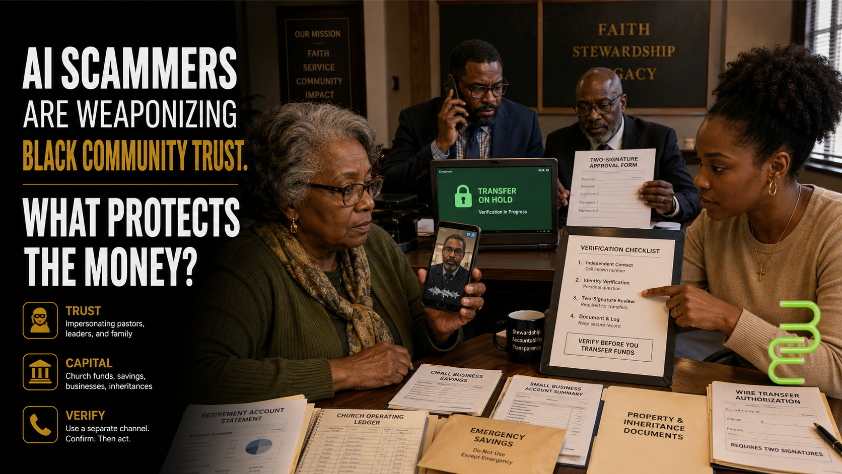
Deepfake voices, fake celebrity accounts, pastor impersonation, and affinity fraud are making deception cheaper and easier to scale. Black families and institutions need financial controls that do not depend on recognizing a face, voice, or social media profile.
A familiar face is no longer proof.
Neither is a recognizable voice, a convincing video call, a pastor’s name on a social media account, or a message that appears to come from a relative.
Artificial intelligence is making it cheaper to imitate the people and institutions we trust.
Criminals can use synthetic voices, altered images, copied profiles, polished messages, and personal information collected online to make a financial request feel authentic.
A recent California case involving someone allegedly impersonating actor Tom Selleck points to a much larger economic threat: scammers can use familiar identities to build trust, isolate a target, and move money.
Authorities have not said that artificial intelligence was used in that particular case, but the reported incident reflects a broader impersonation economy in which public identity and personal trust can be converted into financial leverage.
For Black families, churches, businesses, and community organizations, the threat is not limited to money disappearing from one account.
It can drain retirement savings, church funds, business capital, emergency reserves, charitable donations, and assets intended for the next generation.
AI-enabled fraud is becoming another channel for economic extraction.
Trust is an economic asset
Black communities have long relied on trusted relationships to move information, organize resources, support businesses, respond to emergencies, and help families navigate institutions that have not always served them fairly.
That trust exists inside families, churches, fraternities and sororities, alumni groups, professional networks, nonprofits, mutual-aid organizations, neighborhood associations, and relationships with entertainers, pastors, creators, and public figures.
These networks produce real economic value.
A respected pastor can mobilize donations. A family member can trigger an emergency transfer. A community leader can encourage people to support a business. A celebrity can direct attention toward a product, charity, or investment opportunity.
Scammers understand that value.
They do not have to spend years earning credibility when they can imitate someone who already has it.
Affinity becomes the access point. Trust becomes the distribution channel. Money becomes the extraction target.
The Securities and Exchange Commission describes affinity fraud as investment fraud that preys on identifiable groups, including religious and ethnic communities and older adults. The scammer may belong to the group or merely pretend to share its identity, beliefs, or relationships.
The SEC has pursued cases involving alleged schemes targeting African American communities, Christian investors, and church members. Those cases show how shared identity and faith can be turned into tools for gaining financial access.
AI changes the labor economics of deception
Fraud has always required labor.
Someone had to locate a potential victim, develop a believable story, maintain a conversation, answer questions, overcome hesitation, and move the money without being caught.
Generative AI can reduce the cost of performing many of those tasks.
It can help criminals write polished messages, translate conversations, generate realistic images, imitate voices, research targets, operate multiple identities, and adjust a pitch based on how someone responds.
The economics are straightforward.
When the cost of producing a convincing fake identity falls, scammers can approach more people. They can pursue smaller payments and still make the operation profitable.
A criminal may no longer need to steal $30,000 from one household. An operation may be able to collect $500 from dozens of church members, fans, customers, employees, or relatives.
AI does not create the desire to exploit people.
It can increase the productivity of those trying to do it.
Imposter fraud is already a multibillion-dollar economy
Consumers reported losing approximately $3.5 billion to imposter scams in 2025, according to the Federal Trade Commission. The agency received more than one million imposter-scam reports, and reported losses were nearly three times their 2020 level.
Consumers reported nearly $15.9 billion in total fraud losses during 2025, according to FTC testimony. Those figures reflect only reported cases, meaning the full economic damage may be larger.
Social media has become an important part of the distribution system.
The FTC reported that people lost more money in 2025 to scams that began on Facebook than to scams beginning on any other social media platform. WhatsApp and Instagram ranked a distant second and third.
That does not mean every Facebook message or online relationship is suspicious.
It means platforms designed to connect people can also give criminals access to personal interests, family relationships, religious affiliations, favorite entertainers, grief, financial hardship, and other information that makes deception more persuasive.
Black digital engagement creates value—and exposure
Black cultural participation helps social platforms, entertainers, media companies, creators, churches, and businesses build valuable audiences.
That activity should not be framed as a weakness.
It is an economic asset.
But visible engagement can also provide criminals with information about whom people admire, where they worship, which causes they support, what they are worried about, and which family or community relationships matter most to them.
Pew Research Center found that Black adults were more likely than White adults to use several platforms, including Instagram, TikTok, and WhatsApp. In its 2025 survey, 54% of Black adults reported using Instagram, compared with 45% of White adults.
Black Americans were also more likely than White Americans to regularly get news from YouTube, Instagram, and WhatsApp.
That engagement creates cultural and commercial power. It also means fraud prevention must reflect the platforms and communication habits people actually use.
The lesson is not that Black people should withdraw from digital life.
The lesson is that digital participation now requires stronger verification systems.
A familiar celebrity can become a financial weapon
Celebrity impersonation works because fame creates a preexisting reservoir of trust.
The scammer did not build the career, audience, reputation, or emotional connection associated with the celebrity. But a copied name, image, voice, or social account can allow the scammer to borrow that credibility long enough to make a financial request.
This is a form of unauthorized economic extraction.
- The celebrity owns the identity.
- The platform controls access to the audience.
- The victim owns the money.
The scammer attempts to capture the upside.
The same model can be used with actors, musicians, athletes, pastors, influencers, entrepreneurs, and other prominent figures.
The celebrity may change.
The economic structure does not.
Black aging makes this a wealth-transfer issue
Older adults may control assets accumulated over decades:
- Retirement accounts
- Home equity
- Insurance proceeds
- Savings
- Pensions
- Business interests
- Church contributions
- Property intended for heirs
They may also have less time or earning capacity to replace stolen capital.
The issue is not that older Black adults are incapable of using technology. It is that many have become custodians of assets their families spent generations trying to accumulate.
When scam losses deplete money intended for housing, caregiving, burial costs, education, business formation, or inheritance, the damage reaches beyond one consumer.
Fraud becomes an unauthorized transfer of generational wealth.
A scam can redirect years of accumulated savings before those assets reach children, grandchildren, churches, businesses, or community institutions.
The same loss can create unequal consequences
A scam does not have to empty a wealthy person’s account to destabilize a household with limited liquid savings.
A $5,000 loss can produce radically different outcomes depending on the financial position of the victim.
One family may absorb it from reserves. Another may miss a mortgage payment, rely on high-cost debt, delay medical care, lose transportation, or withdraw financial support from relatives.
That is why this is a Black economic-development issue.
The question is not only how often different groups encounter fraud.
It is also:
- How much financial cushion does the victim have?
- How quickly can the money be replaced?
- Was the payment protected?
- Can the transaction be reversed?
- Will the loss interrupt an inheritance?
- Will relatives or community institutions have to cover the shortfall?
Payment methods matter. The FTC reported that consumers lost more through bank transfers and cryptocurrency than through all other payment methods combined in 2024. These payment channels can make recovery especially difficult once money has been transferred.
The scammer captures the immediate upside.
The household may carry the risk for years.
Challenging economic times make the pitch more persuasive
Scammers do not rely only on celebrity admiration or romantic interest.
They also exploit economic pressure.
A fraudulent message may promise:
- Debt relief
- A grant
- A government benefit
- An investment opportunity
- Business financing
- A remote job
- Emergency assistance
- Cryptocurrency profits
- A church-development program
- Access to a celebrity or prominent leader
When households are struggling with high costs, debt, weak savings, employment uncertainty, or limited access to capital, an opportunity promising relief or income can become more persuasive.
Scammers can exploit generosity as easily as greed.
A grandmother may send money because she believes a grandchild is in danger. A church member may respond because a pastor appears to be requesting emergency help. A small-business owner may transfer funds because a familiar vendor seems to have changed banking information.
The emotional trigger varies.
The economic result is the same: capital moves from a legitimate household or institution into a criminal network.
Black churches are high-value trust networks
Black churches often operate as far more than places of worship.
They may function as communication networks, emergency-assistance providers, senior-support systems, business-referral networks, financial-education centers, political gathering spaces, and stewards of community resources.
That makes them valuable.
It can also make them attractive targets.
A scammer may impersonate:
- A pastor requesting urgent assistance
- A finance officer changing payment instructions
- A church member facing an emergency
- A vendor submitting a new invoice
- A ministry leader collecting donations
- A nonprofit partner offering a grant
- A denominational official requesting private information
The Black church’s growing use of donor platforms, livestreams, member databases, mobile communications, and online banking creates opportunities for greater reach and service.
But digital power without financial controls can become digital exposure.
Churches and community organizations need more than cybersecurity software. They need clear rules governing who may request money, who may approve it, how identities are verified, and what happens when suspicious communication appears.
Recognition is no longer verification
For years, consumers were advised to request a photograph, phone call, or video conversation before trusting someone online.
Those checks are becoming less reliable.
A familiar voice can be cloned.
A photograph can be generated.
Caller ID can be manipulated.
A social media account can be copied.
A video conversation may no longer provide sufficient proof on its own.
That does not mean people are powerless.
It means verification must move away from appearance and toward process.
The question is no longer:
Does this look or sound like someone I know?
The better question is:
Did this request pass an independently established verification procedure?
The Black Community Trust Protection Protocol
Verify through a separate channel
Do not confirm a request through the same number, email address, social media account, or conversation that delivered it.
End the contact. Then call the person or institution through a number already stored or independently verified.
Require two-person approval
Churches, nonprofits, businesses, and family caregiving arrangements should require two authorized people to approve unusual transfers, gift-card purchases, new payees, vendor changes, or emergency payments.
No single person should be able to respond to an urgent digital request by moving significant funds without review.
Establish a private verification process
Families and leadership teams should create a private word, question, or procedure that is not posted online.
A verification phrase should be treated as one layer of protection, not the only one.
Never change payment instructions through email or direct message alone
Changes to vendor accounts, payroll information, donation platforms, or wire instructions should require confirmation through an established contact.
An email that appears authentic may still come from a compromised or copied account.
Treat secrecy as a financial warning
A request to hide a transaction from relatives, church officers, trustees, coworkers, or financial institutions should trigger an immediate pause.
Legitimate leaders and relatives should not object to independent verification.
Create a mandatory waiting period
Families and organizations should consider a waiting period for unusual transfers unless an independently verified emergency procedure applies.
Urgency should increase scrutiny, not eliminate it.
Protect community data
Church directories, prayer requests, staff charts, birthdays, family relationships, travel schedules, and member information can help scammers personalize an approach.
Access should be limited to people who need it.
Establish no-shame reporting
People often delay reporting because they feel embarrassed.
That delay gives criminals more time to move the money and approach other people in the same network.
Families and institutions should make early reporting a sign of responsibility, not failure.
Run fraud simulations
Churches and organizations conduct fire drills.
They should also test how staff and volunteers respond to a fake executive request, altered invoice, cloned voice, suspicious donation appeal, or message that appears to come from a pastor.
Who should carry the responsibility?
Consumers must use caution, but this cannot remain only an individual-responsibility story.
Social platforms control account access, messaging, identity policies, recommendation systems, reporting tools, and significant amounts of behavioral data.
Banks and payment companies control transaction monitoring, payment speed, fraud alerts, holds, and recovery procedures.
Telecommunications companies carry calls and messages.
AI companies influence access to tools capable of generating voices, images, video, and text.
These institutions may not knowingly participate in fraud. But they control much of the infrastructure through which fraud is distributed and monetized.
The ownership question is unavoidable:
Why does the consumer carry most of the financial risk when corporations control so much of the data, distribution, identity, and payment infrastructure?
Protecting money is economic development
Black economic development is not only about generating new income.
It is also about protecting what Black households and institutions have already built.
Every dollar preserved from fraud remains available for housing, retirement, business investment, education, caregiving, charitable work, and inheritance.
That makes scam prevention more than a consumer-awareness issue.
It is wealth preservation.
It is institutional governance.
It is digital literacy.
It is community infrastructure.
As artificial intelligence makes false identities more convincing, Black families and organizations cannot rely only on recognizing the person asking for money.
The face may be familiar. The voice may sound right. The process still has to verify the request.
Economic implication
AI is lowering the cost of producing persuasive impersonations while increasing the number of people a criminal operation can approach.
This shifts fraud from labor-intensive, one-on-one deception toward a more scalable model of automated outreach, personalization, and financial extraction.
Households and community institutions carry the direct financial damage, while platforms, payment systems, telecommunications companies, and technology providers control much of the infrastructure through which the activity occurs.
Why it matters
For Black communities, fraud can become another channel through which accumulated wealth leaves families and institutions before it can support ownership, stability, or inheritance.
A scam loss can interrupt mortgage payments, church programs, business plans, retirement, caregiving, and intergenerational transfers.
Protecting existing capital is part of building Black economic power.
Question for you
Does your family, church, business, or organization have a verification rule for urgent money requests—or are you still relying on recognizing someone’s face and voice?