



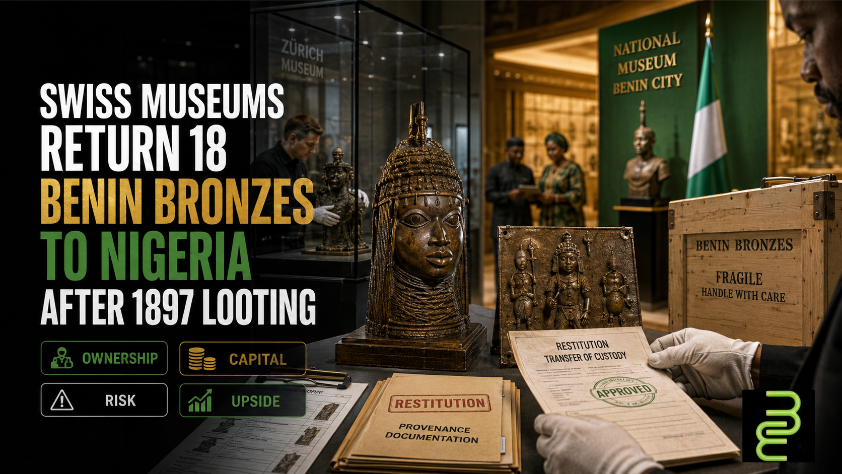
Three Swiss museums have returned 18 Benin Bronzes to Nigeria, marking another important step in the global reckoning over looted African cultural property.
The objects were returned by the Ethnographic Museum at the University of Zurich, Museum Rietberg Zurich, and the Musée d’Ethnographie de Genève.
Nigeria’s National Commission for Museums and Monuments formally received the artifacts at a ceremony at the National Museum in Lagos on behalf of the Federal Republic of Nigeria.
The Swiss government described the items as courtly and religious objects from the Kingdom of Benin, looted at the end of the 19th century.
The surface story is about museums.
The deeper story is about ownership.
For more than a century, African cultural wealth helped Western institutions build prestige, attract visitors, educate audiences, raise donor money, strengthen research authority, and position themselves as global stewards of civilization.
That value was not abstract.
Museums do not only preserve objects. They control access, interpretation, scholarship, exhibition economics, donor relationships, licensing, tourism flows, and cultural legitimacy.
That is why the return of the Benin Bronzes matters economically.
The Cultural Asset Was Never Just Cultural
The Benin Bronzes are among the most famous examples of African artistic and political sophistication.
They include plaques, heads, figures, and courtly objects connected to the Kingdom of Benin, located in what is now Nigeria.
They were looted in 1897 after a British military expedition attacked Benin City. Afterward, thousands of objects were dispersed into museums and private collections around the world.
That history matters because the objects did not simply sit quietly in European collections.
They helped build institutional value.
They gave museums rare holdings. They supported exhibitions. They drew scholars, tourists, donors, and students. They helped Western institutions tell stories about African history while often controlling the terms of that storytelling.
In economic terms, the Benin Bronzes became cultural capital.
The question is who had the right to benefit from that capital.
Restitution Shifts Control
Switzerland’s return is part of a wider movement around colonial-era collections and museum accountability.
The Benin Initiative Switzerland, launched in 2021 and led by Museum Rietberg, involved eight Swiss museums and Nigerian partners. The project researched the provenance of Benin works in Swiss collections, and those findings helped support restitution decisions.
That matters because provenance research is not just academic housekeeping.
It is an audit of ownership.
When museums investigate how objects entered their collections, they are also investigating whether institutional value was built on stolen cultural property.
That creates pressure not only to acknowledge harm, but to return control.
The 18 returned objects now shift legal and cultural authority back toward Nigeria.
But return is not the final economic question.
It is the beginning of a new one.
Who Controls the Value Next?
Once artifacts return, new questions emerge.
- Who controls exhibition rights?
- Who decides where the objects are displayed?
- Who receives tourism revenue?
- Who funds conservation?
- Who gets research access?
- Who owns the digital archive?
- Who benefits from books, documentaries, licensing, educational programs, museum partnerships, and cultural diplomacy?
These questions matter because restitution can become either a symbolic transfer or an economic reset.
If the objects return but the surrounding value chain remains controlled elsewhere, the economic power shift is limited.
If Nigeria and Edo cultural institutions can build strong public access, conservation infrastructure, scholarship, tourism strategy, and creative industry partnerships around returned heritage, the upside becomes much larger.
That is where restitution begins to connect with development.
The Labor Behind Cultural Return
The return of cultural property also creates labor questions.
Museums need conservators, curators, historians, archivists, educators, security teams, designers, guides, researchers, translators, digital archivists, and public programming staff.
Cultural restitution can support a wider heritage economy if the infrastructure is funded and managed well.
That economy can include museum jobs, tourism jobs, creative production, local hospitality, academic partnerships, documentary projects, publishing, educational curricula, and diaspora travel.
But the labor opportunity depends on whether returned objects are treated as living cultural assets, not just stored symbols.
The Benin Bronzes can support jobs and institutions if they become part of a serious long-term cultural strategy.
The Risk Moves Too
Restitution also transfers responsibility.
Nigeria gains control, but also carries the risk of conservation, security, governance, infrastructure, and public trust.
That risk should not be used as an excuse to keep stolen objects abroad. Western museums have often framed themselves as safer custodians, even while many of their collections were built through colonial violence, weak provenance, or unequal power.
But the risk is still real.
Returned objects need preservation systems. They need transparent governance. They need public access. They need protection from political disputes, elite capture, neglect, and underfunding.
The economic opportunity is strongest when return is paired with investment.
That includes museum capacity, conservation labs, community access, cultural education, and tourism planning.
Why This Matters for Black Communities
For Black communities across the diaspora, the Benin Bronzes are not only Nigerian heritage.
They are part of a larger story about how Black cultural production has been extracted, displayed, monetized, and interpreted by institutions that did not create it.
That pattern is not limited to museums.
It shows up in music, fashion, sports, media, technology, data, language, aesthetics, and labor.
Black culture creates value. The recurring question is who owns the system that captures it.
The Benin Bronzes make that question impossible to ignore.
When African cultural assets are held in European museums, the prestige, tourism, donor capital, research access, and institutional authority often accumulate in Europe.
When those objects return, a different possibility opens.
Nigeria can build cultural power at home. The diaspora can reconnect through heritage tourism and education. African institutions can claim authority over African history. Black creators and scholars can engage with returned objects on different terms.
That is the real economic implication.
The return of 18 Benin Bronzes is not just about correcting the location of art.
It is about correcting the direction of value.
The Bigger Ownership Question
The next stage of restitution will not be measured only by how many objects return.
It will be measured by who controls the future around them.
- Who controls the museums?
- Who controls the archives?
- Who controls the scholarship?
- Who controls the tourism strategy?
- Who controls the digital images?
- Who controls the story?
For more than a century, the Benin Bronzes helped Western museums build cultural authority from African heritage.
Their return to Nigeria signals a power shift.
But the full value of that shift will depend on whether cultural ownership becomes economic infrastructure.
The objects are coming home.
Here’s the economic lesson. Cultural restitution is not only about returning objects. It is about rebuilding the systems that determine who controls value, access, labor, and long-term upside.
Share Your Take
What is the real ownership question in this story: the return of the objects, or control over the value they create next?

Latest posts by normbond (see all)
- Who Owns the Upside From Power? 50 Cent’s Variety Interview Reveals a Bigger TV Economics Story - October 20, 2026
- Burkina Faso Rejected a U.S. Deportation Deal. Then the Fight Moved to Visa Access. - October 19, 2026
- NC A&T Students Marched 45 Minutes to Vote. The Bigger Story Is Who Controls Access. - October 17, 2026