


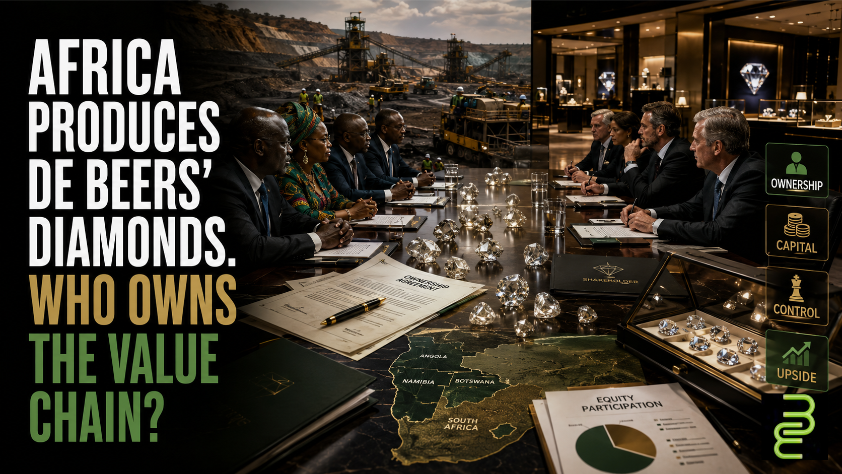
Anglo American’s move to select a preferred buyer for its 85% stake in De Beers is not just a corporate sale.
It is a test of whether African diamond-producing countries can move from supplying raw wealth to controlling more of the value created from it.
Reuters reported that Anglo selected the Global Diamond Consortium as the preferred buyer for its De Beers stake. The Global Diamond Consortium (GDC) is an investment group led by former De Beers CEO Gareth Penny.
Botswana, which already owns 15% of De Beers, is now weighing whether to exercise its right of first refusal, join the preferred buyer, or bring in another partner. Namibia and Angola have also shown interest in the transaction.
That makes this more than a diamond industry story.
It is an ownership story.
Botswana Already Supplies the Stones
Botswana is not a minor stakeholder in the De Beers system.
The country already owns 15% of De Beers. It is also central to the company’s production base, with the Financial Times reporting that Botswana supplies about 70% of De Beers’ diamonds.
That fact changes the economic meaning of the sale.
If a country supplies most of the diamonds but does not control the company, the brand, the pricing channels, the marketing machine, or the downstream customer relationships, then the country may remain powerful in geology but limited in commercial control.
That is the gap this transaction exposes.
Botswana has the resource. De Beers has the global brand, the sales architecture, the relationships, and the history of shaping diamond demand.
The economic question is whether Botswana can turn mineral importance into corporate leverage.
“If African countries produce the stones, carry the economic dependence, and absorb the market shocks, they have a strong case for more control over the company, the brand, and the downstream profits.”
The Real Asset Is Not Only the Diamond
For African diamond-producing states, the value chain does not end at extraction.
The money moves through mining, sorting, grading, cutting, polishing, branding, retail relationships, luxury marketing, data, financing, and distribution.
Whoever controls De Beers controls more than mines.
They influence how diamonds are priced, how scarcity is managed, how customers are reached, how markets are defended against lab-grown competition, and where long-term margins accumulate.
That matters because the diamond market is under pressure. Anglo put De Beers up for sale in 2024 as part of a broader restructuring during a period of falling diamond prices and rising competition from synthetic diamonds.
The Financial Times also reported that weaker demand in China and lab-grown competition have added pressure to the sector.
So the sale is happening at a complicated moment.
The asset is still globally recognized, but the market around it is changing.
That creates both risk and opportunity.
Who Captures the Upside?
If Botswana increases its stake, the upside could be larger than dividends.
A stronger ownership position could give Botswana more influence over strategy, production decisions, beneficiation, employment, skills development, local processing, and how much of the diamond economy stays in-country.
It could also help shift the country from being mainly a source of stones to being a more powerful player in branding, sales, and long-term value capture.
But ownership is not automatic power.
A larger stake also requires capital, governance capacity, market expertise, and the ability to manage a global luxury business during a downturn.
Botswana officials appear to understand that. Reuters reported that Botswana is working with financial advisers to determine the optimal transaction structure, and that officials emphasized the importance of a stable, well-funded operator.
That is the hard part.
Buying more of De Beers could increase control. But it could also increase exposure if diamond prices remain weak, if consumer demand keeps shifting, or if the company needs major investment to defend its market position.
The Regional Signal: Botswana, Namibia, and Angola
The interest from Namibia and Angola makes this a broader African economic story.
A coordinated African ownership position could change the meaning of the deal.
Instead of outside capital simply buying control over an African resource company, diamond-producing states could push for a structure that keeps more decision-making closer to the countries that supply the stones.
Angola has already shown interest in De Beers. Reuters reported earlier in 2026 that Angola was seeking a 20% to 30% stake, setting up the possibility of competition or coordination with Botswana.
That raises a strategic question.
Will African producers negotiate separately, or can they align around a shared value-chain strategy?
Separate bids may secure national advantage.
A coordinated position could build regional leverage.
The difference matters.
Diamonds are not only exports. They are fiscal revenue, foreign exchange, employment, infrastructure, and industrial policy.
The Risk: Africa Supplies, Others Control
The structural risk is familiar across many resource economies.
African countries supply the raw material while external investors, trading houses, luxury brands, financial institutions, and global distributors capture the higher-margin layers.
In diamonds, the gap can be especially sharp because the public sees the finished product as luxury, romance, scarcity, and status.
But the producing country often faces the volatility: commodity cycles, mine employment, fiscal dependence, environmental obligations, and public pressure when revenues fall.
That is why this sale matters.
If the next ownership structure leaves African states with limited say over strategy, the result may be another version of the old model: African resources, external control, uneven value capture.
If Botswana and regional partners secure meaningful ownership with operating influence, the deal could become a case study in converting resource wealth into corporate power.
What This Means for Black Economic Development
For BlackEconomicDevelopment.com, the story is bigger than De Beers.
It is about whether Black-majority nations can control the economics of the assets that come from their land, labor, and markets.
Ownership is the difference between participating in a value chain and shaping it.
Botswana’s decision will not be simple. A larger stake could increase leverage, but it could also increase financial risk at a time when diamonds face pressure from weaker demand and lab-grown alternatives.
Still, the strategic issue is clear.
If African countries produce the stones, carry the economic dependence, and absorb the market shocks, they have a strong case for more control over the company, the brand, and the downstream profits.
The De Beers sale will show whether that case can be converted into ownership.
And ownership is where the real diamond value may be decided.
Economic Implication
This transaction is about value-chain control.
Botswana already has geological leverage because it supplies a large share of De Beers’ diamonds, but the sale will determine whether that leverage becomes corporate control over pricing, branding, distribution, beneficiation, and long-term profit capture.
Why It Matters
For Black economic development, the story shows the difference between resource ownership and commercial power. A country can own the land and supply the commodity while still lacking control over the company, customer relationships, luxury brand value, and financial upside.
Ownership Question
Can Botswana, Namibia, and Angola turn diamond production into control of the diamond company — or will African states remain suppliers while outside capital controls the highest-value layers?
Latest posts by normbond (see all)
- Beyoncé Funded Cécred Herself. Now the Real Test Is Global Distribution. - October 2, 2026
- Africa Doesn’t Own Most of the World’s AI. It Still Controls Something AI Companies Need: Access. - September 29, 2026
- Michael Jordan Gave Morehouse $1 Million. Now It Has a Media Production Center. - September 26, 2026