



For decades, reparations have often been presented to the public as a moral argument about whether governments and institutions should acknowledge the lasting damage caused by enslavement and colonialism.
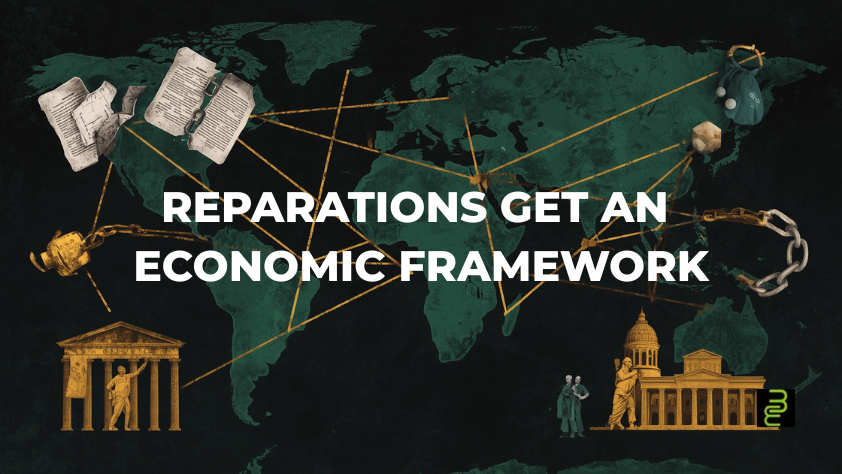
A framework adopted in Accra, Ghana, on June 19, 2026, pushes the conversation deeper into economic territory.
Government leaders and other officials adopted an 18-point global framework for reparatory justice that calls for fair compensation for Africans and people of African descent, faster restitution of cultural property and measures addressing sovereign debt, including restructuring, relief and cancellation.
The framework does not create a binding financial settlement. It does not establish a payment amount, compel a country to cancel debt or immediately transfer museum collections.
What it does create is shared economic and legal architecture.
That distinction matters.
A moral demand asks institutions to recognize harm.
An economic framework begins asking who owes what, which assets should move, who will control them and which institutions will enforce the outcome.
From recognition to financial mechanisms
The Accra framework expands the reparations discussion beyond direct cash payments.
Compensation remains part of the agenda, but so do public debt, cultural assets, human remains, archives, heritage, international law and institutional coordination.
That creates several possible channels through which reparatory justice could affect economies:
- Direct compensation from states or institutions
- Sovereign-debt relief or cancellation
- Transfers of cultural property and associated intellectual value
- Investment in education, health, infrastructure and development
- Legal settlements involving governments, corporations or religious institutions
- New financing structures serving African and diaspora communities
The economic significance lies in the possibility of moving reparations from isolated demands into coordinated negotiations involving states, regional organizations and international institutions.
That possibility is still far from guaranteed.
But the framework changes the starting point. Instead of debating only whether repair is justified, participating officials are beginning to define the mechanisms through which repair could occur.
Debt cancellation could be one of the largest stakes
The framework’s inclusion of sovereign debt may prove more economically consequential than the public conversation about individual payments.
Debt service absorbs government revenue that could otherwise support infrastructure, schools, health systems, industrial development and social investment. When a country must prioritize external creditors, its policy choices narrow.
Debt cancellation or restructuring framed as reparatory justice would therefore involve more than reducing a balance sheet.
It could change who controls public spending.
The central question is whether debt relief would create durable fiscal space for African governments. Or simply postpone financial pressure without changing the underlying systems that produce dependency.
Implementation would also require difficult decisions.
Which debts would qualify? Would relief apply only to obligations held by former colonial powers, or also to multilateral lenders and private bondholders? Would governments receiving relief be required to direct the savings toward specific development priorities?
Without transparent rules, debt cancellation could benefit public budgets without necessarily improving household conditions.
The economic test is not only whether debt disappears. It is whether the freed capital reaches communities, productive industries and public institutions.
Restitution is also an ownership issue
The framework calls for accelerating the return of cultural property, human remains, archives and heritage to their places of origin.
Restitution is frequently described as a matter of dignity and historical truth. It is also an ownership and revenue issue.
Museums, universities and private collections have built prestige, visitor traffic, research authority and licensing opportunities around African cultural objects. Those institutions have often controlled how the objects are displayed, interpreted, reproduced and monetized.
Returning an artifact changes more than its physical location.
It can transfer control over:
- Exhibition revenue
- Image and reproduction rights
- Academic access
- Tourism value
- Cultural interpretation
- Digital archives
- Brand partnerships
- Educational products
But return alone does not guarantee economic benefit.
Countries and communities receiving cultural property will need conservation infrastructure, secure facilities, research capacity and clear governance. Decisions must also be made about whether national governments, traditional authorities, local communities or independent cultural institutions should control returned assets.
The ownership question cannot end when the shipping crate arrives.
It must include who governs the asset after its return and who captures the value it generates.
Three panels could shape implementation
The Accra gathering also established three panels focused on reparatory justice, cultural restitution and legal strategy. Ghanaian President John Mahama described them as support structures intended to help governments and institutions move from recognition toward implementation.
These panels will operate alongside existing African Union and Caribbean mechanisms.
Days before the framework’s adoption, the African Union and CARICOM convened their principal reparations bodies for a first joint meeting.
Participants agreed to coordinate research, legal strategy, diplomatic engagement, education and civil-society participation. The bodies also established plans for regular coordination.
That institutional infrastructure matters because reparations claims cross jurisdictions.
The history involved is transcontinental. So are the banks, governments, museums, universities, religious institutions and corporations that could become parties to future negotiations.
A coordinated legal strategy may help countries avoid negotiating alone against institutions with far greater financial and technical resources.
Still, panels do not move capital by themselves.
Their value will depend on whether they produce specific claims, credible valuations, negotiating mandates, legal pathways and public accountability.
Who would finance reparatory justice?
The framework raises a question that will become harder to avoid: who pays?
Potential sources include national governments, former colonial powers, corporations with documented historical ties to enslavement, religious institutions, universities, financial institutions and foundations built with wealth connected to colonial extraction.
Different forms of repair would require different financing models.
Debt cancellation would involve creditors accepting losses or changing repayment terms.
Cultural restitution would transfer assets and could require funding for preservation and transportation.
Development programs might rely on grants, long-term funds, trust structures or contributions from multiple governments and institutions.
Direct compensation would require standards for eligibility, administration and distribution.
Each model creates a power question.
Who sets the value of the harm? Who chooses the recipients? Who manages the fund? Who audits the process? Who decides whether money goes to individuals, governments, institutions or community-controlled vehicles?
A reparations system administered entirely by creditor nations or large international institutions could reproduce the same power imbalance it claims to address.
Black communities and African nations will therefore need more than a seat at the table. They will need meaningful authority over valuation, governance and distribution.
The risk of symbolism without transfer
The new framework is important, but declarations should not be mistaken for completed repair.
The Accra document is a basis for collaboration rather than a binding settlement. Its immediate value is political and institutional.
The danger is that governments celebrate the framework while delaying the financial commitments required to make it real.
There are several warning signs to watch:
- Panels that meet without publishing timelines or deliverables
- Restitution agreements that preserve control for European institutions
- Debt relief that comes with new austerity conditions
- Reparations funds managed without affected communities
- Compensation formulas that undervalue extracted labor and assets
- Public apologies that substitute for material repair
Progress should be measured through capital movement, transferred ownership and changed economic conditions—not only conferences and statements.
Why this matters to Black communities
For Black communities across Africa and the diaspora, the reparations debate is ultimately about the distribution of assets, opportunity and economic power.
The question is not simply whether history will be acknowledged.
It is whether that acknowledgment changes balance sheets, public budgets, cultural ownership, investment capacity and the institutions that determine who benefits from global wealth.
CARICOM’s existing 10-point reparations plan already treats repair as broader than a check. It includes formal apology, repatriation, cultural institutions, public-health investment and development measures.
The global framework adopted in Accra may help connect those demands to a wider international strategy.
Its success will not be determined by the strength of its language.
It will be determined by whether the framework can convert historical responsibility into enforceable obligations, returned assets, reduced debt burdens and community-controlled capital.
That is the economic line to follow next.
Economic implication
The framework broadens reparations from an argument about recognition into a negotiation over balance sheets, sovereign obligations, cultural assets and institutional control.
The largest potential economic effects may come from debt relief, restitution and long-term development financing rather than one-time individual payments.
The unresolved question is governance: whether affected countries and communities will control reparatory assets and funds, or whether existing international institutions will retain decision-making power.
Where the money could move
Money and value could move through debt cancellation, direct compensation, development funds, cultural-property transfers, museum and tourism revenue, legal settlements and investments in health, education and infrastructure.
Who captures the upside
African governments could gain fiscal space. Communities and cultural institutions could gain ownership of returned assets. Black-led legal, research, preservation and financial institutions could also gain new roles.
The upside will be limited, however, if creditor governments, multinational institutions or national elites retain control over implementation.
Who carries the risk
African taxpayers and communities carry the risk if promised debt relief never materializes, if governments misuse freed funds or if restitution occurs without resources to preserve and monetize returned assets.
Reparations advocates also face the risk that a nonbinding framework will produce years of process without enforceable transfers.
Ownership question
Who will own and govern the assets, funds, archives and institutions created through reparatory justice—and who will have the power to decide how their value is distributed?
Why it matters
This is a test of whether global institutions are willing to shift resources and authority, not merely recognize historical harm.
For Black communities, the strongest outcome would combine repair with ownership: community-controlled capital, stronger public institutions, returned cultural assets and reduced dependence on external creditors.

Latest posts by normbond (see all)
- Burkina Faso Rejected a U.S. Deportation Deal. Then the Fight Moved to Visa Access. - October 19, 2026
- NC A&T Students Marched 45 Minutes to Vote. The Bigger Story Is Who Controls Access. - October 17, 2026
- Black Family Wealth Fell 25%. The Ownership Gap Is the Bigger Story. - October 16, 2026







Asian and Native Americans have already received reparations. Why is another framework required for us?