


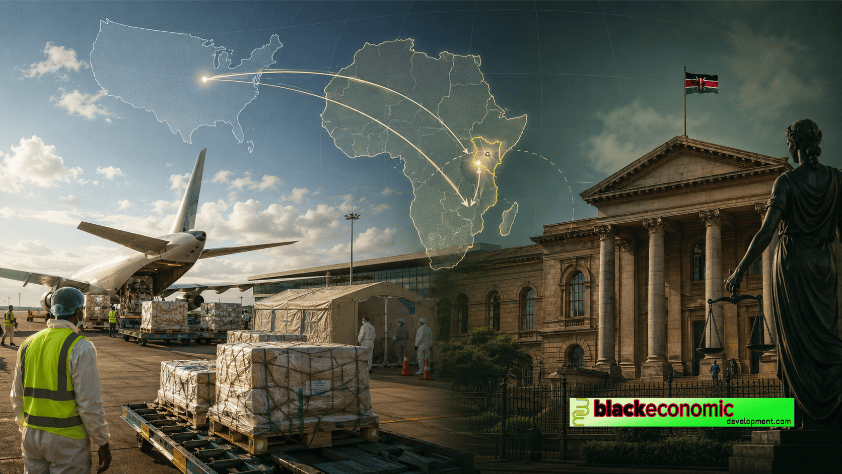
A Kenyan court has temporarily blocked a U.S. plan to establish an Ebola quarantine facility in Kenya for Americans exposed to the virus abroad, according to reports from the Associated Press and Reuters. The proposed facility was reportedly tied to Laikipia Air Base and would have included 50 quarantine beds for Americans exposed to the Bundibugyo strain of Ebola spreading in northeastern Congo.
On the surface, this is a public health story.
Underneath, it is an economic power story.
The question is not only whether exposed Americans should be quarantined near the outbreak region.
The deeper question is whether a wealthy country can move a dangerous public health risk into an African country while avoiding the political cost of bringing that risk home.
That is the economics of outsourced risk.
What Kenya was being asked to absorb
U.S. officials said the facility would be used for Americans exposed to Ebola while abroad instead of immediately flying them back to the United States. Reuters reported that the site under discussion was an air force base in Laikipia, central Kenya, and that the facility would be staffed by personnel from the U.S. Public Health Service.
The U.S. position appears to be built around speed, logistics and containment.
But Kenya’s backlash shows a different calculation.
Kenyan medical workers, civil society groups, and legal advocates raised concerns about public health risk, consultation, and national biosecurity. The Associated Press reported that Kenya’s doctors’ union threatened to strike, while legal challenges cited health risks and insufficient public participation.
That matters because quarantine facilities are not just medical spaces.
They are political spaces.
They require trust, staffing, transport systems, legal authority, public communication, waste handling, emergency protocols, and confidence that the host population is not being treated as disposable.
Where the money is moving
The reported U.S. commitment included $13.5 million toward Kenya’s Ebola preparedness efforts.
That funding is important. African countries need stronger public health infrastructure, and outbreak preparedness is not optional in a connected world.
But the economic question is sharper:
Was Kenya receiving long-term public health investment — or being paid to host risk that the U.S. did not want to carry at home?
That distinction matters.
If the money builds durable Kenyan capacity, strengthens laboratories, trains health workers, improves emergency response, and leaves Kenya better prepared after the crisis, the arrangement could have public value.
But if the money mainly supports a foreign-controlled facility designed to manage foreign citizens while Kenyan communities absorb the perceived exposure risk, then the deal looks different.
It becomes a transaction over risk.
Who owns the decision?
This is where the court ruling becomes bigger than one facility.
Kenya’s High Court did not simply interrupt a health plan. It asserted that public health decisions involving foreign governments, national territory, and disease exposure cannot be treated as administrative shortcuts.
The assets at stake include:
- Land and air base access.
- Public health infrastructure.
- Health worker labor.
- Emergency response capacity.
- Legal authority.
- Public trust.
- National sovereignty.
Those are economic assets.
They determine who can operate, who gets protected, who gets paid, and who gets exposed.
BlackEconomicDevelopment.com’s editorial lens is built around this exact question: who owns, funds, controls, profits from, or is exposed by the story?
In this case, Kenya’s court, doctors, lawyers, and public institutions pushed back against a deal where the power to decide appeared to sit too heavily with Washington and too lightly with Kenyan citizens.
Who captures the upside?
The United States could benefit by avoiding the domestic politics of bringing Ebola-exposed Americans directly onto U.S. soil.
It could also reduce transport complexity by placing a quarantine facility closer to the outbreak region.
Kenya could benefit from funding, diplomatic leverage, stronger preparedness systems, and deeper international health cooperation.
But the upside is uneven.
The U.S. gets risk distance.
Kenya gets responsibility.
Kenyan health workers may get the labor burden. Kenyan communities may carry public fear. Kenyan institutions may absorb the trust cost if the public believes the arrangement was negotiated without enough transparency.
That is why this story should not be framed as anti-Americanism or panic.
It is about the price of sovereignty.
Why this matters beyond Kenya
African countries are often asked to provide strategic assets to global powers: military access, health logistics, minerals, data, labor, land, migration enforcement, climate offsets, and humanitarian response capacity.
Each request may come with money.
But money does not automatically equal power.
The question is whether the deal increases local control or deepens dependency.
In public health, this tension is especially sensitive. Global disease response requires cooperation. No country can manage major outbreaks alone.
But cooperation becomes unequal when one country gets to export its political risk and another country is expected to absorb the public health anxiety.
That is the danger Kenya’s backlash exposed.
The Black diaspora angle
For Black communities across the diaspora, this story connects directly to a larger pattern: African nations are too often treated as logistical space for global crises rather than equal partners with full decision-making power.
The issue is not whether Kenya should participate in Ebola response.
Kenya has an interest in regional health security. Ebola outbreaks in Central and East Africa can affect trade, travel, tourism, labor mobility, public spending, and investor confidence.
The issue is who designs the arrangement.
- Who controls the facility?
- Who decides who enters the country?
- Who pays Kenyan health workers?
- Who owns the emergency protocols?
- Who answers if something goes wrong?
- Who benefits after the crisis ends?
Those are not side questions. They are the economic center of the story.
The ownership question
The ownership question here is not about a company or a celebrity brand.
It is about control over national risk.
A quarantine facility is not just a tent, a hospital bed, or a medical unit. It is a decision about whose lives are prioritized, whose land is used, whose workers are mobilized, and whose public trust is put on the line.
Kenya’s court pause signals that African sovereignty is not just symbolic. It can be operational.
- It can stop a deal.
- It can force disclosure.
- It can make governments answer to citizens before answering to foreign partners.
That is a power shift worth watching.
Economic implication
This case reveals how public health emergencies can become markets for risk transfer.
Wealthier countries may seek to move exposure, containment, labor demands, and political backlash outside their own borders. Host countries may receive aid, infrastructure, or diplomatic benefits, but they may also inherit public distrust and operational risk.
For African governments, the challenge is not rejecting global cooperation.
The challenge is negotiating it from a position of transparency, public accountability and long-term national benefit.
Why it matters
Kenya’s Ebola quarantine fight shows that foreign aid is never just money.
- It can be leverage.
- It can be infrastructure.
- It can be dependency.
- It can be a public good.
Or it can become compensation for accepting risks another country does not want to carry.
For Black communities and the African diaspora, the question is not only what the U.S. wanted to do in Kenya.
The question is what kind of economic relationship African nations are being asked to accept in moments of crisis.
Because when risk moves, money moves.
And when money moves, power is usually close behind.

Latest posts by normbond (see all)
- Burkina Faso Rejected a U.S. Deportation Deal. Then the Fight Moved to Visa Access. - October 19, 2026
- NC A&T Students Marched 45 Minutes to Vote. The Bigger Story Is Who Controls Access. - October 17, 2026
- Black Family Wealth Fell 25%. The Ownership Gap Is the Bigger Story. - October 16, 2026