


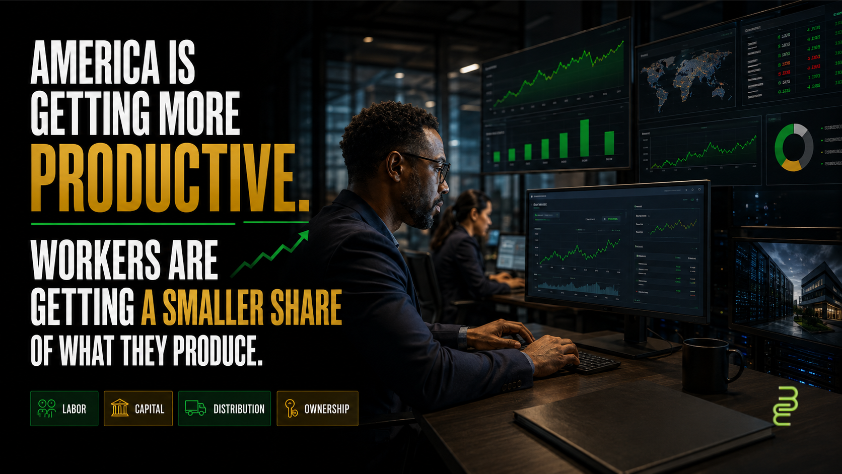
U.S. productivity rose in the second quarter, but labor’s share of economic output fell to a record low. Now, a weaker July jobs report adds another warning: workers are capturing less of the economy at the same time the labor market is losing momentum.
America is becoming more productive.
That should be good economic news.
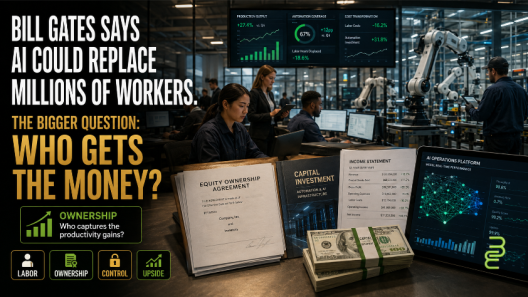
But two new federal reports point to a harder question: Who is actually capturing the value of that productivity?
The Bureau of Labor Statistics reported that nonfarm business productivity increased at a 1.4% annualized rate in the second quarter of 2026. Output increased 1.7%, while hours worked increased just 0.3%.
At the same time, labor’s share of output fell to 52.9%, down from 53.7% in the first quarter and the lowest level since the BLS series began in 1947.
That means more economic output is being produced, but workers are receiving a smaller share of it.
Now, the July employment report adds a second warning.
U.S. nonfarm payrolls fell by 23,000 in July, according to the Bureau of Labor Statistics. Over the prior year, payroll gains had averaged just 34,000 per month.
Local government education lost 50,000 jobs. Retail employment declined by 19,000.
The broader message is becoming difficult to ignore:
Workers are capturing less of what the economy produces at the same time the labor market supporting their wages is weakening.
A weaker jobs market makes the ownership question more urgent
The July jobs report materially changes the context around the productivity numbers.
The two trends are now colliding: workers are receiving a smaller share of what the economy produces just as the labor market is beginning to weaken.
Payroll employment turned negative in July, adding to evidence that the labor market is losing momentum.
That does not mean the economy is in a broad employment collapse.
But it does mean workers are entering a more fragile environment at the same time their share of economic output has fallen to a historic low.
For Black workers, the position is even more exposed.
- Black unemployment stood at 6.3% in July, compared with 3.6% among White workers.
- The Black unemployment rate improved from 6.6% in June, but that headline alone does not tell the full story.
- Black labor-force participation also declined.
That matters because a lower unemployment rate does not automatically mean stronger household employment security when fewer people are participating in the labor market and overall payroll employment is shrinking.
Black workers are entering this slowdown with unemployment still far above the White rate.
That creates a very different level of exposure to labor-market risk.
Productivity is rising. That does not tell us who gets paid.
Productivity measures how much output is produced for each hour of work.
In the second quarter, output increased faster than hours worked.
That is one reason productivity rose.
But productivity growth does not automatically determine how the gains are distributed.
Businesses can use productivity gains in several ways.
They can raise wages.
They can lower prices.
They can expand hiring.
They can reinvest in operations.
Or increased efficiency can improve margins and ultimately benefit owners and shareholders.
That is why the defining economic question of the AI era may not simply be:
Will AI replace workers?
It may be:
Who owns the productivity gain when technology allows businesses to produce more without a proportionate increase in labor costs?
The ownership question sits underneath the AI debate
AI, automation, software and other forms of capital investment are increasingly part of how businesses raise productivity.
Reuters has reported that economists see AI and broader capital investment as among the forces helping companies increase output without equivalent increases in hiring.
But an important distinction is necessary.
The BLS data show that productivity rose and labor’s share fell.
They do not prove that AI alone caused the decline in labor’s share.
AI is part of a larger capital-investment story.
The more important issue is how the economic value created by those investments gets divided.
Imagine a business that can serve twice as many customers after installing new software.
The workers may become far more productive.
But the software does not automatically determine where the financial gain goes.
Workers primarily participate through compensation.
Owners participate through something different:
equity.
Equity gives its holder a claim on the upside when businesses become more productive, more profitable or more valuable.
That difference becomes more consequential when labor’s share of output is falling.
Why this hits differently for Black households
This distribution question is unfolding in an economy where asset ownership remains deeply unequal.
Black households remain less likely than White households to hold large amounts of stock, business equity and other financial assets.
Federal Reserve data have shown a substantial racial wealth gap, even as Black stock ownership and business ownership improved in recent years.
That matters because an economy that shifts more rewards toward capital can widen wealth inequality even without explicit discrimination in the underlying technology.
The technology itself does not have to discriminate.
An unequal starting distribution of ownership can produce unequal outcomes.
If productivity gains increasingly flow toward people who own companies, stocks, intellectual property, software systems and other productive assets, households with less ownership participate less fully in the upside.
At the same time, those households may remain heavily dependent on wages.
That creates an economic imbalance.
Workers can be exposed to job loss, weaker hiring and wage pressure while owning relatively little of the capital generating the productivity gains.
Black workers face a double exposure
The new jobs data sharpen that point.
Black workers are not only operating in an economy where labor is capturing a historically small share of output.
They are also entering a weakening labor market from a structurally higher unemployment base.
That creates what can be understood as double exposure.
The first exposure is labor-market risk.
If hiring slows or layoffs increase, workers who depend primarily on wages lose income security.
The second exposure is ownership risk.
If productivity gains increasingly reward capital, households with less stock ownership, business equity and other productive assets have less access to the upside.
For Black households, both sides of that equation matter.
A weaker labor market can hurt wage earners.
A stronger capital economy can still create wealth.
But if the same households are underrepresented in ownership, they may experience more of the downside than the upside.
This is bigger than wages
The conventional response to productivity growth is often a conversation about whether workers deserve higher pay.
That conversation matters.
But wages alone do not solve the ownership question.
A worker who receives a raise gains more income.
A worker who also owns stock, retirement assets, business equity, intellectual property or other productive assets gains another channel through which wealth can compound.
That is the deeper Black economic challenge emerging alongside AI.
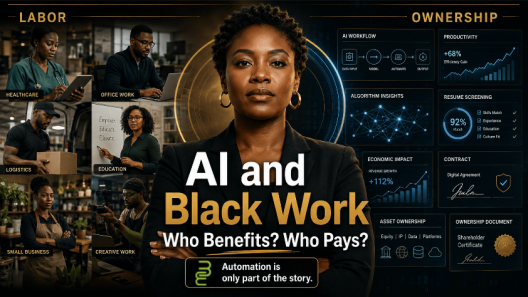
How do Black workers move from participating primarily as labor to participating more substantially as owners of the capital becoming more productive?
- That can include greater retirement-plan participation.
- It can include stock ownership.
- It can include scalable Black-owned businesses using AI to expand margins and output.
- It can include creator ownership of intellectual property and audience data.
- It can include employee ownership structures.
- It can include stronger access to business capital.
And it can include public policy designed to broaden ownership rather than assuming productivity gains will automatically reach households through wages.
The productivity boom has a distribution problem
Higher productivity can expand the economy’s potential.
- It can support higher wages.
- It can lower costs.
- It can improve profitability.
- It can create new industries and new businesses.
But productivity is not a distribution system.
Ownership, bargaining power, corporate decisions and public policy determine much of what happens next.
The second-quarter productivity report and the July jobs report now tell complementary parts of the same story.
America is producing more per hour of labor.
Labor is receiving a historically small share of that output.
And monthly payroll employment has now turned negative.
For Black workers and households, the stakes are higher because unemployment remains well above the White rate while financial and business asset ownership remains substantially lower.
That means the central AI-era economic question is becoming larger than job displacement.
It is about who owns the systems increasing productivity.
It is about who has enough bargaining power to capture higher wages.
It is about who has enough equity to participate in rising profits and enterprise value.
And it is about who carries the risk when labor markets weaken.
If workers have less bargaining power and households own too little of the capital generating productivity gains, who captures the next wave of economic growth?
That may be one of the most important Black economic development questions of the decade.
Economic implication
The new productivity and employment data point to a growing distribution challenge.
More output is being produced, but labor is capturing a smaller share of it. At the same time, payroll employment weakened in July.
That makes ownership of productive capital increasingly important.
The economic issue is not simply whether AI eliminates jobs.
It is whether workers and households own enough of the assets generating the next wave of productivity growth.
Why it matters
Black workers face higher unemployment than White workers and Black households hold less stock, business equity and overall wealth.
If labor’s share of output continues to decline while returns to capital become more important, unequal asset ownership can translate into wider wealth inequality.
The question is not only who works in the AI economy.
It is who owns it.
Ownership question
Is the bigger AI risk job loss, weaker worker bargaining power, or unequal ownership of the productivity gains?

Latest posts by normbond (see all)
- HUD Is Investigating Wells Fargo’s Black Homeownership Programs. The Stakes Go Beyond One Bank. - October 8, 2026
- How Warren Thompson Turned Corporate Contracts Into a Black-Owned Hospitality Empire - October 7, 2026
- Beyoncé Funded Cécred Herself. Now the Real Test Is Global Distribution. - October 2, 2026