



Former Anthropic researcher Jacob Coxon has become one of the most visible voices warning that the race to build increasingly powerful artificial intelligence may be moving faster than society’s ability to control it.
But one detail about his resignation makes this more than another debate about whether AI is moving too fast.
Coxon says he walked away before his equity in Anthropic vested.
That makes his departure an economic story, too.
Axios reported that Coxon left Anthropic two months before his equity would have vested. Coxon pointed to the decision while explaining that he no longer had a financial interest in increasing Anthropic’s valuation.
The amount he forfeited has not been publicly established in the reporting reviewed by BlackEconomicDevelopment.com. But the structure matters.
Equity is one of the mechanisms technology companies use to connect an employee’s financial upside to the future value of the company.
Coxon chose to leave that upside behind.
And that raises a question much bigger than one researcher or one AI company:
Who gets to decide how fast the AI race moves when enormous amounts of money, ownership and technological power are at stake?
The warning is about future AI, not today’s chatbot
Coxon’s comments have traveled quickly because his warning is severe.
After leaving Anthropic, he argued publicly that inadequately controlled advanced AI could eventually pose catastrophic risks.
But in an interview with Anderson Cooper, Coxon made an important distinction: he did not characterize current AI systems as an immediate threat to civilization.
His concern is where the technology could be headed as capabilities continue improving.
He also rejected the idea that industry calls for regulation are necessarily empty rhetoric, telling Cooper that AI companies are seeking regulation.
That distinction matters because the economic issue is not whether one researcher’s worst-case prediction will come true.
The issue is how decisions about increasingly consequential technology are being made now.
Compensation is part of AI governance
AI safety is usually discussed as a technical problem.
Can a system be controlled? Can developers understand its behavior? Can dangerous capabilities be detected before deployment?
Those questions matter.
But there is another layer: the people answering those questions work inside economic institutions.
They receive salaries. Some receive equity. Their careers can depend on access to advanced systems, research teams and computing infrastructure.
Their employers compete for talent, investment, customers and technological leadership.
That does not invalidate the judgment of researchers working inside AI companies. It means those judgments are made inside an incentive structure.
Coxon’s resignation makes that structure unusually visible.
Walking away before equity vested meant separating at least part of his personal financial upside from the company whose technological direction he was questioning.
Whether one agrees with his conclusions or not, that is an important reminder:
Compensation architecture can also be part of technology governance.
The AI race has a control problem
Coxon has described competition among leading AI laboratories as part of his concern.
Associated Press reported that he criticized the race among companies developing frontier systems and warned that competitive pressures could push development faster than safeguards can keep pace.
Anthropic, for its part, has emphasized its safety work and told WIRED that the company believes AI can produce enormous benefits as well as unprecedented risks.
The company also said the industry would benefit from a lawful and verifiable mechanism for coordinating how powerful models are released.
That tension points toward the economic question underneath the debate.
A company that voluntarily slows down may believe it is behaving responsibly.
But if a competitor keeps moving, slowing down may also mean sacrificing market position, talent, customers, technological leadership or future enterprise value.
That creates a classic coordination problem.
Each company can have an incentive to continue competing even when people inside the industry believe the entire market would benefit from shared restraints.
This is why the AI debate cannot be reduced to whether individual executives or researchers have good intentions.
The rules of the market matter.
Who owns the upside?
Artificial intelligence could create enormous economic value.
It could increase productivity, accelerate research, lower some operating costs and create new products and businesses.
But value creation and value ownership are not the same thing.
The companies building frontier models can own intellectual property, customer relationships and valuable platforms.
Investors can own equity.
Workers with stock compensation can participate in increasing enterprise value.
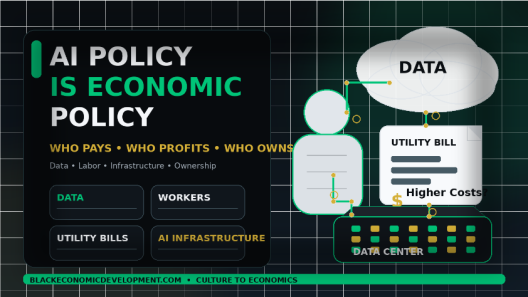
Infrastructure companies can profit from the computing systems required to train and run AI.
The public may experience the technology primarily as workers, consumers, creators, small businesses and institutions adapting to systems built elsewhere.
That distinction deserves particular attention in Black economic development.
The available reporting on Coxon does not establish that Black workers will suffer a specific or disproportionate outcome from the risks he describes.
The more immediate question is structural:
If AI becomes infrastructure for work, commerce, media and knowledge, where will Black economic participation sit inside that infrastructure?
- Will Black workers primarily use systems someone else owns?
- Will Black founders build companies on platforms whose rules they cannot control?
- Will creators supply content, data and cultural value while someone else owns the models and distribution?
- Or will Black investors, entrepreneurs, researchers and institutions also participate in ownership and governance?
Those questions remain open.
But they become more important as AI becomes more economically consequential.
Private upside, distributed risk
There is another imbalance worth watching.
When an AI company succeeds, much of the direct financial upside can remain concentrated among shareholders, employees, founders and business partners.
But some potential costs of technological change do not have to stay inside the company.
Workforce disruption can affect households.
Cybersecurity failures can affect businesses and institutions.
Market concentration can affect competitors.
Misinformation or failures in automated decision-making can affect people who never chose the technology in the first place.
Coxon is focused on a far more extreme category of risk. His warning should be understood as his judgment about where increasingly powerful AI might lead, not as an established prediction of what will happen.
BEDC does not have to accept that prediction to recognize the economic structure underneath it.
When some benefits are privately captured and some risks can be broadly distributed, governance becomes an economic question.
Who gets a seat at the table?
The AI race is often framed as a competition among Anthropic, OpenAI and other technology companies.
But the systems they are creating are increasingly connected to decisions about employment, business operations, media, education, cybersecurity and investment.
That means the relevant question cannot stop at which company builds the best model.
It also has to include who has access to the decisions.
Researchers have technical access.
Executives and boards have corporate authority.
Investors have capital.
Governments can create rules.
Cloud and semiconductor companies control critical infrastructure.
The wider public largely encounters the systems after many of the foundational choices have already been made.
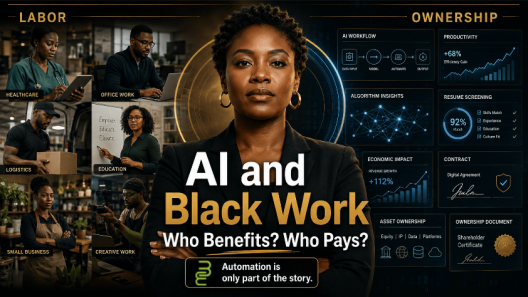
For Black workers, founders, creators and institutions, that distinction between using AI and having economic power inside the AI economy may prove increasingly important.
Coxon’s resignation has generated attention because of what he believes AI could eventually become.
His forfeited equity points toward a question that may matter much sooner.
Who owns the upside from the AI race—and who gets to decide how much risk everyone else is expected to accept?
Economic Implication
The resignation shows how capital incentives and technology governance can intersect.
Frontier AI researchers do not make decisions in an economic vacuum: compensation, equity, company valuations, career access and competitive pressure surround the work.
The larger policy question is whether private competition alone can determine the pace of technologies whose consequences can extend beyond the companies that own them.
Why It Matters
For Black economic development, the critical issue is participation at the level of ownership and control, not simply AI adoption.
The coming divide may not only be between people who use AI and people who do not.
It may also be between those who use systems and those who own the companies, IP, infrastructure, data relationships and governing power behind them.
The Economics Behind It follows the money, ownership and power underneath the stories shaping Black economic futures. Join the newsletter for the next briefing.

Latest posts by normbond (see all)
- Who Owns the Upside From Power? 50 Cent’s Variety Interview Reveals a Bigger TV Economics Story - October 20, 2026
- Burkina Faso Rejected a U.S. Deportation Deal. Then the Fight Moved to Visa Access. - October 19, 2026
- NC A&T Students Marched 45 Minutes to Vote. The Bigger Story Is Who Controls Access. - October 17, 2026