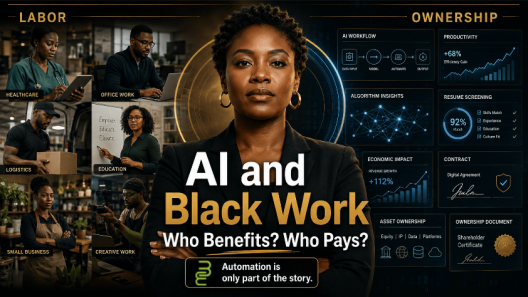



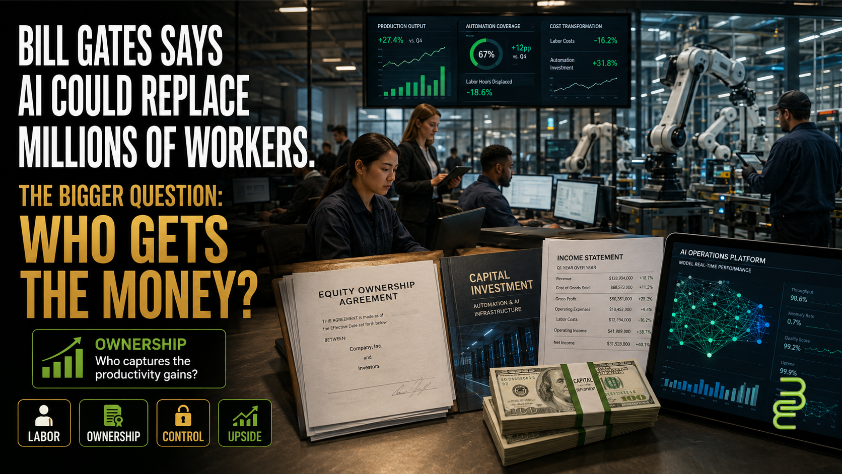
Bill Gates is warning that AI could permanently reduce the need for human labor. For Black workers, the issue may go beyond job loss. The deeper question is who owns the technology, capital and businesses capturing the productivity gains.
Bill Gates is warning that artificial intelligence could do something far more disruptive than eliminate a few categories of jobs.
It could change the economic relationship between work, income and ownership.
In an August 26 essay, Gates argues that AI will increasingly substitute for human cognition and eventually affect industries ranging from customer service and software engineering to law, medicine, manufacturing and physical labor.
His concern is not simply that workers will have to learn new skills.
He believes some jobs may disappear permanently.
And if that happens at scale, the bigger question is not only who still gets to work.
It is who gets the money when machines do more of the work.
For BlackEconomicDevelopment.com, this warning lands inside a conversation we have already been tracking.
In 2025, BEDC examined McKinsey research suggesting generative AI could put Black workers at substantial economic risk, particularly because Black workers are overrepresented in several jobs vulnerable to automation. And because many of those jobs serve as important pathways into middle-income careers.
That earlier analysis focused on exposure.
Gates pushes the question further.
What happens if AI does not merely change jobs, but reduces the amount of human labor the economy needs?
At that point, reskilling is still important.
But reskilling alone may not solve the wealth problem.
AI could shift income from labor to ownership
For most households, employment remains the main connection to the economy.
People sell their labor. Employers pay wages. Workers use those wages to pay for housing, food, transportation, healthcare and everything else that keeps the economy moving.
Governments also depend heavily on that system through income and payroll taxes.
Gates argues that AI could disrupt both sides of the arrangement.
If companies need fewer employees or fewer hours of human labor, household income could decline at the same time governments collect less employment-related tax revenue.
Meanwhile, the productivity created by automation does not disappear.
It goes somewhere.
Some of it may show up in lower prices.
Some may become higher profit margins.
Some may increase returns to shareholders.
Some may accrue to the companies that own the models, platforms, robotics systems, intellectual property and infrastructure powering the technology.
That is where the economics becomes more complicated.
The question is no longer simply whether AI creates new jobs.
It becomes:
If human labor produces a smaller share of economic output, what gives ordinary people a claim on the wealth that replaces it?
That is an ownership question.
BEDC has already seen the warning signs for Black workers
Our previous McKinsey-focused analysis raised a concern that AI could disproportionately affect Black workers because of where many Black workers are concentrated across the labor market.
The concern was not simply unemployment.
It was also the potential erosion of career ladders.
Jobs in customer service, administrative work, data entry and similar occupations often function as entry points into broader economic mobility.
If AI reduces those jobs, workers could lose both current wages and access to the experience that helps them move into higher-paying roles.
That makes Gates’ warning especially important.
He argues that entry- and mid-level jobs are among those most at risk and that young workers may enter a labor market with fewer entry-level openings.
The two stories connect.
The earlier BEDC question was:
Which Black workers are most exposed to AI disruption?
The Gates question forces a harder follow-up:
What if there are simply fewer jobs to retrain into?
That is where the conversation shifts from workforce preparation to economic structure.
Companies may have strong incentives to automate
Gates describes a competitive cycle that could accelerate AI adoption.
One company introduces AI or robotics and lowers its operating costs.
Its competitors then face pressure to do the same.
If established businesses hesitate, startups designed around lower-cost automation can enter the market and challenge them.
That means automation may spread even when employers understand the social consequences.
From the perspective of an individual company, replacing an expensive task with cheaper technology can be rational.
Across an entire economy, however, the same decision repeated thousands of times could produce significant displacement.
Gates argues that as AI becomes more reliable and requires less human checking, businesses will have an even stronger financial incentive to let it operate independently.
That makes AI adoption more than a technology trend.
It is also a story about competition, cost pressure and who controls productive capacity.
Black workers could lose more than wages
For Black workers, the economic risk is not limited to job loss.
It could include loss of career progression.
Entry-level work often provides three things at once:
income,
experience,
and access.
Those jobs help workers learn professional systems, build networks and qualify for better-paying positions.
If AI removes some of those roles, workers may lose not only wages today but career capital tomorrow.
That could make existing racial wealth gaps harder to close.
BEDC’s previous coverage raised this concern from a workforce perspective.
Gates’ argument broadens it.
If automation eventually affects both white-collar and blue-collar work, the pressure may not remain confined to a handful of occupations.
That means the key question for Black economic development cannot only be:
How do we help people find the next job?
It also has to be:
How do we help people build economic claims that do not depend entirely on wages?
AI could also give Black businesses new leverage
The story is not only about downside.
Gates argues that AI could give individuals and small businesses access to capabilities that today require larger staffs or expensive professional services.
That could matter enormously for Black-owned businesses operating with limited capital or small teams.
AI could potentially lower the cost of:
- research;
- administration;
- customer service;
- marketing;
- software development;
- data analysis;
- financial modeling;
- and other business functions.
A small company might gain capabilities that previously required a much larger staff.
A founder who could not afford specialized professional support may be able to automate portions of that work.
That creates real opportunity.
But it also introduces an important ownership distinction.
Using AI is not the same as owning AI.
A Black business may become more productive by subscribing to an AI platform.
The company that owns the platform collects recurring revenue from thousands or millions of businesses doing the same thing.
The user gains efficiency.
The owner captures platform economics.
That difference matters.
Access to AI is not the same as owning the upside
One of AI’s promises is that powerful capabilities once available only to large companies could become widely accessible.
That could expand access.
But access alone does not answer the wealth question.
If more economic value flows toward the owners of AI models, chips, data centers, software platforms, robotics systems and intellectual property, society could become more productive while remaining highly unequal.
Gates himself warns that AI could become either a major equalizer or a source of deeper injustice depending on how the transition is managed. He also argues that, without intervention, the benefits could accrue to a relatively small group.
That brings BEDC to the central ownership question:
Will Black communities primarily use AI—or own economically meaningful pieces of the AI economy?
The answer could determine whether AI functions mainly as a productivity tool or also becomes a wealth-building platform.
The Black economic issue may be moving from jobs to assets
This is the point where the Gates story goes beyond our earlier McKinsey analysis.
The previous question centered on protecting workers from displacement.
That remains important.
But if Gates is correct that the economy may need less human labor over time, then workforce protection cannot be the entire strategy.
The conversation has to expand toward assets.
- Who owns the companies deploying AI?
- Who owns equity in the companies becoming more productive?
- Who owns the intellectual property?
- Who owns the data?
- Who owns the infrastructure?
- Who controls the distribution?
- Who receives the profits?
Those questions determine where the gains accumulate.
For Black economic development, AI preparation cannot stop at teaching people how to use AI tools.
It also has to include:
business ownership, equity ownership, intellectual property, capital formation and access to productive assets.
If labor becomes less economically valuable relative to capital, ownership becomes more important, not less.
Gates wants governments to tax AI and robots
One of Gates’ most consequential proposals is also one of the most economic.
He argues that governments should consider taxing AI tokens and robots.
His reasoning is straightforward.
Employers who hire workers pay payroll taxes.
Businesses that purchase automation may receive tax treatment that makes capital investment financially attractive.
Gates believes that can create an incentive to substitute machines for people.
He argues that taxing AI and robots could slow that substitution somewhat while generating revenue for retraining and a stronger social safety net.
Whether governments ultimately adopt that proposal is another question.
But Gates is pointing to a structural problem.
The tax system was built around an economy where human employment remained one of the central sources of income and government revenue.
What happens if machines produce more while people work less?
Governments would still need money.
Workers displaced by automation could need more assistance.
Communities experiencing concentrated job losses could need investment.
Yet the employment-based tax base could weaken at precisely the moment public support becomes more expensive.
That means AI policy could eventually become tax policy.
Should every job that can be automated be automated?
Gates also introduces an idea he calls Human Reserved.
The concept is that societies may deliberately decide some functions should remain human even if machines become technically capable of performing them.
Caregiving is one example he raises.
A machine might eventually perform certain tasks, but Gates argues that some forms of human care carry social value that should not automatically disappear simply because automation becomes technically possible.
That creates another economic tension.
Markets reward efficiency.
Societies also value employment, human contact, dignity, community stability and people’s ability to earn income.
The AI economy may force governments to decide how those values should be balanced.
The Black economic question is bigger than retraining
The dominant public response to AI and work has been skills.
- Workers are told to retrain.
- Students are told to prepare for new careers.
- Businesses are told to adopt AI.
All of those responses matter.
BEDC’s previous coverage reflected that reality by emphasizing future-proof skills and preparation for an AI-shaped labor market.
But Gates’ argument suggests the next phase of the conversation has to go further.
If machines increasingly perform productive work, training people for different jobs does not completely solve the distribution problem.
Ownership becomes more important.
- Who owns the company?
- Who owns the model?
- Who owns the robot?
- Who owns the intellectual property?
- Who owns the infrastructure?
- Who receives the profit?
- Who holds equity in the businesses becoming more productive?
Those questions determine where the gains accumulate.
For Black economic development, that means AI strategy cannot stop at workforce readiness.
It has to include ownership readiness.
The transition may arrive before the policy does
Gates argues that governments and institutions are not adequately prepared for the changes he expects.
He calls for new national and international systems capable of addressing AI’s effects across employment, taxation, education, national security, energy, health and other sectors.
Whether all of his predictions prove correct remains uncertain.
But his central economic warning deserves attention.
AI is not simply another workplace tool.
If it significantly reduces the amount of human labor businesses need, it could alter the economic bargain around employment itself.
For Black workers, the question cannot only be:
What job should I train for next?
For Black businesses, it cannot only be:
What AI tool should I buy?
For Black institutions, it cannot only be:
How do we increase AI literacy?
Those questions matter.
But another question sits underneath all of them:
Who will own the productive assets of the AI economy?
BEDC’s earlier reporting asked whether AI could cost Black workers billions in lost economic opportunity.
The next stage of the story is even bigger.
If AI shifts economic power from labor toward capital, then the future of Black work cannot be separated from the future of Black ownership.
That is the economics behind it.
Why It Matters
The economy traditionally connects most households to production through employment.
AI could weaken that connection.
If Gates is correct that fewer workers may eventually be needed across major sectors, Black economic strategy cannot rely exclusively on workforce participation.
Skills and employment remain critical.
But so do:
business ownership, equity, capital formation, intellectual property and participation in the infrastructure producing AI-driven value.
The danger is not simply unemployment.
It is an economy where productivity rises while ownership remains concentrated.
And that makes the next question unavoidable:
If AI replaces more labor, who owns enough of the upside to still get paid?

Latest posts by normbond (see all)
- Who Owns the Upside From Power? 50 Cent’s Variety Interview Reveals a Bigger TV Economics Story - October 20, 2026
- Burkina Faso Rejected a U.S. Deportation Deal. Then the Fight Moved to Visa Access. - October 19, 2026
- NC A&T Students Marched 45 Minutes to Vote. The Bigger Story Is Who Controls Access. - October 17, 2026