

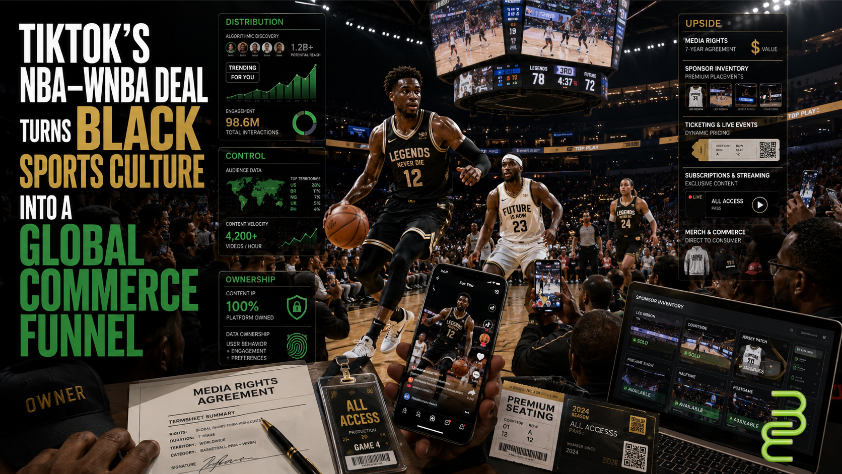
TikTok, the NBA and the WNBA have announced a multiyear global partnership designed to move basketball fans from short-form videos toward official league content, schedules and live broadcasts.
The agreement includes TikTok GamePlan, creator access to major league events, official highlights and advertising opportunities connected to NBA and WNBA programming.
Financial terms were not disclosed.
On the surface, this is a social media and fan-engagement deal.
Economically, it is a distribution and data agreement that could shape who controls the relationship between basketball audiences and the money generated from their attention.
TikTok is building a bridge from the feed to the broadcast
TikTok GamePlan allows leagues, teams and broadcasters to attach in-app links to sports content.
Those links can direct users toward official accounts, game schedules and information about where to watch live broadcasts.
That makes TikTok more than a place where basketball clips circulate.
The platform is positioning itself inside the conversion pathway between discovery and commercial action.
A fan may first encounter a highlight, player interview or creator reaction in the TikTok feed.
From there, the platform can help move that user toward a broadcast, subscription, ticket, sponsor message or other league-related product.
The NBA said its TikTok GamePlan activation during the 2026 NBA Finals generated 497 million impressions. A related “Tap to Watch” feature produced more than 426,000 referrals to broadcasts.
Those numbers show why the partnership matters.
TikTok is demonstrating that it can influence not only what sports fans watch, but also what they do next.
Black sports culture supplies much of the demand
The commercial value of professional basketball cannot be separated from Black athletic labor and Black cultural influence.
Black players produce much of the competition, personality and cultural relevance that make the NBA and WNBA globally marketable.
Their playing styles, fashion, rivalries, interviews, music connections and off-court identities help turn games into cultural events.
Independent creators add another layer of value.
They produce commentary, humor, analysis, edits, reactions and fan conversations that keep basketball visible between games.
TikTok benefits from that activity.
Every view, search, replay, share and comment produces engagement data. That data can improve recommendations, increase time spent on the platform and create more valuable advertising inventory.
The athletes create the performance.
The leagues control the official rights.
Creators extend the conversation.
TikTok controls much of the discovery system.
Who owns the fan relationship?
The NBA and WNBA enter the partnership with major economic assets.
They control league brands, official footage, schedules, event access, sponsorship inventory and broadcast relationships.
According to the partnership announcement, the NBA and WNBA’s official TikTok accounts have a combined global following of approximately 30 million.
TikTok brings a different kind of power.
It controls the recommendation algorithm, user interface, behavioral data and the digital pathway through which many fans encounter basketball content.
That distinction is important.
The leagues may know who buys a ticket, watches through a media partner or purchases merchandise.
TikTok can observe what users searched for, watched repeatedly, skipped, shared and discussed before they took that action.
That behavioral information helps platforms determine which content to promote, which audiences to target and which advertising opportunities can command higher prices.
The partnership may help the NBA and WNBA reach younger and more international audiences.
But reach does not automatically equal ownership.
The economic question is whether the leagues, teams, players and creators will gain meaningful access to the audience intelligence generated through the partnership—or whether TikTok will retain the most complete view of the fan journey.
The WNBA faces a major opportunity—and a strategic risk
The agreement comes as interest in women’s basketball continues to expand.
Ministry of Sport reported that global interest in WNBA-related content on TikTok had risen by approximately 15% during 2026. Interest in NBA content increased by nearly 30%.
The partnership will also give selected creators access to major events, including WNBA All-Star Weekend.
That exposure could help the WNBA attract new viewers, increase sponsorship value and reach fans who may not regularly consume traditional sports media.
But the league also faces a strategic tradeoff.
The WNBA’s long-term economic value depends on its ability to build direct and durable relationships with fans.
Those relationships can support ticket sales, merchandise, subscriptions, memberships, newsletters, digital products and future media offerings.
When discovery happens primarily through an outside platform, the league remains exposed to algorithm changes, shifting platform priorities and limited access to first-party customer data.
The immediate benefit is reach.
The long-term risk is dependence.
Who captures the upside?
TikTok gains premium sports content, increased engagement and more valuable advertising inventory.
It also strengthens its position as a platform capable of moving users from entertainment discovery toward live-event consumption.
The NBA and WNBA gain broader global distribution and a potentially more efficient path from social attention to broadcasts, subscriptions, tickets and sponsor exposure.
Media partners may receive additional viewers.
Selected creators may receive access, visibility and monetization opportunities.
Players could benefit indirectly if the partnership increases league revenue, sponsorship demand and the commercial value of individual athlete brands.
But the upside will not necessarily be distributed equally.
Players may generate enormous engagement without receiving direct compensation tied to platform advertising or audience data.
Independent creators may help sustain basketball culture online while remaining dependent on unpredictable algorithmic visibility.
Smaller Black-owned sports media companies may contribute analysis and audience development without gaining access to the partnership’s most valuable commercial infrastructure.
The people producing the culture can still sit downstream from the companies controlling its distribution.
Who carries the risk?
TikTok carries the cost of building and maintaining the platform infrastructure, but athletes, creators and leagues carry a different type of risk.
Their visibility depends partly on a recommendation system they do not control.
A change in the algorithm could reduce reach overnight.
A change in platform policy could affect monetization, content access or referral traffic.
The WNBA also risks allowing TikTok to capture valuable audience relationships that the league could otherwise develop through its own websites, apps, newsletters and direct subscription products.
Creators face similar exposure.
They may gain attention through the partnership without gaining ownership of the audience, customer data or recurring revenue layer connected to that attention.
The larger Black economic question
Black culture repeatedly creates demand for platforms it does not own.
That pattern appears across music streaming, social media, sports broadcasting, fashion, entertainment and the creator economy.
- Black talent produces the performance.
- Black audiences help establish relevance.
- Black creators amplify the moment.
But the recurring revenue layer often belongs to the platform, rights holder, advertiser or investor positioned between the culture and the customer.
The TikTok partnership does not automatically mean the NBA, WNBA, players or creators are being exploited.
The leagues could generate substantial value from TikTok’s reach. Players and creators may also benefit from larger audiences and new commercial opportunities.
But the agreement highlights a structural question that should follow every major platform partnership involving Black culture:
When Black labor and Black cultural influence generate the attention, who owns the data and the conversion pathway?
Views create visibility.
Owned audience relationships create leverage.
The next phase of Black sports economics will depend not only on who appears in the content, but also on who controls the systems that turn attention into recurring revenue.
Economic implication
TikTok is becoming part of professional basketball’s commercial infrastructure.
By connecting highlights, creator content and fan conversations directly to live-game discovery, the platform can influence the path from cultural attention to broadcasts, advertising, subscriptions and ticket sales.
Why it matters
Black athletes and creators help generate basketball’s global cultural value, but they do not control TikTok’s platform, recommendation system or much of the audience data produced around that value.
The deal shows why digital economic power depends on more than visibility.
It depends on ownership of distribution, customer information and the route from attention to revenue.
Ownership question
When Black athletes and creators generate the attention, who owns the customer data and the path from the feed to the purchase?
Latest posts by normbond (see all)
- Who Owns the Upside From Power? 50 Cent’s Variety Interview Reveals a Bigger TV Economics Story - October 20, 2026
- Burkina Faso Rejected a U.S. Deportation Deal. Then the Fight Moved to Visa Access. - October 19, 2026
- NC A&T Students Marched 45 Minutes to Vote. The Bigger Story Is Who Controls Access. - October 17, 2026