


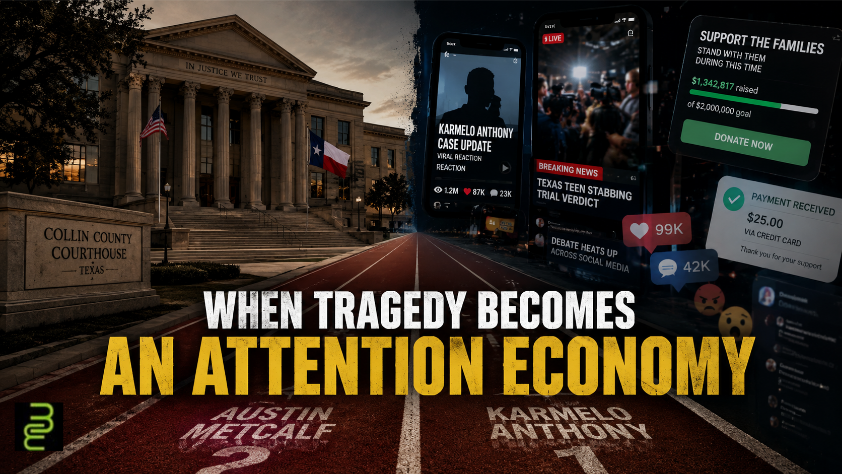
A fatal stabbing, a murder conviction and a 35-year sentence became fuel for fundraising, political debate and social-media engagement. While two families carried the deepest costs.
Karmelo Anthony was convicted of murder and sentenced to 35 years in prison for fatally stabbing 17-year-old Austin Metcalf during a high school track meet in Frisco, Texas.
Anthony, who was also 17 at the time of the April 2025 incident, maintained that he acted in self-defense. Prosecutors argued that the stabbing was murder, and the jury rejected his defense. Anthony has since filed a notice of appeal.
The case did not remain a local courtroom story.
It became a national argument about race, punishment, jury selection and self-defense. Anthony is Black. Metcalf was white.
No Black jurors were selected for the trial, a fact that intensified public questions about whether race shaped the process or outcome.
Prosecutors have defended the jury-selection process, while Anthony’s appeal may focus partly on alleged legal errors and the exclusion of Black prospective jurors.
But beneath the public debate is another story: the economics of attention.
Where the money moved
Once the case went viral, public attention began producing measurable economic activity.
Anthony’s family raised more than $600,000 through an online crowdfunding campaign intended to support legal expenses, relocation and family security. After his conviction, Anthony said he could not afford counsel for his appeal and requested a court-appointed attorney.
That raises difficult questions about what legal fundraising can—and cannot—buy.
Money can help a family retain attorneys, investigate a case, manage security threats and continue an appeal.
But a large crowdfunding total does not guarantee a favorable legal outcome. It also does not show how much remained after legal fees, taxes, platform charges, household expenses and other costs.
The case also generated traffic for television networks, digital publishers, podcasts, reaction channels and social-media accounts. Every development created another cycle of breaking-news alerts, videos, commentary and online conflict.
The families at the center of the case did not control most of that distribution.
Platforms controlled reach. Publishers controlled framing. Fundraising services controlled access to donors. Influencers could gain followers and engagement by discussing the case, even when they offered little original reporting or legal expertise.
Who captured the upside?
The strongest economic asset surrounding the case was not a product or physical property.
It was attention.
Media companies could convert public interest into pageviews, advertising impressions and audience growth. Social platforms benefited from increased engagement. Commentators used the controversy to build their personal brands. Political figures gained opportunities to speak to larger audiences about race and justice.
Those benefits were distributed across an ecosystem of intermediaries.
The risks were concentrated elsewhere.
Metcalf’s family lost a child. Anthony’s family faces the emotional and financial consequences of a decades-long prison sentence and an appeal. Both families have had their names, images and private grief pulled into a permanent digital record.
The government also assumes long-term costs. Taxpayers fund court proceedings, appeals, incarceration and any court-appointed legal representation. A 35-year sentence is therefore not only a moral and legal judgment. It also creates a substantial public financial obligation.
The ownership question
Who owns a viral criminal case?
Legally, no one owns the public facts. Economically, however, the organizations controlling distribution are often best positioned to capture value from them.
Families may provide the story’s emotional center, but they do not control algorithms, advertising systems, search rankings or the broader public narrative.
That imbalance matters for Black communities.
High-profile cases involving Black defendants or victims are frequently transformed into competing media narratives before the legal record is fully understood.
Complex questions about evidence, jury composition and sentencing can become simplified into content designed to confirm what an audience already believes.
The result is a marketplace where outrage travels faster than context.
Race and accountability can both be examined
The public discussion does not have to choose between accountability for Metcalf’s death and scrutiny of the legal system.
A teenager was killed. A jury convicted Anthony of murder after rejecting his claim of self-defense. Those facts cannot be erased by political messaging or social-media advocacy.
At the same time, questions about jury representation, equal treatment and access to an effective appeal remain legitimate public concerns.
Examining those concerns is not the same as declaring the verdict invalid. It means recognizing that public trust depends on both accountability and a process that communities view as fair.
The appeal will be the formal venue for reviewing claims of legal error. Social media cannot substitute for that process.
The economic implication
The Karmelo Anthony case shows how quickly tragedy can become part of the attention economy.
Money moved through legal fundraising. Media organizations gained traffic. Platforms accumulated engagement. Public figures gained visibility. Taxpayers assumed long-term costs.
But the people closest to the tragedy carried the greatest risk.
This is the imbalance behind many viral criminal cases: the institutions that distribute the story can benefit from sustained attention, while families live with consequences that no amount of engagement can reverse.
For Black communities, that makes media literacy an economic issue as well as a civic one.
We should ask who produced the information, who verified it, who is monetizing our attention and whether our clicks are helping us understand the case—or merely rewarding polarization.
Why it matters
This story is larger than one verdict.
It reveals how race, media power, legal resources and platform economics can converge around a tragedy. It also shows why public attention should be treated as an asset.
The central questions are not only who was right, who was wrong or which side won the online argument.
They are also:
Who controlled the narrative?
Who converted attention into money or influence?
Who paid for the legal process?
And who will carry the costs long after the story stops trending?
Drop your take
What economic consequence of this case deserves more public discussion: legal fundraising, platform monetization, jury representation or the long-term public cost of incarceration?

Latest posts by normbond (see all)
- NC A&T Students Marched 45 Minutes to Vote. The Bigger Story Is Who Controls Access. - October 17, 2026
- Black Family Wealth Fell 25%. The Ownership Gap Is the Bigger Story. - October 16, 2026
- Rihanna Turned a TikTok Live Into a Storefront. That Changes the Economics of Celebrity Attention. - October 14, 2026