


Byron Allen’s Comics Unleashed moving into CBS late night is not just a story about who follows Stephen Colbert.
It is a story about distribution, risk and who controls the economics of attention.
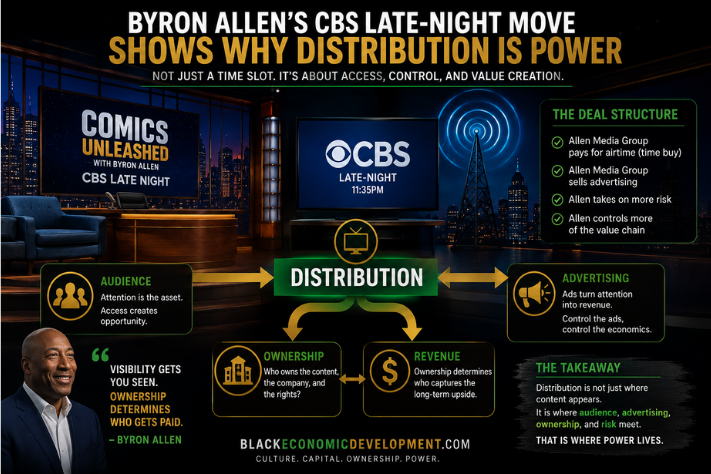
CBS moved Comics Unleashed with Byron Allen into the 11:35 p.m. late-night slot after the end of The Late Show with Stephen Colbert. The move also places Allen Media Group deeper inside CBS’s late-night block, with Funny You Should Ask following in the next slot.
That matters because this is not a traditional network replacement in the old late-night model.
Reports describe Allen’s CBS arrangement as a time-buy structure, meaning Allen Media Group pays CBS for airtime and sells advertising around the programming.
That detail changes the whole story.
This is not only about a Black comedian and media mogul getting a national television window.
It is about a Black-owned media company using capital to gain access to distribution.
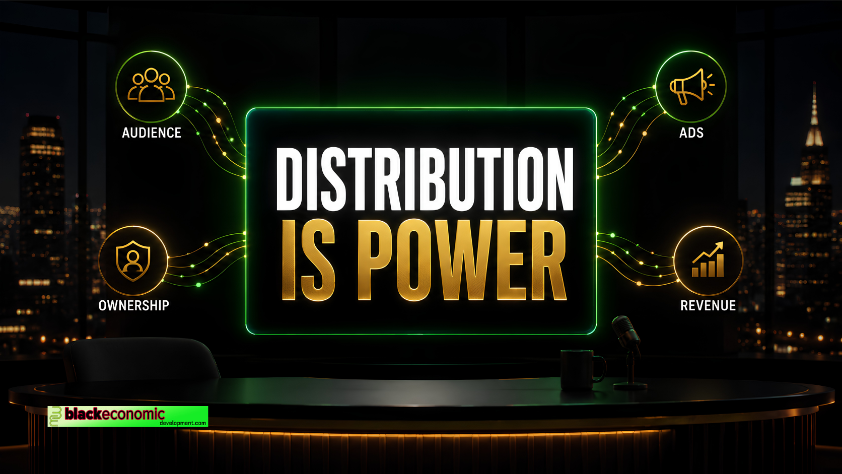
And in media, distribution is power.
This Is Bigger Than Replacing Colbert
Stephen Colbert’s exit created the obvious cultural headline.
A familiar late-night franchise ended. A different kind of comedy show moved into the slot. Viewers, critics, advertisers, affiliates and competitors all had something to watch.
But Byron Allen has been clear that Comics Unleashed is not trying to become The Late Show. He has described his program as its own format, with its own history, built around comedians and a lighter, non-political tone.
That distinction matters.
Colbert’s show was part of the modern late-night host model: monologues, political commentary, celebrity interviews, viral clips and a large production machine.
Allen’s model is different.
It is lower-cost, repeatable, comedy-driven, and built around a rotating bench of performers instead of one central nightly personality.
Some viewers may compare the two shows as entertainment.
But the business comparison is more important.
CBS is reducing exposure to the expensive host-driven late-night model. Allen Media Group is taking on more of the risk in exchange for access to a valuable national time slot.
That is the economic story.
The Real Asset Is the Time Slot
In television, a time slot is not just empty space on a schedule.
It is distribution.
It determines who gets access to the audience, who can sell ads, who can build awareness, and who controls the connection between content and monetization.
For decades, late night helped shape American culture. It moved comedy careers, music bookings, celebrity visibility, political conversation, book sales, film promotion and viral moments.
But late-night television is no longer operating in the same economic world.
Audiences are fragmented across YouTube, TikTok, podcasts, streaming platforms, newsletters and social feeds. Younger viewers often discover interviews and comedy in clips rather than by watching linear television at a fixed hour.
That shift puts pressure on expensive traditional late-night shows.
A legacy network has to ask whether a large production budget still makes sense in a fragmented attention economy.
Allen’s approach answers the question from another direction.
Instead of waiting to be programmed into a network slot under the old model, he is reportedly paying for access and trying to monetize the audience himself through advertising.
That is not just visibility.
That is a business model.
Time Buy Means Risk and Upside Move Together
A traditional network show usually places more financial risk on the network.
The network commissions the show, pays for production, controls the schedule, sells advertising, and captures the economics.
A time-buy model changes the structure.
Allen Media Group reportedly pays CBS for the airtime and then looks to make money by selling advertising around the show. MediaPost also described the deal as a continuation of a time-buy structure, with advertising sales as the path to making the arrangement work.
That means Allen takes on more risk.
If the audience is weak, the economics can be difficult. If advertisers are not interested, the cost of the slot can become a burden. If the format does not build momentum, national distribution alone is not enough.
But the upside is also different.
Allen is not simply appearing on someone else’s platform. His company is attempting to control more of the value chain: programming, production, talent, advertising, and distribution access.
That is the difference between being seen and owning part of the system that turns attention into revenue.
Visibility gets you noticed.
Ownership determines who gets paid.
Why Black Media Ownership Still Matters
Black culture has always created media value.
Black comedians, musicians, actors, athletes, creators, commentators, and audiences have helped build the economics of television, radio, streaming, publishing, fashion, sports, and social media.
But creating value and capturing value are not the same thing.
That is one of the recurring tensions in Black media.
Black talent often creates cultural demand inside systems owned, financed, programmed, and monetized by others.
A joke goes viral. A performance lifts ratings. A creator builds a platform. A community drives attention. A cultural moment becomes profitable.
But who owns the show?
Who controls the advertising?
Who has the distribution rights?
Who owns the audience data?
Who captures the long-term upside?
That is why Allen’s CBS move deserves analysis beyond whether someone personally likes the show.
This moment raises a larger question: what does it take for Black media ownership to move from content supply to distribution control?
Allen’s model is not risk-free.
It may not be the only model.
It may not be the easiest model.
But it puts the ownership question in plain view.
CBS Reduces Risk. Allen Gains Access.
From CBS’s side, this move can be read as a lower-risk approach to late night.
Instead of carrying the full cost of a major host-driven franchise, the network can lease valuable airtime and reduce its financial exposure.
From Allen’s side, the move creates a national window for his programming and a chance to sell advertising against a recognizable time slot.
That tradeoff is the heart of the deal.
CBS gives up some of the old late-night programming identity.
Allen gets access to legacy network distribution.
Advertisers get a different kind of inventory.
Comedians get another platform.
Audiences get a different format.
And the media industry gets another signal that legacy television is being restructured around cost, control, and fragmented attention.
This is not simply a personality story.
It is a power shift in how late-night television can be financed, programmed and monetized.
The BlackEconomicDevelopment.com Read
This is culture news, but it is also business news.
Byron Allen’s move into CBS late night fits a larger pattern in his career: building media assets, acquiring distribution, selling advertising and using ownership as leverage.
That is the part worth watching.
The question is not whether this is a symbolic win.
Symbols matter, but economics decide the outcome.
The deeper question is whether a Black-owned media company can use capital, content, and advertising relationships to turn a legacy late-night window into a durable business asset.
That is why this story matters.
Black economic power is not only about representation on screen.
It is about who owns the screen, who sells the attention, who controls the programming, who manages the risk, and who captures the upside.
Distribution is not just where content appears.
Distribution is where audience, advertising, ownership and risk meet.
The Economic Layer
This story is about distribution economics.
Byron Allen’s Comics Unleashed is not simply appearing on CBS as a conventional network replacement. Reports describe the arrangement as a time-buy model, where Allen Media Group pays for airtime and sells advertising around the programming.
That shifts the economics.
CBS reduces its exposure after moving away from the traditional late-night franchise model. Allen gains national network access but carries more financial risk. The upside depends on whether his company can turn audience attention into advertising revenue, brand value, and long-term media leverage.
Ownership Question
Who controls the value of the late-night audience?
Is it the network that owns the broadcast platform? The media company that pays for access? The advertisers who fund the inventory? The comedians who supply the content? Or the audience whose attention makes the whole system valuable?
The Byron Allen story matters because it shows the difference between being invited onto a platform and using capital to gain access to distribution.
Why It Matters
Black culture has always created media value. But value creation and value capture are not the same thing.
This move puts a Black-owned media company inside one of television’s most recognizable late-night windows. It also shows the cost of access. Ownership can create upside, but it often comes with greater risk, capital requirements, and pressure to monetize quickly.
For Black media builders, creators, and entrepreneurs, the lesson is clear: distribution is not a detail.
Distribution is the business model.

Latest posts by normbond (see all)
- NC A&T Students Marched 45 Minutes to Vote. The Bigger Story Is Who Controls Access. - October 17, 2026
- Black Family Wealth Fell 25%. The Ownership Gap Is the Bigger Story. - October 16, 2026
- Rihanna Turned a TikTok Live Into a Storefront. That Changes the Economics of Celebrity Attention. - October 14, 2026