


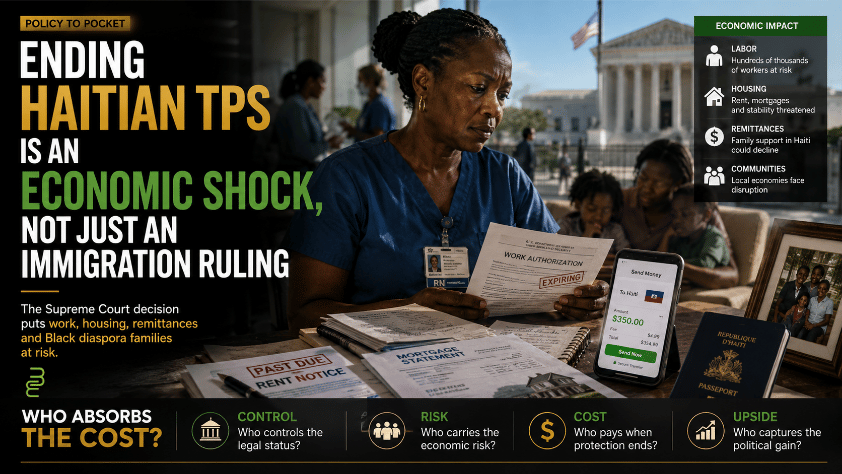
The Supreme Court’s decision allowing the Trump administration to end Temporary Protected Status for Haitians and Syrians will be discussed primarily as an immigration ruling.
But its consequences will move through paychecks, rental agreements, mortgages, hospitals, nursing facilities, schools and family budgets.
For roughly 350,000 Haitians, TPS has meant more than protection from deportation.
It has also provided legal authorization to work in the United States. The ruling places that employment stability—and the household economy built around it—at risk. The decision also applies to approximately 6,000 Syrians.
This is where immigration policy becomes pocketbook policy.
When legal protection is withdrawn, the cost does not stop with the person whose status changes. It spreads to children, employers, landlords, lenders, customers, caregivers and relatives abroad.
For Black diaspora communities, the ruling represents a potential economic shock with consequences on both sides of the Caribbean.
What the Supreme Court decided
In Mullin v. Doe, decided June 25, the Court ruled 6–3 that federal law largely prevents courts from reviewing the Homeland Security secretary’s determination to terminate a country’s TPS designation.
The ruling reversed lower-court orders that had postponed the termination of protections for Haitians and Syrians. The Court’s majority concluded that the challengers could not use the Administrative Procedure Act to obtain orders delaying those terminations.
TPS was created by Congress in 1990. It allows eligible people from countries facing war, natural disasters or other severe instability to remain and work legally in the United States for a limited period. It does not provide a direct path to citizenship.
Haiti was first designated for TPS after the catastrophic 2010 earthquake. The designation was subsequently extended or renewed as the country faced continuing violence, food insecurity, weak healthcare infrastructure and political instability.
The immediate legal question concerned executive authority and judicial review.
The larger economic question is who absorbs the loss when workers who have built lives, careers and households around lawful employment suddenly face removal from the legal labor market.
TPS is part of the labor infrastructure
Legal status determines more than whether someone may remain in the country.
It determines whether that person can work legally, pass employment verification, qualify for certain professional opportunities and make long-term financial commitments with some expectation of stability.
That affects whether a family can sign a lease, maintain a mortgage, finance a vehicle, pay tuition, purchase insurance or invest in a business.
The Associated Press reported that many Haitian TPS holders have lived and worked in the United States for decades. Some have U.S.-citizen children. The decision is expected to take effect July 27, although individual circumstances and other immigration claims may differ.
For these households, the loss of TPS can turn an immigration deadline into an income deadline.
A worker may still possess valuable skills, experience and professional relationships. But without valid authorization, that labor becomes harder—or impossible—to sell legally.
The economic asset has not disappeared.
Access to the legal market has.
The risk travels through employers
The ruling also creates costs for businesses that depend on stable labor.
Haitian TPS holders work across healthcare, caregiving, hospitality, food production, construction, transportation and other essential industries. AP specifically reported concerns about caregiving and long-term-care facilities, where TPS holders are significantly represented.
Replacing an experienced nurse, nursing assistant, home-health worker or production employee is not cost-free.
Employers may face recruitment expenses, overtime costs, training delays and operational disruption. Smaller businesses can be especially exposed because they often lack the staffing cushion and financial reserves of larger firms.
Some employers may attempt to replace workers quickly or reduce their long-term obligations.
Others may lose employees they cannot easily replace.
Either way, the policy shifts risk from Washington into workplaces that did not make the decision but must absorb its consequences.
Housing instability becomes part of the fallout
A lease depends on income.
A mortgage depends on income.
Property taxes, utility bills, maintenance costs and insurance payments depend on income.
When work authorization becomes uncertain, housing security becomes uncertain with it.
Some households may delay purchases, reduce spending or attempt to sell property. Others may double up with relatives or prepare for family separation.
AP reported that one Haitian nurse transferred property to her children and prepared a will because she feared deportation. Haitian community leaders said residents were asking whether they should withdraw money from banks and whether they would still be allowed to work.
Those decisions reveal how legal uncertainty can produce economic behavior before deportation or job loss actually occurs.
Fear itself changes spending, saving and investment.
Households pull back. Businesses lose customers. Banks may lose deposits. Neighborhood markets experience weaker demand.
The economic damage can begin before enforcement does.
The ruling also reaches Haiti through remittances
Haitian workers in the United States do not support only the households in which they live.
Many also support relatives in Haiti through remittances.
That money can pay for food, rent, school fees, medical care, transportation and small-business activity. It operates as a private transnational support system in a country where public institutions and formal safety nets remain under severe strain.
When a worker loses legal employment, remittances may decline.
When a worker is detained, deported or forced into unstable informal labor, the flow can become less predictable.
That means the ruling’s economic effects may cross borders.
A policy decision made in Washington can reduce purchasing power in Port-au-Prince, Cap-Haïtien or a rural Haitian community without appearing in the ruling itself.
The person carrying the legal risk may be in the United States.
The family carrying part of the financial risk may be in Haiti.
Who controls the system?
The Department of Homeland Security controls whether a country receives, retains or loses TPS designation.
The Supreme Court’s ruling limits how federal courts may delay or review those termination decisions under the relevant statute.
Haitian workers do not control the designation.
Their employers do not control it.
Their landlords, children, customers and relatives do not control it.
Yet all can bear the economic consequences.
That imbalance is the central ownership and power question in this story.
The government controls access to legal work.
Workers supply the labor.
Employers build operations around it.
Families build budgets around it.
But once the legal protection is withdrawn, the people most dependent on the arrangement have the least power over its continuation.
Who captures the upside?
There is no simple pool of economic “winners” created by the ruling.
Some employers may gain access to workers with less bargaining power if former TPS holders are pushed toward informal employment. Other employers may replace affected workers with lower-cost labor or avoid benefits and long-term obligations.
Federal immigration agencies gain enforcement leverage.
Political leaders gain the ability to present the decision as evidence of a harder immigration policy.
But those gains come with significant costs elsewhere: disrupted businesses, worker shortages, weakened household spending, housing instability and increased pressure on local service systems.
The upside is concentrated in political and enforcement power.
The risk is distributed across families and communities.
Why this matters to Black communities
Haitian TPS is not a distant or abstract immigration issue.
- It is a Black labor issue.
- It is a Black housing issue.
- It is a Black family-wealth issue.
- It is a caregiving and healthcare-workforce issue.
- It is also a diaspora-capital issue because household income earned in the United States helps sustain relatives and commerce in Haiti.
The ruling shows how quickly wealth-building can be disrupted when the legal foundation beneath a worker’s income is temporary.
A family may own a home, operate a business or hold money in a bank.
But if the right to remain and work is controlled by a designation that can be terminated, that wealth sits on top of political risk.
That does not make the wealth less real.
It makes the protection surrounding it less secure.
What comes next
Affected TPS holders should seek qualified immigration counsel because individual cases may involve other applications, statuses or forms of relief.
Community organizations, employers and local governments will also need to clarify employment, housing and family-planning consequences as implementation approaches.
The policy debate will continue to focus on borders, executive authority and deportation.
BlackEconomicDevelopment.com’s economic question is different:
Who absorbs the loss when legally employed workers are pushed out of jobs, leases and remittance systems?
The answer is not only the worker.
The cost travels.
It reaches children, businesses, property owners, care facilities, neighborhoods and relatives across the diaspora.
That is why ending Haitian TPS is not only an immigration decision.
It is an economic shock.
Economic implication
The ruling threatens to remove hundreds of thousands of people from the authorized labor market, potentially reducing household income, weakening housing stability and disrupting employers that rely on experienced workers.
The economic chain is direct:
Loss of protection ? loss of work authorization ? income instability ? housing and debt pressure ? reduced household spending ? lower remittances ? broader community disruption.
Ownership and control
Who controls the legal asset: Department of Homeland Security
Who narrowed judicial intervention: U.S. Supreme Court
Who supplies the labor: Haitian and Syrian TPS holders
Who depends on the income: Workers, children, relatives and mixed-status households
Who depends on workforce continuity: Employers, care facilities and local businesses
Who has the least control: The households carrying the greatest financial exposure
Who captures the upside
Potential areas of concentrated advantage include:
- Greater federal enforcement leverage
- Political value from demonstrating a hardline immigration position
- Reduced worker bargaining power in parts of the informal labor market
- Short-term flexibility for employers willing to replace experienced staff
These potential gains are not cost-free. They may be offset by worker shortages, recruitment costs, weaker consumer demand and local economic instability.
Who carries the risk
- Haitian and Syrian workers
- U.S.-citizen children in mixed-status households
- Family members dependent on household income
- Relatives in Haiti who receive remittances
- Employers dependent on stable labor
- Long-term-care and caregiving institutions
- Landlords and mortgage lenders
- Black immigrant neighborhoods and business corridors
Why it matters
This decision demonstrates how immigration policy can function as labor-market policy.
It also reveals the fragility of wealth accumulated under temporary legal protection. A household may build equity, credentials, savings and business relationships for years, yet remain exposed to a federal decision it cannot control.
For Black communities, the ruling connects immigration status to broader questions of labor power, housing security, family wealth and the movement of capital across the diaspora.
Editors Note: This content is for news and economic analysis and is not legal advice.