


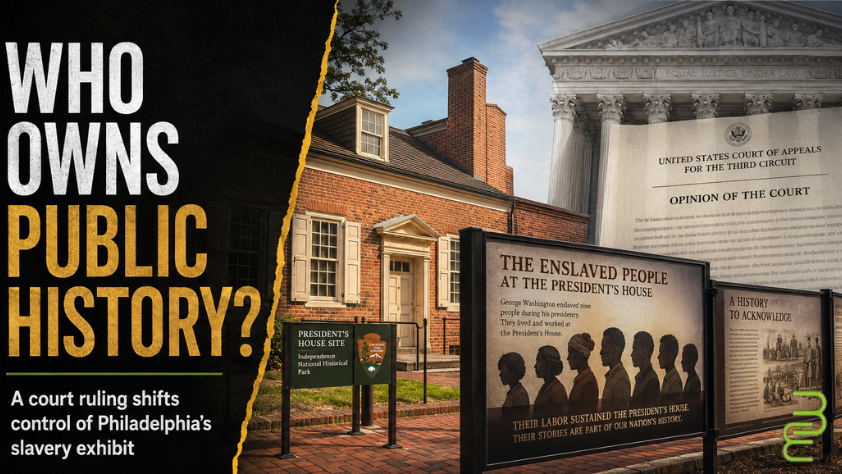
The Third Circuit ruled that Philadelphia lacks authority to curate the federally controlled President’s House site, but the coalition that spent decades protecting its history is reviewing its options and preparing to continue the fight.
The legal fight over Philadelphia’s President’s House/Slavery Memorial is not over, according to the organization that spent decades working to ensure the people enslaved at the site were not erased from its history.
Avenging The Ancestors Coalition, known as ATAC, said it was disappointed by the Third Circuit Court of Appeals’ decision but is reviewing the opinion with its legal team and considering all available options.
“This is definitely not the end of this fight,” the coalition said in a statement.
That response adds an important layer to the dispute.
This is not simply a disagreement over museum panels. It is a struggle over who has the authority to define Black history at a federally controlled public site—and whether communities that helped establish that history’s public visibility have lasting power over how it is presented.
What the court decided
The Third Circuit ruled that Philadelphia does not possess the statutory, property, or contractual rights needed to curate exhibits at the President’s House Site on Independence Mall.
The ruling weakens the city’s ability to prevent the National Park Service from replacing the existing exhibit, which focuses on the nine people George Washington enslaved while living at the site during his presidency.
But the decision should not be described as ending every possible legal or public challenge.
ATAC said it is conducting a thorough review of the ruling, consulting its legal team, and evaluating what steps may remain available. Philadelphia Mayor Cherelle Parker has also said the city will continue pursuing legal options.
The decision therefore represents a significant shift in legal leverage, not necessarily the final resolution of the conflict.
ATAC’s role predates the current lawsuit
ATAC’s involvement is not recent.
For decades, the coalition has worked to ensure that the enslaved African descendants who lived and labored at the President’s House were not erased, overlooked, or misrepresented.
Its work helped move the site beyond a narrow celebration of presidential history and toward a fuller account of the relationship between slavery, labor, and the founding of the United States.
That distinction matters.
ATAC was not simply reacting to a proposed exhibit change. The organization helped create the public and political pressure that made the memorial possible.
In its statement, ATAC said its commitment remains unchanged.
“We believe that historical truth matters, and we will continue to advocate for the protection, preservation, and accurate interpretation of this important chapter of American history,” the coalition said.
Public history is also an economic asset
Historic sites are not economically neutral.
They attract tourists, school groups, researchers, documentary producers, publishers, and cultural institutions. They support local businesses and shape which stories receive public funding, educational attention, and institutional legitimacy.
At Independence Mall, the interpretation of the President’s House influences how visitors understand both George Washington and the nine people he enslaved while serving as president.
The question is not simply whether slavery is mentioned somewhere in the exhibit.
It is how central that history remains, how much detail is preserved, whose perspective shapes the presentation, and which institution holds the authority to change it.
The organization that controls the property and exhibit platform holds significant cultural and economic power.
Who controls the asset?
The National Park Service administers the federal site.
That gives the federal government control over the physical location, exhibit infrastructure, visitor experience, and official interpretation presented to the public.
Philadelphia benefits from tourism and the economic activity surrounding Independence Mall, but the appeals court found that the city does not possess the legal authority needed to curate the exhibit.
ATAC occupies a different position.
Its historical knowledge, organizing, advocacy, and public credibility helped shape the memorial. But the court’s ruling focused on the city’s authority. It did not erase ATAC’s political influence, historical standing, organizing capacity, or ability to continue advocating for the site.
The ruling strengthens federal control over the platform.
It does not eliminate the coalition’s power to organize, educate, litigate, build public support, and create independent spaces where Black history can be preserved and interpreted.
Who created the value?
The federal government controls the site, but public institutions did not create the memorial’s meaning alone.
ATAC, historians, descendants, educators, local officials, and community advocates contributed years of labor and pressure to ensure that the enslaved people connected to the President’s House were not treated as a footnote.
That work created value.
It gave the site greater historical depth, educational importance, and public relevance.
The ownership tension is clear: one institution controls the physical platform, while a community-based coalition helped create much of the interpretive value that makes the platform meaningful.
This pattern extends far beyond museums.
Black communities often supply the stories, labor, research, audiences, and credibility. Another institution may still own the property, archive, contract, platform, or distribution system.
Who captures the upside?
The federal government holds the strongest institutional advantage: control over the site.
That authority includes the ability to shape the exhibit’s design, emphasis, language, and visitor experience, subject to court orders and other legal constraints.
Philadelphia captures indirect benefits through tourism and local economic activity.
ATAC and the broader community capture a different kind of value: historical recognition, educational impact, civic influence, and the preservation of collective memory.
But those gains remain vulnerable when they are not accompanied by direct control of the site or binding curatorial authority.
Who carries the risk?
Black communities, descendants, educators, and historians carry much of the risk if the story becomes less specific or less central.
A revised exhibit could still acknowledge slavery while changing its tone, reducing its prominence, or weakening the connection between forced Black labor and the nation’s founding institutions.
There is also an institutional risk.
When community groups contribute decades of research, organizing, and cultural labor without retaining governance power, their work can later be reframed by officials who did not build the original project.
ATAC’s response makes clear that it does not intend to accept that outcome without further action.
Visibility is not the same as control
The President’s House dispute illustrates the difference between achieving representation and securing lasting governance.
A coalition can win an exhibit.
A city can support it.
A court can temporarily restore it.
But durable control depends on law, contracts, property rights, funding structures, institutional authority, and political power.
That does not mean community advocacy is powerless.
ATAC’s statement shows the opposite. Legal authority is only one form of leverage. Public organizing, historical expertise, partnerships, media attention, and community legitimacy can continue shaping what institutions are able to do.
The coalition’s Juneteenth programming also demonstrates another form of control: the ability to create independent spaces where Black history can be discussed and distributed outside the federal exhibit itself.
The ownership question
The central ownership question is this:
Who should control the interpretation of Black history at a public memorial—the federal agency that administers the property, the city that partnered in its development, or the community coalition whose organizing helped make the memorial possible?
The court’s ruling answers part of that question by limiting Philadelphia’s authority.
It does not settle the larger questions of historical legitimacy, community stewardship, or the forms of power ATAC may still exercise.
What this reveals about Black economic power
The lesson is not that Black organizations must own every physical site where Black history appears.
It is that they need multiple forms of leverage.
That can include ownership of archives, oral histories, educational materials, research, documentary rights, digital platforms, donor relationships, and public programming.
It can also include formal advisory authority, shared-governance agreements, contractual protections, independent fundraising, and permanent community institutions capable of preserving the history when government policy changes.
ATAC’s statement signals that the coalition understands this as a continuing struggle rather than a single courtroom loss.
Why it matters
This case is about historical truth, but it is also about institutional power.
The federal government controls the site. Philadelphia’s legal authority has been restricted. ATAC retains community legitimacy, historical expertise, organizing infrastructure, and the ability to pursue additional options.
Those forms of power are not equal, but they all matter.
The deeper lesson is that Black historical preservation cannot depend on visibility alone. It requires legal strategy, independent institutions, owned archives, durable partnerships, community funding, and control over distribution.
ATAC helped ensure that the enslaved people connected to the President’s House became part of the public record.
Its latest statement makes one point unmistakable: the coalition does not consider that work finished.

Latest posts by normbond (see all)
- Who Owns the Upside From Power? 50 Cent’s Variety Interview Reveals a Bigger TV Economics Story - October 20, 2026
- Burkina Faso Rejected a U.S. Deportation Deal. Then the Fight Moved to Visa Access. - October 19, 2026
- NC A&T Students Marched 45 Minutes to Vote. The Bigger Story Is Who Controls Access. - October 17, 2026