


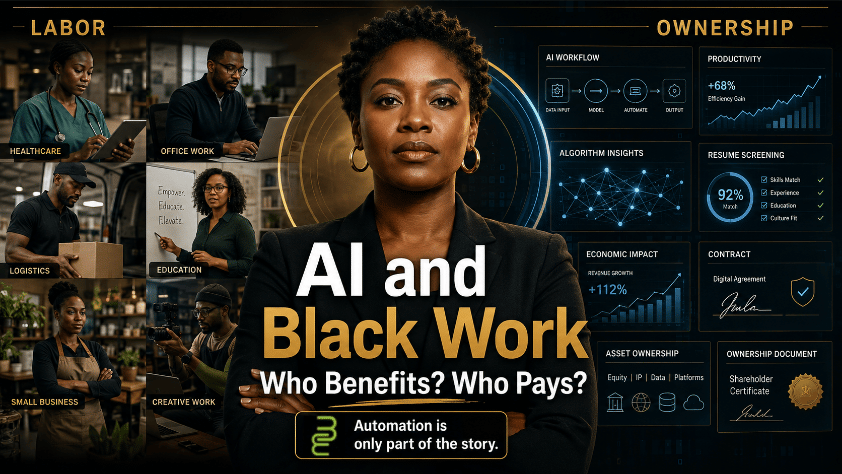
AI will not affect every worker the same way. The deeper question is who owns the tools, who captures productivity gains, who gets monitored, who gets trained and who pays for the transition.
AI is not coming for work in one dramatic wave.
It is entering quietly.
- Through chatbots.
- Through agents.
- Scheduling systems.
- Resume screeners.
- Customer service scripts.
- Productivity dashboards.
- Writing assistants.
- Workflow automation.
- Data tools.
- Software updates.
That matters because the future of Black work may not look like one sudden replacement.
It may look like fewer entry-level roles, higher workloads, tighter surveillance, weaker bargaining power, and productivity gains flowing to the people who own the systems.
That is the real AI question.
Not just what gets automated.
Who benefits?
Who pays?
AI changes tasks before it changes jobs
Most jobs are not one task.
They are bundles of tasks.
A customer service worker answers questions, updates records, handles complaints, follows scripts, manages emotional pressure and keeps customers from leaving.
A nurse documents care, communicates with patients, coordinates with doctors, reviews records, monitors symptoms and responds to emergencies.
A marketing worker writes copy, analyzes campaigns, schedules content, interprets data, manages clients and makes creative decisions.
AI does not have to replace the whole job to change the economics of the job.
It can automate the repeatable parts.
It can speed up the paperwork.
It can monitor performance.
It can reduce headcount.
It can make one worker responsible for what three people used to do.
That is why AI disruption may show up first as workload pressure, wage pressure, surveillance, hiring slowdowns, contractor shifts, and “do more with less” management.
Not just layoffs.
The warning was only the beginning
We previously covered McKinsey’s warning that generative AI could widen the racial wealth gap by $43 billion a year.
That warning matters.
McKinsey estimates that Black workers are overrepresented in several occupations at risk of automation. These include office support, production work, food services and mechanical installation and repair.
The firm also estimates that 24 percent of Black workers are in occupations with more than 75 percent automation potential, compared with 20 percent of White workers.
But the broader issue is bigger than one number.
The $43 billion warning is about wealth distribution.
This article is about the labor map.
- How does AI change the daily structure of work?
- Who owns the tools?
- Who captures the productivity?
- Who gets trained?
- Who gets watched?
- Who gets pushed out?
- Who gets to build?
The risk is not only job loss. It is blocked mobility.
The most dangerous AI impact may not be immediate unemployment.
It may be blocked mobility.
For many Black workers, the path to better wages has often moved through “gateway” jobs. These are roles that do not require a four-year degree but can lead to higher-paying opportunities.
McKinsey defines gateway jobs as experience-based jobs paying more than $42,000 per year that can open a path to upward mobility.
It also notes that 74 percent of Black workers do not have college degrees, and that one in eight Black workers without degrees moved into a gateway or target job over the previous five years.
That pathway is now exposed.
Customer support.
Office support.
Production supervision.
Basic coding.
Administrative coordination.
Entry-level analysis.
Routine content production.
These are not just tasks.
They are stepping stones.
If AI absorbs the first layer of work, fewer people may get the training, exposure and workplace experience needed to move up.
That is how automation can reshape opportunity without eliminating every job.
What gets automated first?
The first wave is likely to hit tasks that are repeatable, text-heavy, rules-based, predictable or easy to measure.
That includes:
- Customer support scripts.
- Data entry.
- Scheduling.
- Basic bookkeeping.
- Document summaries.
- Routine emails.
- Call center workflows.
- Simple HR forms.
- First-pass legal or compliance documents.
- Basic coding tasks.
- Standard marketing copy.
- Low-complexity research.
- Internal reporting.
The issue is not that every person doing this work disappears.
The issue is that the job changes.
One worker may be expected to handle more output.
A junior worker may get fewer chances to learn.
A supervisor may manage by dashboard instead of relationship.
A company may pause hiring because software now handles the first draft, the first response, or the first review.
That is still an economic shift.
Who benefits from AI productivity?
AI creates value when it saves time, reduces labor costs, increases output, improves decision-making or helps a company sell more.
But value creation is not the same as value sharing.
If a company uses AI to make workers more productive, who gets the benefit?
Does the worker get higher pay?
Does the worker get fewer hours without losing income?
Does the company invest in training?
Does the customer get better service?
Does management reduce staff?
Do shareholders capture the savings?
Does the software vendor capture the subscription revenue?
This is the ownership question.
The people who own the platforms, data, tools, companies, and capital are positioned to capture the largest upside.
Workers may get the tools.
But without bargaining power, training access, or ownership pathways, they may not capture much of the value they help create.
That is the difference between AI as empowerment and AI as extraction.
AI can also become the boss
AI is not just a helper.
It can become a manager.
It can track keystrokes.
Monitor calls.
Score productivity.
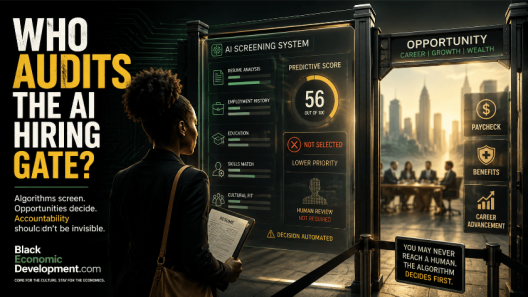
Rank resumes.
Schedule shifts.
Evaluate performance.
Flag workers.
Recommend discipline.
Predict turnover.
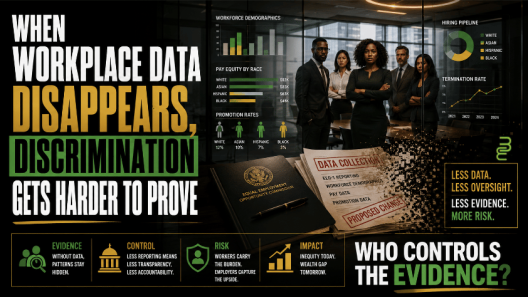
For Black workers already navigating bias in hiring, promotion, discipline, and workplace culture, algorithmic management creates a serious risk.
Old discrimination can become automated discrimination.
The danger is not only that a person makes a biased decision.
The danger is that a biased system makes the decision look neutral.
- That matters in hiring.
- It matters in lending.
- It matters in healthcare.
- It matters in benefits.
- It matters in housing.
- It matters in education.
- It matters in work.
When an algorithm affects someone’s paycheck, schedule, promotion, loan, care, or opportunity, people need transparency and appeal rights.
Technology cannot be allowed to hide accountability.
Black businesses face opportunity and pressure
For Black-owned businesses, AI can be a force multiplier.
A small business owner can use AI to draft proposals, improve customer follow-up, organize content, write grant materials, build sales emails, research markets, summarize contracts, create hiring templates, manage inventory, and improve local marketing.
That matters.
Many Black-owned businesses operate with thin margins and small teams. AI can give a one-person or five-person business access to capabilities that once required consultants, agencies, or additional staff.
But there is a risk.
If larger companies adopt AI faster, they may widen the productivity gap.
If platforms control the tools, small businesses may become more dependent on subscriptions, algorithms, and systems they do not own.
If Black businesses only use AI as consumers, not builders, trainers, vendors, consultants, integrators, or owners, the wealth opportunity stays limited.
The goal should not be only AI adoption.
The goal should be AI capacity.
Future-proof skills, not future-proof jobs
For years, workers were told to find “future-proof jobs.”
AI complicates that advice.
McKinsey argues that workers may need to shift from chasing future-proof jobs to building future-proof skills. The report highlights skills that are harder to automate, including socioemotional understanding, physical presence, and comfort with ambiguity.
That is a useful starting point.
But for Black workers, the strategy has to be more specific.
The real opportunity is not simply “learn AI.”
It is AI plus a real economic lane.
- AI plus healthcare.
- AI plus logistics.
- AI plus education.
- AI plus construction.
- AI plus finance.
- AI plus cybersecurity.
- AI plus marketing.
- AI plus public administration.
- AI plus real estate.
- AI plus small business operations.
- AI plus legal support.
- AI plus community development.
- AI plus media production.
The worker who knows a tool may get faster.
The worker who knows a field and can use AI inside that field may gain leverage.
Who pays for the transition?
This may be the biggest policy question.
If AI changes work, who pays for retraining?
The worker?
The employer?
The school system?
The government?
The platform companies?
The communities already facing disruption?
Too often, the answer becomes the individual worker.
People are told to reskill on their own time, with their own money, while still paying rent, caring for family, managing debt, and navigating unstable work.
That is not a serious workforce strategy.
A serious Black economic development strategy would include employer-paid training, paid learning time, community college programs, HBCU partnerships, public library AI labs, union protections, worker voice, Black business AI grants, procurement opportunities, and audits of AI systems used in hiring, lending, healthcare, housing, education, benefits, and employment.
The question is not only whether people can learn.
The question is whether the systems around them invest in their transition.
The Black creator economy is exposed too
AI is also coming for creative labor.
- Writing.
- Design.
- Music.
- Video.
- Voice.
- Marketing.
- Editing.
- Research.
- Translation.
- Brand strategy.
- Social content.
That matters because Black creators have built real economic power through digital platforms.
But AI tools trained on massive amounts of online material raise ownership questions.
Who owns a style?
Who owns a voice?
Who gets paid when cultural patterns become training data?
Who benefits when platforms use AI to produce content at scale?
Who protects Black creators from imitation without compensation?
AI may help creators produce faster.
But it may also flood platforms with cheaper content, drive down rates, and make originality harder to monetize.
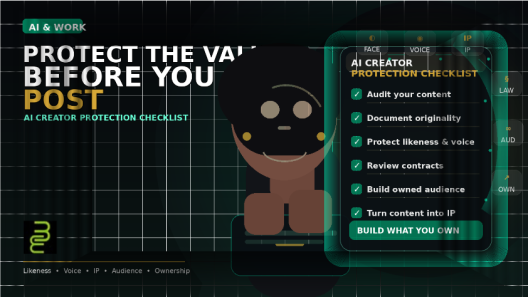
For Black creators, the response must include IP protection, owned audiences, licensing, contracts, direct commerce, and brand equity beyond any single platform.
The future is not automatic
AI will not decide the future of Black work by itself.
Employers will make choices.
Policymakers will make choices.
Schools will make choices.
Investors will make choices.
Workers will make choices.
Communities will make choices.
The technology matters.
But power matters more.
- Who decides how AI is used?
- Who is consulted before it is deployed?
- Who can challenge harmful systems?
- Who gets trained before their job changes?
- Who gets ownership in new AI businesses?
- Who gets access to capital?
- Who gets protected from biased decision-making?
- Who gets left managing the fallout?
Those are the questions that will determine whether AI becomes a tool of mobility or another engine of inequality.
The ownership question
AI is not just changing work.
It is changing who captures value from work.
If Black labor becomes more productive but Black workers do not gain wages, mobility, ownership, or bargaining power, then AI becomes extraction.
If Black businesses use AI to grow revenue, reduce costs, improve service, and compete for larger contracts, then AI becomes capacity.
If Black creators use AI while protecting their IP and building owned audiences, then AI becomes leverage.
If Black institutions build training, financing, and protection around the transition, then AI becomes part of economic development.
That is the line.
AI will automate tasks.
But the bigger question is whether it will automate inequality or expand ownership.
Economic implication
AI will shift value from routine tasks toward systems, data, platforms, judgment, capital, and ownership.
Black workers and businesses face real risk if they are only exposed to automation.
But they also have opportunity if they gain skills, tools, capital, institutional support, and ownership in AI-enabled markets.
Why it matters
The future of Black work will be shaped by who controls AI deployment, who gets trained, who owns the tools, who captures productivity gains, and who pays for disruption.
Visibility in the AI economy is not enough.
Black communities need leverage, protection, and ownership.
AI will not only change work. It will change who captures value from work.
What’s Your Read?
Where do you see AI creating the biggest risk for Black workers: job loss, lower wages, surveillance, biased decisions, or ownership gaps?

Latest posts by normbond (see all)
- Dangote Refinery IPO Opens. Africans Can Buy Shares—Dangote Keeps Control - September 14, 2026
- U.S. Lends Africell Nearly $100M. Africa Faces a Bigger Ownership Question - September 11, 2026
- Jacob Coxon Quit Anthropic Over AI Risk. He Also Walked Away Before His Equity Vested - September 10, 2026