



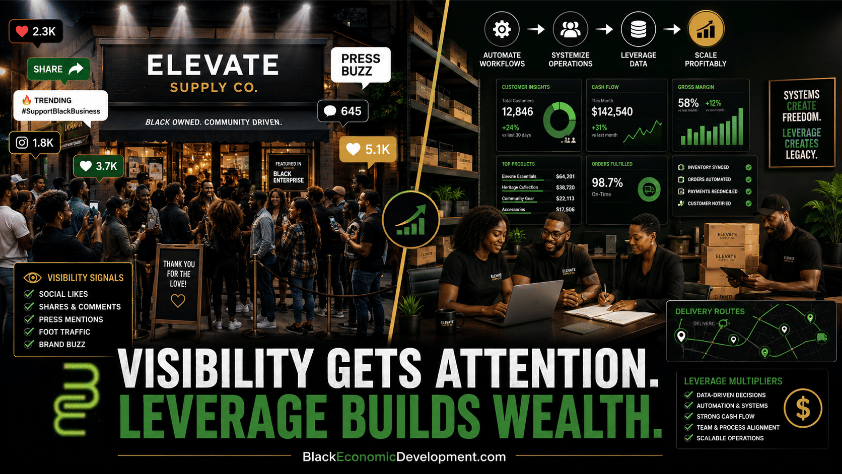
Attention can bring customers. But systems, capital, margins, customer data, staffing, contracts and distribution determine whether Black-owned businesses can turn demand into durable wealth.
Visibility matters.
A social media post can send traffic to a Black-owned business. A holiday gift guide can introduce new customers. A viral moment can sell out inventory. A media feature can create momentum.
But visibility alone is not a business model.
For many Black-owned businesses, the bigger question is not whether people know they exist.
The question is whether the business has the operating leverage to turn attention into profit, capacity, repeat customers and long-term ownership.
That is the economics behind the visibility conversation.
Attention Can Create Demand. It Does Not Automatically Create Capacity.
When Black-owned businesses get visibility, the public often sees the exciting part first.
- More followers.
- More orders.
- More foot traffic.
- More press.
- More community support.
But behind the scenes, growth creates pressure.
Can the business fulfill a sudden spike in orders?
Can it afford inventory before revenue comes in?
Can it hire without weakening cash flow?
Can it ship on time?
Can it keep margins healthy?
Can it manage customer service?
Can it convert one-time attention into repeat revenue?
Visibility can create opportunity.
But without systems, it can also expose operational weakness.
A business can go viral and still struggle if the demand arrives faster than the infrastructure.
What Operating Leverage Really Means
Operating leverage is the ability to grow revenue without costs rising at the same pace.
In plain language, it is what allows a business to do more without breaking the business.
That can include better systems, stronger supplier relationships, automation, trained staff, efficient fulfillment, repeatable sales processes, customer data, financial controls, and access to working capital.
For a Black-owned business, operating leverage may look like a restaurant using better inventory systems to reduce waste.
It may look like a beauty brand improving fulfillment so online orders ship faster.
It may look like a consultant turning custom work into a repeatable product or package.
It may look like a retailer negotiating better wholesale terms.
It may look like a contractor building back-office capacity to compete for larger contracts.
It may look like a creator-owned business using email, data, and digital products instead of relying only on social platforms.
The point is not just growth.
The point is profitable growth.
Visibility Without Leverage Can Become a Trap
A business can look successful from the outside while becoming more fragile on the inside.
More sales can mean more inventory pressure.
More customers can mean more service demands.
More locations can mean more rent, payroll and operational complexity.
More media attention can mean higher expectations without higher margins.
More social visibility can mean platform dependency, where the business depends on algorithms it does not control.
That is why the question cannot stop at “How do we support Black-owned businesses?”
The better question is:
How do we help Black-owned businesses build capacity, ownership and leverage?
Support should not only mean buying once after a viral post.
It should also mean helping businesses survive beyond the moment.
Where the Money Is Moving
The money is moving toward businesses that control their customer relationships, understand their margins, use technology well, and can fulfill demand reliably.
That matters because visibility is easier to generate than infrastructure.
A platform can spotlight a Black-owned brand for a campaign.
A marketplace can feature Black entrepreneurs during a heritage month.
A corporation can promote supplier diversity.
But the business captures more upside when it owns the customer list, controls its distribution, has strong cash management, and can negotiate from a position of capacity.
Visibility creates the opening.
Operating leverage determines how much of the upside the business keeps.
The Ownership Question
The ownership question is not only who owns the business.
It is also who owns the systems around the business.
- Who owns the customer data?
- Who controls the marketplace access?
- Who owns the storefront or lease terms?
- Who controls the payment system?
- Who finances the inventory?
- Who owns the brand assets?
- Who controls distribution?
- Who captures the margin?
If a Black-owned business depends entirely on a third-party platform for discovery, payments, customer access, and fulfillment, the business may have visibility without control.
That does not mean platforms are bad.
It means dependency has a cost.
Operating leverage gives businesses more choices.
What Black-Owned Businesses Actually Need
Black-owned businesses need customers.
But they also need working capital, back-office systems, procurement readiness, accounting support, technology adoption, legal structure, supplier relationships, pricing strategy, and repeatable sales channels.
They need the ability to handle growth without being punished by growth.
That includes access to tools and support that are often less visible than a public campaign but more important to long-term survival.
- Better bookkeeping.
- Stronger cash-flow planning.
- Automated follow-up.
- Email and SMS lists.
- Inventory management.
- Contract review.
- Procurement coaching.
- Insurance and compliance support.
- AI tools for operations.
- Customer retention systems.
These are not glamorous.
They are leverage.
Why It Matters
Black business ownership is often discussed through the lens of representation.
That matters.
But the deeper economic issue is durability.
Can the business stay open?
Can it hire?
Can it build assets?
Can it win contracts?
Can it retain customers?
Can it survive slow seasons?
Can it expand without losing control?
Can it create wealth for the owner, workers, and community?
Visibility can help people discover Black-owned businesses.
Operating leverage helps those businesses convert discovery into economic power.
The Bottom Line
Black-owned businesses do not need less visibility.
They need visibility connected to infrastructure.
- Attention should lead to owned customers.
- Sales should lead to margin.
- Growth should lead to capacity.
- Support should lead to durability.
- Campaigns should lead to contracts.
- Technology should lead to leverage.
- Community spending should lead to Black wealth.
The goal is not just to be seen.
The goal is to be built to last.
That is why Black-owned businesses need more than visibility.
They need operating leverage.
Economic Implication
Visibility can drive demand, but operating leverage determines whether Black-owned businesses can convert demand into profit, capacity, ownership and durable wealth.
The real economic opportunity is helping businesses control customer relationships, improve margins, adopt technology, strengthen operations, and reduce dependency on platforms they do not own.
Why It Matters
Black-owned businesses are often celebrated through visibility campaigns. But long-term wealth comes from systems that support survival, growth, hiring, contract readiness and ownership.
Without operating leverage, attention can create pressure without building power.
Over to You
What does a Black-owned business need most after visibility: capital, systems, contracts, technology, staffing, or customer retention?
Latest posts by normbond (see all)
- Dangote Refinery IPO Opens. Africans Can Buy Shares—Dangote Keeps Control - September 14, 2026
- U.S. Lends Africell Nearly $100M. Africa Faces a Bigger Ownership Question - September 11, 2026
- Jacob Coxon Quit Anthropic Over AI Risk. He Also Walked Away Before His Equity Vested - September 10, 2026





Exceptional customer service training.