


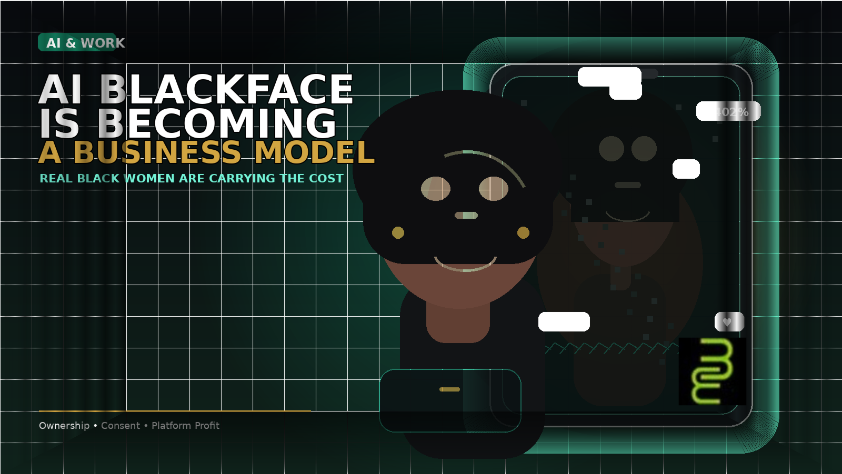
Part 1 of the Black Creators, AI, and Ownership series
AI is not just creating fake images.
It is creating fake people.
And in a growing number of cases, those fake people look like Black women.
A recent Glamour investigation found that hyper-realistic AI-generated Black women have been gaining attention across TikTok and Instagram.
Many appear in dance videos, stylized influencer posts, and sexualized content funnels. Some accounts are reportedly linked to paid subscriber platforms or adult-content ecosystems.
The investigation also found that some of these synthetic personas appear to be built from real Black women creators’ content without consent, including copied dances, camera angles, styling, and body movement.
That makes this more than an AI trend.
It is a labor story.
It is an ownership story.
It is a platform power story.
And it is a warning about how quickly Black women’s digital presence can be turned into someone else’s monetized asset.
The product is not just the image
When people talk about AI-generated influencers, the conversation often focuses on whether the image looks real.
That misses the deeper economic issue.
The product is not only the face.
The product is the whole package: the look, the dance, the styling, the captions, the attitude, the skin tone, the body language, the audience reaction, and the cultural signals that make the account feel familiar enough to go viral.
In other words, Black women are not just being visually copied.
Their digital labor is being converted into synthetic inventory.
That inventory can generate views.
- It can collect followers.
- It can drive traffic.
- It can send users to subscription platforms.
- It can feed adult-content funnels.
- It can train audiences to engage with artificial versions of Black womanhood.
And the real women whose creativity made that content valuable may receive nothing.
No licensing fee.
No credit.
No revenue share.
No control.
No meaningful protection from reputational harm.
That is the economic problem.
The market may value Black aesthetics more than Black people. That is not just a representation problem. It is an economic one.
From creator labor to unpaid input
One example in the Glamour report involved Josephine, a 21-year-old TikTok creator based in Sierra Leone, who said she found an AI-generated video that looked like it had recreated one of her older dance clips.
She said the dance, transitions, and camera angles mirrored content she had posted years earlier, but the video belonged to an AI-generated account and had received significant attention.
This is where the language matters.
Calling this “AI content” can make it sound neutral.
But if a creator’s original work is copied, remixed, and monetized without permission, the better economic term is extraction.
The inputs are unpaid.
The source is uncredited.
The output is commercial.
The harm is personal.
And the upside moves somewhere else.
That is not innovation by itself. That is a business model built on someone else’s creative value.
Digital blackface has entered its AI phase
Digital blackface is not new.
It has long referred to the use of Black imagery, expression, language, or personas online for entertainment, spectacle, or profit, often without accountability to Black people themselves.
AI changes the scale.
Instead of one meme, one GIF, or one stolen dance, someone can now create a full synthetic influencer.
- A fake face.
- A fake body.
- A fake personality.
- A fake relationship with followers.
- A fake creator identity.
But the revenue can be real.
Glamour’s reporting described this as an escalation of digital blackface, with AI-generated Black female personas often exaggerated, hyper-sexualized, and tailored toward racialized or fetish audiences.
That matters because the synthetic version does not exist in a vacuum.
It competes for attention with real Black women creators.
It shapes how audiences see Black women.
It can reinforce stereotypes while separating Black aesthetics from Black people.
It can make Blackness profitable while making Black women disposable.
The platform still wins
Even when a fake account is removed, the platform may already have benefited.
Every view creates engagement.
Every comment creates data.
Every share expands reach.
Every controversy keeps users scrolling.
That is why this cannot be understood only as individual bad actors using AI tools irresponsibly.
The platforms are part of the economic structure.
- They control distribution.
- They control the algorithm.
- They set the rules for reporting and takedowns.
- They decide what gets labeled.
- They decide how quickly harmful content is removed.
- They collect the audience behavior generated by the content.
Meanwhile, the creator whose image, movement, or style was copied has to do the work of noticing the theft, documenting it, reporting it, and hoping the platform responds.
That is an imbalance of power.
Who captures the upside?
Follow the money.
The anonymous operator of the AI account may capture subscriber revenue, affiliate income, traffic, or brand attention.
The social platform captures engagement, watch time, and data.
The AI tool ecosystem captures subscriptions, usage, and market growth.
The content platforms connected to paid “exclusive” material may capture transaction fees or user activity.
But the real Black woman whose likeness, dance, styling, or cultural identity helped make the synthetic persona valuable may capture none of it.
She may instead carry the risk.
- Her reputation can be distorted.
- Her image can be sexualized.
- Her work can be buried under a fake version.
- Her audience can be confused.
- Her ability to monetize her own identity can be diluted.
This is the ownership question at the center of the story:
Who owns Black digital identity when AI can copy the look, movement, and cultural style without copying the person exactly?
The insult is layered
This is happening in a creator economy where Black women already report unequal treatment.
The Glamour piece notes that Black women creators have raised concerns about shadowbanning, harassment, limited monetization, and unequal exposure. It also cites a 2024 Influencer Pricing Report from Sevensix Agency finding that Black influencers were paid 34% less than white influencers.
That makes the AI issue even more serious.
Real Black women can be underpaid, under-promoted, and over-policed.
Meanwhile, AI-generated versions of Black women can be boosted, fetishized, and monetized.
That reveals a hard truth about the digital economy:
The market may value Black aesthetics more than Black people.
It may value Black culture more than Black creators.
It may value Black women’s image more than Black women’s ownership.
That is not just a representational problem.
It is an economic one.
This is cultural value without consent
Black culture creates enormous economic value online.
Dance trends.
Beauty aesthetics.
Language.
Fashion.
Comedy.
Reaction culture.
Music discovery.
Visual style.
Community storytelling.
Black creators help build the internet’s rhythm, but they often do not control the platforms, policies, monetization systems, or data that turn that rhythm into revenue.
AI intensifies that pattern.
It can take cultural signals and reproduce them endlessly.
It can imitate without hiring.
It can remix without licensing.
It can scale without consent.
It can profit from the emotional and visual familiarity of Black womanhood while removing the Black woman herself from the economic equation.
That is why this story belongs in the BlackEconomicDevelopment.com lens.
The issue is not simply that fake Black women are going viral.
The issue is that Black women’s digital labor is being converted into a new class of synthetic media assets.
Visibility is not ownership
Some may argue that AI influencers are just part of the new creator economy.
But visibility is not ownership.
Going viral is not ownership.
Being imitated is not ownership.
Being culturally influential is not ownership.
Ownership means control.
It means consent.
It means licensing.
It means compensation.
It means the ability to say no.
It means the ability to participate in the upside when your likeness, labor, or cultural value generates revenue.
Without that, Black creators risk becoming raw material for systems they do not control.
What this reveals about AI and Black economic power
The AI economy is moving quickly.
The legal, platform, and cultural protections around likeness, image rights, deepfakes, and synthetic content are moving more slowly.
That gap creates opportunity for exploitation.
And Black women are once again being placed at the front edge of the harm.
This is not only about whether an AI image is labeled correctly.
It is about whether Black creators have enforceable rights in an economy that can learn from them, copy them, remix them, and compete against them.
It is about whether platforms are accountable when synthetic content uses racialized stereotypes to drive engagement.
It is about whether creators can protect their archives, their audience, their faces, their movement, their voices, and their brand identity.
It is about whether Black cultural value becomes owned wealth or unpaid input.
The bottom line
AI blackface is not just offensive.
It is extractive.
It takes Black women’s faces, dances, styling, movement, audience behavior, and cultural identity and turns them into monetizable content.
It allows fake personas to capture attention while real creators carry the cost.
It lets platforms profit from engagement while creators fight for removal after the damage spreads.
And it shows how the AI economy can reproduce an old pattern in a new form: Black creativity powering markets that Black people do not control.
The question now is not whether AI will keep growing.
It will.
The question is whether Black creators, businesses, educators, attorneys, technologists, and media builders will organize around ownership before more cultural value is extracted.
Because in the AI economy, the choice is becoming clearer:
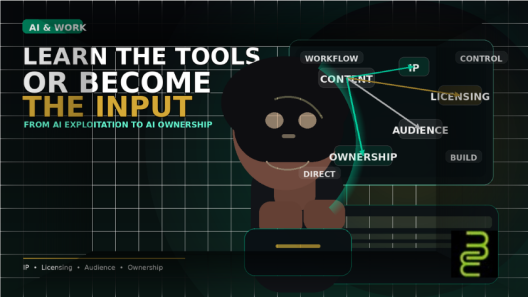
Learn the tools, or become the input.
Economic implication
AI-generated Black influencer accounts expose a new form of extraction: synthetic media built from real creator labor, racialized aesthetics, likeness value, and cultural identity.
The business model depends on unpaid inputs: faces, dances, styling, movement, audience behavior, and online identity.
The upside flows to account operators, platforms, AI tools, subscription funnels, and data-driven media systems.
The risk falls on Black women creators whose image, reputation, labor, and monetization potential can be copied, distorted, or diluted.
Why it matters
For Black communities, this is not just a technology issue.
It is a wealth and ownership issue.
Black creators need stronger rights, better platform enforcement, AI literacy, licensing strategies, and pathways to own the value their digital labor creates.
Black culture cannot continue to be treated as an open-source asset for everyone else’s monetization.
Ownership question
What should Black women creators own in the AI economy: their face, their movement, their voice, their style — or all of it?
Latest posts by normbond (see all)
- Nearly $300 Million for Community Lenders Could Disappear September 30. What Happens to the Credit Behind It? - September 23, 2026
- The Florida College Sports Fight Is Really About Media Money and Control - September 20, 2026
- Porsha Williams’ Fibroid Emergency Points to a Bigger Economic Cost for Black Women - September 19, 2026