


Republican pressure around Caitlin Clark’s treatment raises a larger question: who controls workplace standards when one player’s commercial value becomes a political asset?
The foul itself is not the whole story.
The bigger issue is what happened after it.
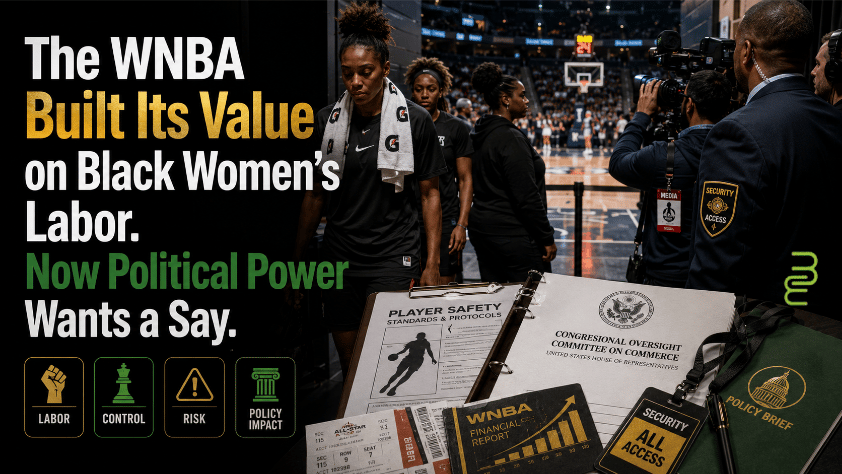
Republican lawmakers have pressed WNBA Commissioner Cathy Engelbert over the league’s treatment of Caitlin Clark, arguing that repeated physical play against Clark may require stronger league action and even potential federal civil-rights scrutiny.
According to The Guardian, 11 Republican politicians wrote to the WNBA asking the league to protect Clark from what they described as “multiple attacks” on court.
The letter also raised the possibility of review by the Justice Department, Department of Labor, or Equal Employment Opportunity Commission if discrimination or retaliation were creating a hostile work environment.
No confirmed Justice Department investigation has been reported in the credible sources reviewed for this story.
The political pressure followed a June incident involving Phoenix Mercury forward Alyssa Thomas and Indiana Fever guard Caitlin Clark.
According to Associated Press reporting, Thomas received a one-game suspension after contact with Clark’s throat was reviewed after the game and classified as a Flagrant Foul 2.
AP also reported that Thomas said she later received death threats and racial slurs.
Thomas criticized the league for not doing more to protect players from off-court abuse. Clark publicly condemned the racist abuse directed at Thomas.
That is where the economics enter.
Caitlin Clark Is an Audience Asset
Clark is not just a player.
She is a major audience asset.
She moves ratings, ticket demand, media attention, sponsorship interest and national conversation. For the WNBA, that matters.
Women’s sports have spent decades being undervalued by networks, advertisers and institutional capital. A player who expands the audience can create real leverage for the league.
That leverage can help raise franchise valuations, increase broadcast interest, strengthen sponsorship deals and bring new fans into the sport.
But the WNBA’s value was not created by one star alone.
The league’s labor, identity and competitive history have been built heavily by Black women.
That history matters when political and media narratives begin framing Black players as obstacles to the league’s newest commercial boom.
This is not simply about who gets fouled.
It is about who gets protected, who gets blamed and who gets treated as part of the product instead of part of the workplace.
The Labor Question Underneath the Culture War
Political actors are now trying to influence how the WNBA disciplines, protects and markets its labor.
- They do not own WNBA teams.
- They do not manage officiating.
- They do not bargain with the players.
Yet by attaching civil-rights language to Clark’s treatment, they are inserting federal political power into a sports labor dispute shaped by race, gender, media attention and commercial value.
That creates a dangerous tension.
The league has a business incentive to protect Clark. She is one of its most marketable players, and her visibility has brought new attention to women’s basketball.
But if that protection becomes unequal, or if Black players are portrayed as threats to the league’s most valuable white star, then the WNBA risks damaging the very labor base that helped build its credibility.
This does not require defending every foul.
The league should have consistent rules. It should protect every player from unnecessary contact. It should improve officiating. It should take online abuse seriously.
It should also address harassment, threats and racism against Black players with the same urgency that political actors now demand for Clark.
Who Controls the Workplace?
That is the ownership question underneath the controversy:
Who controls workplace standards when one player’s market value becomes a basis for outside political intervention?
The WNBA controls discipline, officiating and player-safety policy.
Team owners and media partners control much of the commercial structure.
Players create the product.
Fans create attention.
Sponsors monetize the visibility.
Politicians now see an opportunity to turn that visibility into culture-war leverage.
The upside is clear.
Politicians gain attention from a high-visibility racial and cultural conflict. Media outlets gain traffic. The league benefits from Clark-driven audience growth. Sponsors benefit from the expanded reach of women’s basketball.
The risk is also clear.
Black players carry racial abuse, reputational distortion and potentially unequal scrutiny. The league risks losing control of its own governance narrative. Clark also loses control of how her identity and market value are used politically.
That is why this story matters beyond sports.
When Black Labor Builds Value, Governance Becomes the Fight
The WNBA is a predominantly Black women’s labor institution operating inside a fast-growing commercial market.
As the money grows, the fight over governance grows with it.
That is the deeper economic story.
Black women’s labor helped build the league’s credibility, culture and competitive product.
Now that the audience is expanding, outside political actors are attempting to influence how that labor should behave, be disciplined and be interpreted.
That matters because sports leagues are not just entertainment companies.
- They are workplaces.
- They are media assets.
- They are sponsorship vehicles.
- They are cultural institutions.
- They are also economic systems where ownership, labor, capital and public narratives collide.
The question is not whether Clark deserves protection.
She does.
The question is whether every player does. And whether the WNBA can govern that standard without Black athletes being turned into the cost of someone else’s commercial and political upside.
The Economics Behind It
The core economic issue is governance control over a growing labor market.
Clark’s commercial value gives the WNBA new leverage with audiences, sponsors and media partners. But political pressure can distort how the league manages workplace standards.
Especially when Black women’s labor is framed through suspicion, aggression or threat rather than as the foundation of the product.
The WNBA built much of its institutional value on Black women’s talent, visibility, labor and credibility.
Now that the league’s commercial profile is expanding, the power question becomes sharper:
Who gets to control the rules when the value goes up?
For Black communities, this is not only a WNBA controversy.
It is a case study in what happens when Black labor builds institutional value, but outside actors try to control the rules once the asset becomes more profitable.
Why It Matters
This story is not just about basketball.
- It is about labor.
- It is about ownership.
- It is about media power.
- It is about race, gender and workplace governance inside a league whose value is rising.
And it is about whether Black women can remain central to the WNBA’s economic growth without being framed as a problem to be managed.
Your take:
Who should control workplace standards in a league when one player becomes the league’s biggest commercial asset — the league, the players, the owners, the media market, or political power?

Latest posts by normbond (see all)
- Dangote Refinery IPO Opens. Africans Can Buy Shares—Dangote Keeps Control - September 14, 2026
- U.S. Lends Africell Nearly $100M. Africa Faces a Bigger Ownership Question - September 11, 2026
- Jacob Coxon Quit Anthropic Over AI Risk. He Also Walked Away Before His Equity Vested - September 10, 2026