



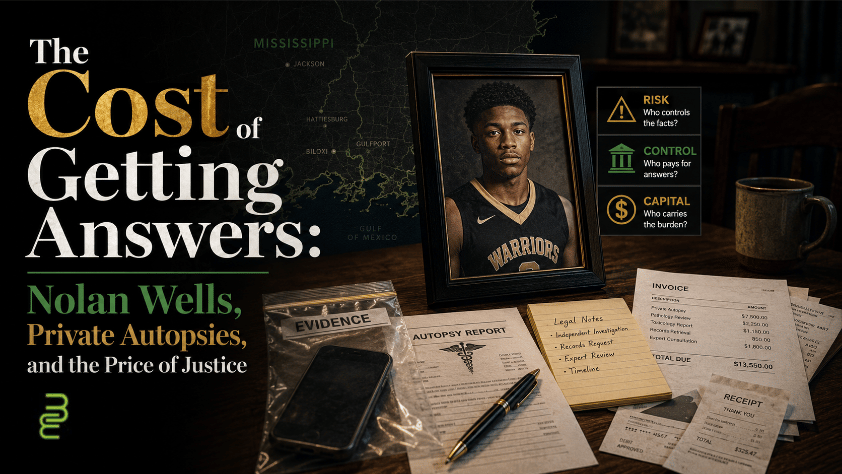
Nolan Xavier Wells was 18 years old.
He was a Black college student. A football player. A son. A young man with a future.
According to AP, Wells traveled by boat with friends to Horn Island, Mississippi, on July 4. He did not return with them that afternoon.
His body was found early Monday morning, more than a day later. Authorities have said investigators do not currently suspect foul play, while Wells’ family is calling for a deeper and more transparent investigation.
That is the human story.
The economic story is about what happens when a grieving Black family feels forced to build its own infrastructure of accountability.
Civil rights attorney Ben Crump has been retained by the family. The family plans to conduct an independent autopsy. AP reports that Tyler Perry is helping pay for Wells’ funeral, Colin Kaepernick is helping pay for the independent autopsy, and Spike Lee appeared at a news conference to support the family.
That should not be reduced to celebrity involvement.
It is a signal.
Because in America, getting answers can cost money.
When Transparency Has a Price Tag
There are obvious costs after a death.
Funeral costs. Travel costs. Legal costs. Time away from work. Counseling. Communications. Public advocacy.
But in cases where families distrust the first explanation, the cost structure expands.
Now the family may need attorneys. Medical experts. Independent forensic review. Digital evidence recovery. Media support. Community organizing. Security. Public records requests. Transportation. Strategy.
That is not just grief.
That is a privately funded search for truth.
Wells’ family has raised concerns about the details surrounding his final hours. AP reports that family members said they had seen video of a fight allegedly involving Wells, and they also noted that he was an athlete who could swim.
Authorities have asked witnesses or people with video from Horn Island to come forward.
That detail matters because evidence is not only physical anymore. It is digital, social, and often scattered across phones, cloud accounts, cameras, group chats, and platforms.
The Phone Is an Economic Asset
One of the most important facts reported so far is not only where Wells was found.
It is where his phone was.
AP reports that attorneys said the friends who left Wells on the island took his phone and keys when they departed.
Crump said Wells’ family used an app to track the phone, and a friend went to where it was on land to pick it up. The family also believes text messages from social media apps had been deleted and plans to use experts to try to recover data.
That is where the economics behind the story becomes clear.
A phone is not just a device.
It can hold location history, messages, videos, timestamps, app activity, photos, calls, and social context. In a case where a family is asking whether the official account is complete, digital information can become evidence.
And evidence has a cost.
Recovering deleted data may require experts. Legal access may require attorneys. Preserving a phone may require chain-of-custody discipline. Interpreting digital activity may require technical skill.
- Who can afford that?
- Who knows whom to call?
- Who has a public platform large enough to make institutions respond?
Those questions are economic questions.
Celebrity Capital Becomes Accountability Capital
Tyler Perry paying funeral costs and Colin Kaepernick helping fund an independent autopsy does not tell us what happened to Nolan Wells.
But it does tell us something about power.
Celebrity capital can become accountability capital.
Perry’s money helps reduce the immediate financial burden of burial. Kaepernick’s support helps fund a second medical review. Spike Lee’s presence increases public visibility. Crump’s involvement brings legal infrastructure and national media fluency.
Together, those resources change the family’s position.
They do not guarantee answers.
But they give the family more leverage to demand them.
That is the economic interpretation: families with access to money, legal networks, public attention, and trusted advocates have more capacity to challenge official narratives than families without those resources.
Who Controls the Facts?
The ownership question in this story is not about a company.
It is about control.
- Who controls the official investigation?
- Who controls the autopsy?
- Who controls the phone?
- Who controls the timeline?
- Who controls the public narrative?
- Who has the resources to challenge an early conclusion?
AP reports that the Jackson County Sheriff’s Office said investigators do not currently suspect foul play, while the family is asking for a transparent investigation and says many details do not add up.
That tension is the center of the story.
This is not a call to speculate. It is a call to recognize that transparency is not equally accessible.
When families trust the system, the official process may feel sufficient.
When they do not, they may have to pay for a parallel process.
The Black Community Impact
Black families have long relied on informal justice infrastructure when formal systems feel incomplete.
That infrastructure can include churches, civil rights attorneys, activists, journalists, community groups, donors, celebrities, and digital organizers.
- Sometimes that network helps raise money.
- Sometimes it keeps a story from disappearing.
- Sometimes it forces institutions to release more information.
- Sometimes it simply gives a grieving family enough support to keep asking questions.
But the need for that infrastructure reveals a gap.
If transparency depends on who can afford an independent autopsy, who can hire experts, who can attract national attention, or who can get a celebrity to help, then justice is not only a legal matter.
It is an economic one.
The Economics Behind It
Where the money is moving:
Funeral expenses, legal representation, independent autopsy costs, possible digital evidence recovery, travel, public advocacy, and media strategy.
Who owns or controls the assets:
Law enforcement controls the official investigation. Medical authorities control the official autopsy process. The family and its legal team are trying to create an independent accountability channel. The phone and any recoverable data may become key evidence assets.
Who captures the upside:
The family could gain a fuller record, more transparency, stronger legal positioning, and public pressure for a thorough investigation.
Who carries the risk:
The family carries emotional risk, financial pressure, reputational exposure, and the burden of navigating public speculation while grieving.
What this reveals:
Access to answers can depend on access to money, experts, attorneys, media attention, and trusted networks.
Why It Matters
Nolan Wells’ death should be handled with care.
The point is not to turn grief into content.
The point is to ask why families so often need outside money, celebrity support, legal pressure, and digital investigators to feel that a death is being fully examined.
For Black communities, the question is not only “What happened?”
It is also: What does it cost to find out?
And who should have to pay that cost?
That is the economics behind it.
Latest posts by normbond (see all)
- Burkina Faso Rejected a U.S. Deportation Deal. Then the Fight Moved to Visa Access. - October 19, 2026
- NC A&T Students Marched 45 Minutes to Vote. The Bigger Story Is Who Controls Access. - October 17, 2026
- Black Family Wealth Fell 25%. The Ownership Gap Is the Bigger Story. - October 16, 2026







ABC morning news didn’t interview the family until July 10 and the case is still receiving spotty evening coverage. What’s the economics behind their reluctance?