


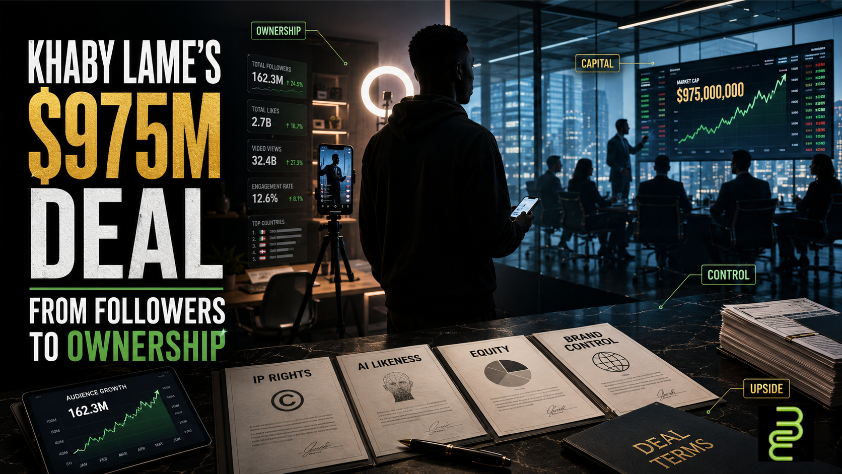
The Senegal-born TikTok star’s rise is not just a creator success story. It is a case study in how audience, identity, AI likeness, and brand rights are becoming investable assets.
Khaby Lame built one of the largest audiences on the internet without saying much at all.
Now the economics around his image are saying plenty.
The Senegal-born, Italy-based creator ranked No. 15 on Forbes’ 2026 Top Creators list, according to Business Insider Africa, with estimated annual creator earnings of $9.9 million, 252.1 million total followers, and a 4.72% average engagement rate.
That ranking matters.
But the bigger story is not just where Lame landed on a creator list.
The bigger story is how his audience, likeness, gestures, brand rights, and commercial future are being packaged as an asset.
From Viral Attention To Investable IP
Lame became globally recognizable through silent comedy videos that parody overly complicated internet trends. His format crossed language barriers, giving him reach far beyond one country, one platform, or one culture.
That global reach helped turn him into one of the most followed creators in the world.
But follower count is only one layer of the business.
In January 2026, Rich Sparkle Holdings Limited disclosed in a U.S. Securities and Exchange Commission filing that it had entered into an agreement to acquire Step Distinctive Limited, a company tied to Lame’s commercial business, for $975 million.
The deal was structured as an all-stock transaction, with the purchase price to be satisfied through the issuance of 75 million ordinary shares.
That detail is important.
This was not simply a sponsorship deal.
It was a proposed public-market transaction that treated creator influence like a business unit with future monetization potential.
The asset was not just funny videos. The asset was audience trust, global recognition, brand identity, commercial rights, and the ability to turn attention into revenue.
The Ownership Question
The ownership question is not just whether Khaby Lame is famous.
The question is: who controls the economic rights attached to that fame?
According to the SEC filing, Rich Sparkle intended to purchase the entire issued share capital of Step Distinctive Limited. The filing also said the company would continue to be led by Lame after the transaction.
That makes the story more complicated than a simple “creator sells company” headline.
The deal potentially converts part of Lame’s creator business into shares of a publicly traded company. That could give him equity upside if the company grows.
But it also exposes the value of his brand to stock-market volatility, investor confidence, regulatory approvals, and execution risk.
That is the part of the creator economy that rarely appears in viral success stories.
Fame can create leverage.
But ownership structures decide who captures the upside.
The AI Layer Changes The Stakes
The most important economic layer may be artificial intelligence.
Forbes reported that the Rich Sparkle deal included authorization for the use of Lame’s Face ID, Voice ID, and behavioral models for AI digital twin development.
That means the asset is not only Lame’s past content.
It may also be his digital likeness, his gestures, his performance style, his audience trust, and the ability to reproduce parts of his identity across markets.
That raises a major creator-economy question: when a creator’s likeness becomes scalable through AI, who owns the output?
For Black and African creators, this is not theoretical.
The next wave of creator wealth may depend less on follower count and more on contract terms, image rights, data rights, AI permissions, platform dependency, equity ownership, and control over distribution.
Why This Is Bigger Than A Creator Ranking
Khaby Lame’s story points to a bigger shift in the creator economy: the move from creator income to creator ownership.
The business is no longer limited to posts, sponsorships, or follower counts.
The new value stack includes brand rights, e-commerce infrastructure, AI likeness rights, public-market exposure, merchandise, livestream shopping, and global distribution.
That matters because visibility is not the same as ownership.
For African and Black diaspora creators, Lame’s rise shows what global cultural reach can become when audience, identity, and intellectual property are treated as business assets.
But it also raises the harder question: who controls the rights, who owns the company, who benefits from the shares, and who has permission to use AI versions of a creator’s image, voice, and behavior?
The lesson is clear: cultural attention creates value, but ownership determines who captures it.
What It Means For Africa And The Diaspora
Lame’s story is powerful because it connects African-born talent to the global creator economy at the highest level.
He was born in Dakar, Senegal, built his career in Italy, and became one of the most recognizable digital creators in the world through a comedy format that needed no translation.
That global reach shows what African-linked creators can build when culture travels faster than traditional media systems.
But it also reveals the gap.
Africa has young, mobile-first audiences and enormous creative output. Yet the infrastructure around creator monetization remains underdeveloped compared with the United States, Europe, and Asia.
That infrastructure includes legal protection, management, licensing, capital access, payment systems, production ownership, brand development, and equity pathways.
Lame’s deal shows both the opportunity and the warning.
The opportunity is that African-born talent can become a global commercial asset.
The warning is that if creators do not understand ownership, intellectual property, AI rights, and equity structures, the most valuable parts of their brands may be controlled elsewhere.
The Economics Behind It
The money is moving from advertising and sponsorships toward ownership structures, licensing rights, AI replicas, e-commerce, merchandise, and public-market speculation.
The asset is not just content.
It is audience trust, identity, likeness, behavior, global reach, and the ability to sell across platforms.
The upside may go to Lame if the equity structure holds value and the business executes. It may also go to Rich Sparkle, investors, platform partners, e-commerce operators, and AI commercialization partners.
The risk sits with the creator’s brand, retail investors, and anyone betting that viral influence can be converted into durable revenue.
For Black communities, the lesson is bigger than one creator.
Culture can travel globally. Attention can become capital. Identity can become intellectual property.
But ownership decides whether creators build wealth from that value or simply help others monetize it.
Khaby Lame did not just make another creator list.
His story shows that the next phase of the creator economy will be fought over rights, equity, AI identity, and control.
Latest posts by normbond (see all)
- Who Owns the Upside From Power? 50 Cent’s Variety Interview Reveals a Bigger TV Economics Story - October 20, 2026
- Burkina Faso Rejected a U.S. Deportation Deal. Then the Fight Moved to Visa Access. - October 19, 2026
- NC A&T Students Marched 45 Minutes to Vote. The Bigger Story Is Who Controls Access. - October 17, 2026