


JAŸ-Z in 8” arrives after a summer of stadium shows, anniversary activations and renewed attention around Jay-Z’s catalog. But the bigger lesson is not nostalgia. It is how assets, audience access, distribution and ownership can be connected to create new leverage long after the original work is done.
Jay-Z is taking decades of music to HBO.
On its own, that is an entertainment story.
But we have seen this asset before.
Less than two months ago, BlackEconomicDevelopment.com examined Jay-Z’s Yankee Stadium anniversary concerts and argued that the real business story was not simply the crowd.
It was the catalog.
The music.
The story around the music.
The New York connection.
The mythology accumulated over decades.
And the ability to turn all of that cultural memory into new economic demand.
Now that same body of work is moving into another distribution system.
HBO.
The eight-part documentary series “JAŸ-Z in 8” is scheduled to premiere September 18 on HBO and HBO Max, with Jay-Z and producer Rick Rubin revisiting songs from across his career.
Look at the documentary by itself and you see a television project.
Look at what has happened around Jay-Z’s catalog over the past few months and something larger comes into focus.
This is not just old music being remembered.
It is old music creating new products, gathering audiences and opening additional economic channels.
And that may be the more important business lesson.
The Stadium Shows Were Not Standing Alone
In July, BEDC covered Jay-Z’s Yankee Stadium run as a case study in the economics of legacy.
The shows were built around the 30th anniversary of Reasonable Doubt and the 25th anniversary of The Blueprint.
Our argument then was simple:
A mature hip-hop catalog can become more than something people stream.
It can become an event.
A destination.
A reason to sell tens of thousands of tickets.
A reason to move merchandise.
A reason for media companies to generate coverage.
A reason for restaurants, hotels, transportation companies, ticketing platforms, vendors and other businesses to participate in the economic activity surrounding the audience.
But the stadium shows were not standing alone.
That line matters.
Because one of the bigger economic lessons here is that strong assets become more powerful when they are connected to other assets.
The catalog can create the concert.
The concert can renew attention around the catalog.
The anniversary can support merchandise.
The merchandise can reinforce identity.
The documentary can extend the story.
The story can introduce the catalog to another audience.
Each piece can make the others more economically useful.
That is leverage.
Don’t Just Build Assets. Connect Them.
Jay-Z and Roc Nation operate at a scale most entrepreneurs never will.
But the mentality is not exclusive to billion-dollar businesses.
A small business owner can ask the same question.
Not simply:
What is this asset worth?
But:
What other assets can this make more valuable?
A newsletter can support a service.
A service can produce customer insights.
Those insights can become a report.
The report can create authority.
Authority can create speaking opportunities.
A scorecard can create leads.
Those leads can reveal customer needs.
Those needs can inform a product.
The product can strengthen the newsletter.
A piece of intellectual property can have several jobs.
The advantage can begin before any of those assets are large.
Thinking in systems can change what an entrepreneur chooses to build in the first place.
That is one of the most transferable lessons in the Jay-Z story.
Do not think only in terms of individual products.
Think in terms of an economic system in which the products reinforce one another.
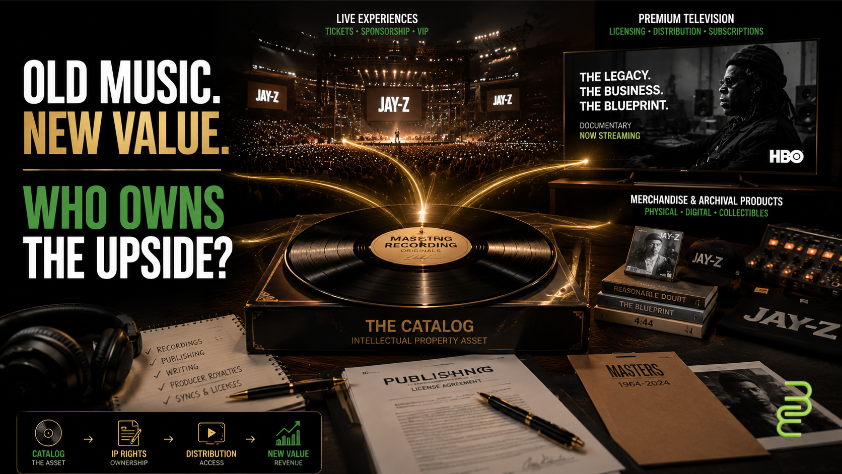
One Catalog. Multiple Economic Lives.
The same legacy can support:
- stadium concerts
- merchandise
- archival experiences
- media coverage
- international performances
- streaming attention
- premium television
Different products.
Different distribution systems.
Different customer experiences.
Same underlying cultural asset.
A song may begin as recorded music.
A catalog can become much more.
- It can become live entertainment.
- It can become television.
- It can become licensing inventory.
- It can become merchandise.
- It can become cultural history.
- It can become a reason for people to gather.
And once people gather, another asset appears.
The audience.
The Catalog Creates the Crowd
That connects directly to another recent BEDC story.
In our examination of how Black culture builds the crowd while the bigger money may sit with whoever controls access to it, we made a distinction that matters here.
Culture may create the audience.
But some of the larger economic value can sit in who controls access to that audience after it has been assembled.
The concert creates the crowd.
Then the crowd can create:
- ticketing revenue,
- sponsorship inventory,
- advertising opportunities,
- customer data,
- platform analytics,
- media distribution,
- brand relationships,
- payments,
- future offers,
- and potentially new intellectual property.
That idea becomes important when we look at Jay-Z’s catalog.
The songs do not only produce content.
They can still organize people.
At Yankee Stadium, the catalog assembled tens of thousands of fans in one place.
On HBO, it can assemble viewers around a premium media product.
Around merchandise, it can assemble buyers.
Across streaming platforms, it can reactivate listeners.
The catalog creates the reason people show up.
The bigger wealth question is who controls what happens after they do.
Owning the Asset Is Only One Layer
That takes us beyond the traditional ownership question.
Who owns the song?
Important.
But not enough.
We also have to ask:
- Who controls the ticketing relationship?
- Who controls the streaming relationship?
- Who owns the customer data?
- Who sells access to sponsors?
- Who controls distribution?
- Who owns the platform analytics?
- Who can reach the audience again after the original transaction is over?
Those questions matter because economic power does not live only in the asset.
It also lives in the pathways around the asset.
A fan buys a ticket.
That is revenue.
But the company controlling the relationship with that fan may gain something else.
- Information.
- Access.
- The ability to communicate again.
- The ability to sell something else.
- The ability to package that audience for advertisers or sponsors.
The concert may create the crowd.
Control of the relationship can create recurring value.
Jaylen Brown Raises the Same Question From Another Direction
That same question recently surfaced in a different part of the Black economy.
In BEDC’s examination of Jaylen Brown and the financial ecosystem surrounding athlete wealth, Brown raised concerns about the incentives surrounding athletes when they try to direct more of their money, time and influence toward their communities.
He also explained during a Twitch stream that part of his reason for streaming was to establish a more direct channel to the public in response to narratives about him in traditional media.
In his words, “they forced my hand.”
That is a media story.
It is also an economics story.
Brown has income.
He has fame.
He has influence.
But his comments point toward something larger:
High income is not the same thing as economic control.
There is an entire ecosystem around elite athletes.
Agents.
Managers.
Financial advisers.
Banks.
Asset managers.
Lawyers.
Brands.
Investment professionals.
Media organizations.
Platforms.
Many of those participants provide legitimate and necessary services.
But each can also sit somewhere between the person creating the value and the ultimate destination of that value.
That gives us a broader question:
Who gets to stand between value creation and value deployment?
The Ownership Question Does Not End With Ownership
The Jaylen Brown story makes one point particularly useful here:
The ownership question does not end when the paycheck reaches the athlete’s account.
The same principle applies to intellectual property.
The ownership question does not end when the creator owns the asset.
Because ownership without control over distribution, audience access, customer relationships, data or deal structure can still leave substantial economic power somewhere else.
That is why we should distinguish between several questions.
- Who creates the value?
- Who owns the asset?
- Who controls access to the asset?
- Who controls access to the audience?
- Who has the right to participate in the transaction?
- Who influences where the money goes next?
- Who stays in the value chain every time the asset gets used again?
That is a much richer definition of economic power.
Digital Platforms Are Changing the Equation
There is another reason this matters now.
The structure of business itself is changing.
The internet, digital platforms and creator tools have made it possible for entrepreneurs, athletes, artists and other talent to establish forms of direct — or at least more direct — two-way relationships with audiences that would have been far more difficult 10 or 20 years ago.
- A musician does not have to rely only on radio.
- An athlete does not have to rely only on traditional sports media.
- A business does not have to rely only on traditional advertising.
- A writer does not have to rely only on a publisher.
- A founder does not have to wait for someone else’s media platform to explain the company.
They can publish.
Stream.
Email.
Sell.
Survey.
Respond.
Test.
Build community.
Collect first-party signals.
And learn from the market directly.
That creates leverage.
But there is an important caveat.
Direct does not always mean controlled.
A creator streaming on Twitch is still using Twitch.
A business building an audience on Instagram is still using Meta’s infrastructure.
An artist reaching fans through a streaming service is still operating inside somebody else’s rules.
So the opportunity is not simply to “go direct.”
It is to understand which relationships you actually own and which relationships you are renting from someone else.
An email list is different from a social follower.
A customer database is different from a platform audience.
Owned intellectual property is different from rented reach.
The strategic opportunity is to use platforms for access while steadily building assets that create more independent leverage.
AI Could Accelerate This Shift
Artificial intelligence adds another layer.
AI does not eliminate the need for judgment.
It does not create demand by itself.
And it certainly does not guarantee that a business will make money.
But it can reduce the cost of coordinating multiple assets.
- One person can research faster.
- Repurpose content faster.
- Analyze customer feedback faster.
- Create variations of an offer faster.
- Turn one idea into several formats faster.
- Connect information across a business faster.
That matters especially for smaller operators.
Large companies have always been able to employ teams that connect content, marketing, research, product development, customer intelligence and sales.
Smaller entrepreneurs often could not.
AI can narrow part of that capability gap.
Not by making the small company large.
But by helping a small operation behave with more coordination than its headcount would normally allow.
That can help entrepreneurs punch above their weight.
The real opportunity is not simply “use AI.”
It is:
Use AI to make your assets work together more effectively.
AI is not the economic engine.
It can be rocket fuel for an engine built around connected assets.
Connected Assets Can Create Optionality
There is another reason this mentality matters.
Risk.
A business built around one product, one platform, one customer type or one revenue stream can become vulnerable quickly.
Algorithms change.
Consumer behavior changes.
Platforms change the rules.
Technology changes the cost structure.
Competitors appear.
Distribution shifts.
A connected asset strategy can create more options.
The newsletter can feed the product.
The product can feed the service.
The service can produce data.
The data can improve the next offer.
The audience can create distribution.
The intellectual property can become content.
The content can become customer acquisition.
Not every pathway will make money.
Some will fail.
Some will remain theoretical until the market proves them.
But the architecture can create more ways for value to move through the business.
And optionality can reduce dependence on any single bet.
HBO Adds Another Distribution Layer
Now return to Jay-Z.
At Yankee Stadium, the product was physical presence and scarcity.
You had to be there.
There were only so many seats.
That scarcity supported tickets, premium experiences, merchandise and the wider live-event economy.
With HBO, the asset changes form again.
Now the product is access to the story.
The conversations.
The creative process.
The history.
The meaning behind music audiences already know.
The same catalog that filled a stadium can support premium television.
That is not merely longevity.
It is portability.
The intellectual property can move from one economic environment into another.
And every new environment introduces another group of participants who may capture value.
Value Creation and Value Capture Are Different Things
That remains the central ownership issue.
The HBO documentary involves several different assets and potentially several different sets of rights.
- There is the documentary itself.
- The songs.
- The sound recordings.
- The compositions.
- Jay-Z’s name and likeness.
- Production rights.
- Distribution rights.
- Potential licensing arrangements.
- Potential backend participation.
Variety identifies Tetragrammaton as the production behind the series and lists Shawn Carter, Daniel Kaluuya and Rick Rubin among the executive producers.
What remains less visible is the underlying economic structure: who owns the documentary, how the music is licensed, how the different rights holders participate, and what financial interests are attached to the project.
Those details matter because the same cultural asset can create value in several places at once. The songs have one rights structure. The documentary has another. Distribution adds another layer. So does audience access.
The economics are not just in what gets created. They are in how the rights around it are divided.
Creating value and capturing value are different things.
The outcome depends on the rights.
The contracts.
The ownership.
The distribution.
The audience relationship.
The leverage.
Who Owns Enough of the Ecosystem?
The question BEDC asked around Yankee Stadium was:
Who captures the upside?
The HBO story allows us to go further.
Who owns enough of the ecosystem to keep participating every time the asset changes form?
That is a higher level of economic power.
A performer can earn from the concert.
A rights holder can earn when a song is licensed.
A venue earns when the crowd enters the building.
A ticketing company earns when access is sold.
A streaming platform benefits when listeners return.
A media platform benefits when the catalog becomes programming.
A sponsor can pay for access to the audience.
A company controlling the customer relationship may continue creating value from that relationship after the original event is over.
The strongest position is not necessarily owning every piece.
That is often unrealistic.
The stronger position is understanding which pieces matter most, owning or controlling the ones that create leverage, and connecting them so the system becomes more valuable than any single component.
A Catalog Can Become a Platform
That may be the best way to understand Jay-Z’s catalog now.
Not simply as a collection of old songs.
As a platform.
The songs create recognition.
Recognition creates attention.
Attention gathers an audience.
The audience creates demand.
Demand supports events.
Events create more attention.
Attention drives merchandise.
Streaming.
Media.
Sponsors.
Documentary content.
And potentially other products that have not yet been announced.
The cycle can feed itself.
catalog -> attention -> audience -> products -> distribution -> data -> relationships -> new demand
Whether or not every piece was designed as one coordinated strategy, the economic pattern is clear: the same underlying cultural asset is supporting several markets at once.
The economic lesson is visible.
The same underlying cultural asset can support several markets at the same time.
And there may be more to come.
The Old Playbook Is Getting Harder to Defend
That is where the story moves beyond entertainment.
Black entrepreneurs are operating in an economy where assumptions about distribution, media, customer relationships, technology and labor are changing quickly.
What worked five, 10 or 20 years ago may not disappear overnight.
But relying on the old structure without understanding the new one can become increasingly expensive.
The opportunity now is to become more observant.
- Look at what assets you already have.
- Look at what relationships you control.
- Look at what you are renting.
- Look at what can be connected.
- Look at where AI can reduce coordination costs.
- Look at where digital platforms can provide access.
- Look at where those same platforms create dependency.
- Look at where customer relationships can become more direct.
- And look at what intellectual property can do beyond its first use.
The entrepreneur who sees those relationships early may have an advantage before the business ever becomes large.
Old Music. New Value. Bigger Lesson.
A song can have one release.
A catalog can have multiple economic lives.
And the most valuable assets may not wait for one economic life to end before another begins.
They can operate across several markets at the same time.
Jay-Z’s recent run makes that visible.
The same legacy has moved through live events, merchandise, anniversary activations and now premium television.
But the deeper lesson is not simply that old music can still make money.
It is that assets become more powerful when they are connected.
The catalog creates the crowd.
The crowd creates the audience relationship.
The audience can create data, sponsors, distribution, new products and renewed demand.
Digital tools can make those relationships more direct.
AI can make them cheaper for smaller organizations to coordinate.
Ownership determines what you possess.
Control determines what you can do with it.
And leverage often comes from how effectively one asset strengthens another.
Black culture has never had a problem creating value.
The next economic challenge is to build more systems in which Black creators, entrepreneurs and institutions remain positioned to capture that value as it moves, changes form and creates something new.
Don’t just ask what an asset is worth today.
Ask what else it can make possible tomorrow.
Latest posts by normbond (see all)
- Who Owns the Upside From Power? 50 Cent’s Variety Interview Reveals a Bigger TV Economics Story - October 20, 2026
- Burkina Faso Rejected a U.S. Deportation Deal. Then the Fight Moved to Visa Access. - October 19, 2026
- NC A&T Students Marched 45 Minutes to Vote. The Bigger Story Is Who Controls Access. - October 17, 2026