


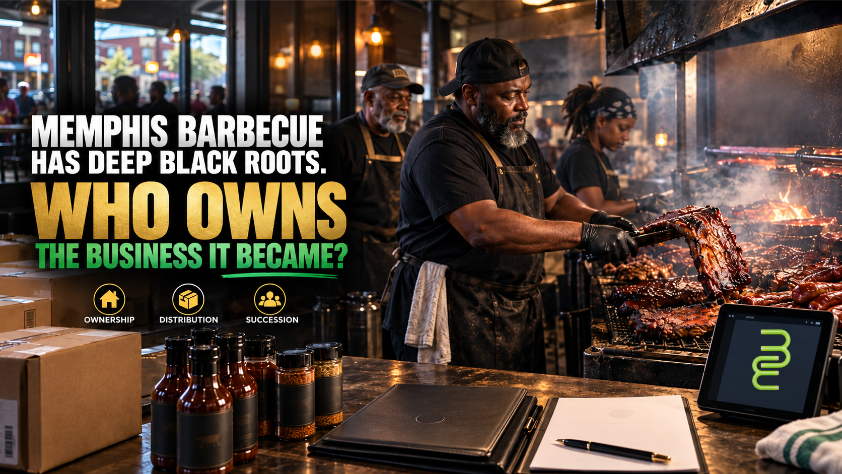
Memphis barbecue is easy to describe as food.
Pork shoulder. Ribs. Smoke. Dry rub. Sauce. Generations of arguments over technique.
But Memphis barbecue is also something else: an economic asset.
The city’s barbecue tradition has become part of how Memphis presents itself to the country and the world.
Memphis Travel actively promotes barbecue as part of the city’s identity, tracing the cuisine in part to the city’s large African American community and its Mississippi Delta roots.
That raises a different question from who makes the best ribs.
When a community helps create a cultural tradition that becomes commercially valuable, how much of that value does the community get to own?
That is where the economics begin.
A food tradition becomes a market
Memphis barbecue is no longer contained inside a smoker.
The value can move through restaurants, catering, tourism, festivals, sauces, seasonings, cookbooks, merchandise, online ordering and national media attention.
The Southern Foodways Alliance has spent decades documenting Memphis barbecue as a distinct culinary tradition, recording restaurant owners and pitmasters whose work helped make smoked pork synonymous with the city.
And Memphis itself markets that identity.
That matters economically because place branding can steer attention and spending.
When visitors arrive looking for an “authentic Memphis barbecue” experience, somebody gets the restaurant check, the online order, the merchandise purchase and potentially a customer relationship that lasts long after the trip.
The key question is where that money ultimately accumulates.
Black ownership is already part of the Memphis barbecue story
It would be inaccurate to tell this story as though Black Memphians supplied the culture while ownership existed somewhere else.
Black-owned and family-run businesses are embedded in Memphis barbecue history.
Andrew Pollard opened A&R Bar-B-Que with his wife, Rose, in 1983. As of 2026, the couple still owns the original Elvis Presley Boulevard restaurant. Their son runs that location, while their daughter owns another A&R location on Hickory Hill Road.
Payne’s Bar-B-Q is another family operation. The restaurant traces its beginning to 1972, and members of the Payne family have continued operating it across generations. On September 9, 2026, co-owner Ron Payne was still speaking publicly about a business that draws both local customers and visitors.
Cozy Corner offers another version of the ownership story. Founded by Raymond and Desiree Robinson, it developed into a multigenerational family business. The restaurant’s current website still identifies Desiree Robinson as co-founder and emphasizes the Memphis cultural experience alongside the food itself.
These are not side notes.
They show that the Black economic story of Memphis barbecue includes business formation, family ownership and succession, not just cultural influence.
But they also reveal the next challenge.
Owning a restaurant is not the same as owning the entire upside
A successful restaurant can create jobs and family income.
A durable enterprise can create something more.
Consider the assets that can exist around a well-known food business:
- The restaurant name.
- The trademark.
- The building and land.
- The recipes and operating knowledge.
- The sauce or seasoning line.
- Online customer relationships.
- Wholesale distribution.
- Licensing rights.
- Additional locations.
- Media rights and brand partnerships.
Those assets can continue creating value beyond a single plate of food.
That distinction matters because a restaurant can be famous and still remain economically fragile.
A family may possess decades of culinary credibility but lack the capital, distribution relationships or succession infrastructure needed to turn that reputation into a larger transferable asset.
The economic ladder can look like this:
Skill => restaurant => brand => protected IP => packaged product => distribution => property => licensing => enterprise value.
Moving up that ladder requires more than knowing how to cook.
It requires access.
The gate is access to scale
For today’s independent restaurant operator, expansion can mean financing equipment, carrying inventory, hiring workers, buying or leasing property, investing in packaging and marketing, protecting a trademark and finding retail or wholesale distribution.
Those are different skills and different markets from running a pit.
And every new layer introduces another gatekeeper.
Banks decide who gets capital.
Landlords and property markets shape who controls location.
Retailers decide which packaged products reach shelves.
Delivery platforms mediate customer access.
Digital platforms influence discovery.
Distributors determine how far a product can travel.
That makes Memphis barbecue a useful example of a broader Black economic question:
Can cultural expertise be converted into assets that survive beyond the people who originally created the value?
The succession question may matter as much as the recipe
An oral history from longtime Memphis restaurateur Jim Neely captures the problem unusually well.
Neely remembered a Memphis where neighborhood barbecue businesses allowed owners to support families. But he also described businesses disappearing as generations changed and successors chose other paths. In some cases, the recipes disappeared with them.
That is more than food nostalgia.
It is an ownership problem.
When a culturally important restaurant closes, Memphis does not necessarily stop making money from the broader reputation of Memphis barbecue.
Tourists still come. Other businesses still sell ribs. The city’s brand survives.
But the individual family’s asset may be gone.
“The culture can remain valuable even after a particular owner stops participating in its value.”
That is the risk.
From recognition to ownership
Black cultural history is often discussed through the language of contribution.
Who created it?
Who influenced it?
Who deserves recognition?
Those questions matter. But economic development requires another set of questions.
- Who owns the business?
- Who owns the property?
- Who controls the trademark?
- Who has distribution?
- Who can finance expansion?
- Who can pass the asset to the next generation?
And who receives the money when the cultural reputation continues creating demand?
Memphis barbecue already offers examples of Black families maintaining ownership across generations. That deserves as much attention as the cuisine’s origin story.
The next question is whether more businesses can move from celebrated local institutions into durable, capitalized and transferable enterprises without giving up control of the value they helped create.
Because culture can create demand.
Ownership determines who keeps the upside.
Economic Implication
Memphis barbecue demonstrates how cultural expertise can become economic infrastructure.
The real wealth opportunity is not limited to restaurant sales; it includes brand ownership, intellectual property, real estate, distribution and succession.
Why It Matters
Black cultural contribution can generate enormous market value without automatically producing durable Black-owned assets.
Memphis also shows that the story is not simply one of exclusion: Black families have built lasting barbecue businesses. The next economic question is whether those businesses can gain the capital and distribution needed to capture more of the value created around the category.
Memphis barbecue is one example of a bigger economic pattern: culture creates value, but ownership determines where that value accumulates.
Subscribe to The Economics Behind It for more reporting on who owns, controls and profits from the markets Black culture helps create.

Latest posts by normbond (see all)
- Memphis Barbecue Has Deep Black Roots. Who Owns the Business It Became? - September 9, 2026
- UN Votes to Correct Africa’s Size on World Maps as U.S. Casts Only No Vote - September 8, 2026
- Memphis Lost Power. Black Communities Supplied the Backup System Themselves. - September 7, 2026