


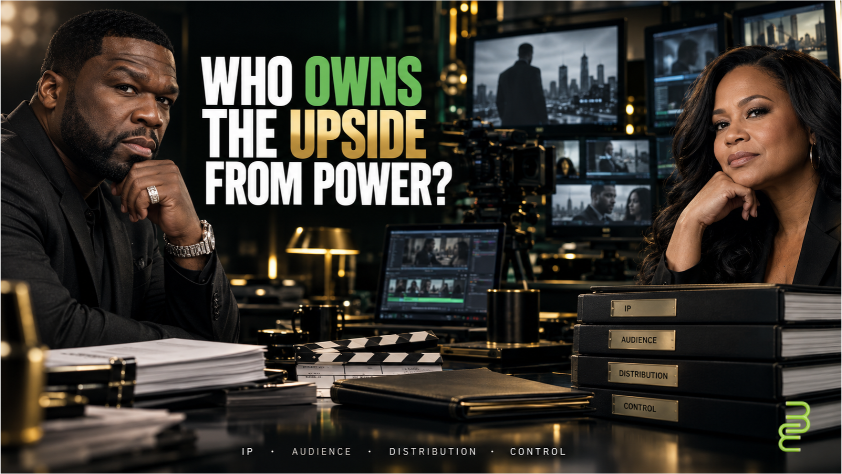
50 Cent and Courtney Kemp are arguing over Power.
But if we stop at the feud, we miss the money.
Their disagreement over who contributed what to the hit Starz series opens a much bigger question about Black entertainment:
What happens after Black creativity proves it can move an audience?
Who owns the property? Who controls distribution? Who gets paid when one show becomes several? Who gains leverage with the network? And who is still participating in the value years after the original series ends?
That is where the economics of Power become more important than the argument surrounding it.
Courtney Kemp created Power. Starz announced the series in 2013 with Kemp as creator, executive producer and showrunner, while Curtis “50 Cent” Jackson was an executive producer.
The series debuted in 2014, ran for six seasons and eventually expanded into multiple spinoffs.
In a wide-ranging Variety interview, Jackson argued that his role in the franchise went far beyond attaching a famous name to the project.
He described helping sell the show, producing music for the pitch, pushing for a broader Power universe and using the audience’s relationship with the series as leverage with Starz.
Kemp disputed parts of his account while acknowledging that Jackson was a significant part of Power’s early development.
Those are different claims about different forms of value.
And that distinction matters.
Creative credit and economic leverage are not the same thing
Kemp’s authorship created one form of value.
Jackson brought celebrity, music, marketing reach, an on-screen role and production participation.
Starz brought distribution.
Lionsgate Television sits inside the franchise’s production structure.
Writers, actors, directors and crews helped turn the original idea into a television property that could keep generating new stories.
Netflix now describes Power as a franchise that includes Power Book II: Ghost, Power Book III: Raising Kanan, Power Book IV: Force and the upcoming Power: Origins.
Lionsgate Television produces the franchise, with Kemp and Jackson among its executive producers through their respective companies.
Each participant occupies a different position in the same economic chain.
The wealth question is what rights, compensation and long-term participation come with each position.
That matters because in entertainment, creating the culture and owning the economic asset are not automatically the same thing.
Visibility is not ownership
Black entertainment conversations often stop at representation.
We celebrate the hit.
We celebrate the creator.
We celebrate the star.
Those things matter. But none of them, by themselves, tell us who owns the underlying value.
Someone can be the face of a franchise without owning the franchise.
A creator can develop a television show without controlling its distribution.
A producer can participate in a project without owning the underlying intellectual property.
And a performer can bring millions of viewers to a platform while still depending on that platform to reach them.
Those are different forms of power.
The strongest economic position comes when cultural influence is connected to rights, capital, production capacity, distribution or ownership.
That is what makes Power more than a television success story.
The original series became the foundation for a wider franchise. And the value of that franchise can continue long after the initial episodes stop airing.
In 2017, Hulu and Lionsgate announced a streaming deal for Power, describing the series at the time as Starz’s No. 1 original show and saying its third season averaged a record 8 million multiplatform viewers per episode.
Nearly a decade later, Netflix announced that all six seasons would begin streaming there in November 2026.
That is what durable media IP can do.
A show can generate value when it first airs.
Then again through spinoffs.
Then again through licensing.
Then again through new distribution windows.
The audience may see reruns.
The rights holders see another economic transaction.
50 Cent says the audience changed his leverage
One of the most revealing parts of Jackson’s Variety interview had little to do with celebrity conflict.
Jackson said there was a point when he told Starz executives that he would determine when Power returned.
According to his account, the network then saw 40% of its subscribers disappear, which strengthened his argument that Starz needed more Power programming throughout the year. He said that episode helped open the door to expanding the series into a broader universe.
The percentage comes from Jackson’s account.
The business principle is bigger than the number.
If viewers subscribe because they want your content, the audience is no longer just an audience.
The audience becomes leverage.
A show that attracts viewers creates value.
A show that helps keep viewers paying every month creates another kind of value.
And a property that a platform believes it cannot easily replace can change the balance of a negotiation.
That is a critical distinction for Black creators.
Attention is valuable.
But attention that can move is more valuable.
An audience that follows the creator, the talent or the franchise can become a business asset.
The harder question is whether that leverage gets converted into ownership.
One hit can become a portfolio
Jackson is no longer talking about television like someone attached to one successful series.
He told Variety that he has 40 shows across 12 networks, with 10 moving toward air.
He also said he had completed 18 episodes of Power: Origins and discussed a slate that includes Fightland, Cash Kings, Bone Parish, Billion Dollar Lawyer, Power: Legacy and Peacock’s adaptation of his book The Accomplice. Variety also reported that Jackson has a Hulu documentary project in development.
That scale points to a different business model.
One successful show gives a producer a hit.
A pipeline spread across multiple buyers begins to look like a production company with options.
And options matter.
A producer dependent on one network remains exposed to that network’s budget decisions, programming priorities and cancellations.
A producer who can take projects to several buyers has more bargaining room.
That can create negotiating leverage.
But leverage still is not ownership.
Forty projects do not tell us who owns the underlying intellectual property, who receives backend participation, who controls derivative rights or how future licensing revenue is divided.
Those questions live in the deal structure.
That is where cultural success becomes economic participation.
The nearly $12 million question
Jackson also told Variety that the budget for the original Power eventually reached nearly $12 million per episode.
He criticized some of the production spending and described changing the way clothing was sourced on later projects. Instead of buying all of the wardrobe, Jackson said he pushed for clothing companies to supply products because of the promotional exposure they would receive from the audience.
Kemp pushed back, saying Jackson was rarely involved in budget meetings and describing his recollection of the production requirements as uninformed.
Their disagreement points to a larger media-economics question.
Jackson is describing the audience itself as an asset that can be exchanged for value.
If millions of viewers are seeing a product inside a television series, that exposure has potential marketing value.
That changes the equation.
A media company is not only producing a television show.
It is also controlling access to attention.
Once attention can be monetized through subscriptions, advertising, brand exposure, licensing and other channels, the value of the audience extends well beyond ratings.
That is one reason ownership matters so much.
If you help create the attention but do not hold rights to the economic activity built around it, somebody else may capture most of the upside.
Power shows how culture becomes an economic system
A successful series does more than generate episodes.
- It can create writing jobs.
- Acting jobs.
- Production jobs.
- Vendor contracts.
- Music opportunities.
- Licensing deals.
- Streaming agreements.
- Character extensions.
- Prequels.
- Sequels.
- Library value.
- And new intellectual property that can live for years.
That is franchise economics.
The cultural product becomes infrastructure for more products.
And once that happens, the real question changes.
It is no longer simply, “Was the show successful?”
It becomes:
Who owns what the success created?
That is the question Black creators, producers and entrepreneurs have to ask earlier.
Not after the hit.
Before the contract is signed.
The Shreveport move takes the economics one step further
Jackson’s television ambitions also extend beyond content.
Variety described him as operating from Shreveport, Louisiana, home to his G-Unit Film & Television studio, and connected his work there to a broader revitalization effort.
Jackson said that once a business becomes large enough to employ significant numbers of people, state and local government inevitably become part of the picture because the activity affects jobs and the wider city economy.
That moves the ownership conversation to another level.
Making television is one business.
Controlling production infrastructure is another.
Studios can create demand for construction, crews, transportation, equipment, hospitality, catering, security and local vendors.
If that activity becomes durable, entertainment spending can move beyond the celebrity at the center of the project and into a larger regional production economy.
Then the questions become bigger:
- Who owns the facilities?
- Which companies get the contracts?
- How much production spending remains local?
- Who gets hired?
- What public incentives support the activity?
- And who owns the assets after the cameras leave?
That is the difference between bringing a production to town and building economic infrastructure around production.
Black creators need to understand the whole value chain
The lesson from Power is not that every creator needs to become 50 Cent.
Celebrity does not automatically produce ownership.
And public visibility does not reveal who holds the most valuable economic position.
The lesson is to understand the whole value chain.
When you create something audiences want, ask what you own.
When a platform needs your audience, ask what leverage that creates.
When your work becomes a franchise, ask whether you participate in the next version.
When your name helps sell the project, ask how that contribution is valued.
When the project produces spinoffs, licensing or adaptations, ask who gets paid.
And when cultural attention becomes large enough to support an entire business ecosystem, ask who owns the infrastructure underneath it.
That is how culture becomes capital.
So who owns the upside from Power?
Courtney Kemp created the original Power series. Starz’s own announcement identified her as creator, executive producer and showrunner, while Jackson served as an executive producer.
Today, Lionsgate Television produces the broader franchise, with Kemp’s End of Episode and Jackson’s G-Unit Film & Television represented among the executive producers.
But those credits do not tell us everything about the economics.
The deeper wealth questions sit inside the contracts:
- Who controls the underlying rights?
- Who receives backend participation?
- Who holds derivative rights?
- Who participates in licensing revenue?
- Who benefits financially when the franchise moves to another platform?
- Who gets paid when new chapters are built on the original property?
Those are the questions that determine who captures the long-term upside.
Kemp created Power.
Jackson says he helped bring cultural, musical and commercial leverage to the project and later pushed for its expansion.
Starz provided critical distribution.
Lionsgate sits within the production and franchise structure.
And millions of viewers supplied the demand that made the entire system valuable.
The cultural victory is that Power became a franchise.
The economic question is who continues owning a piece of that value as the franchise grows.
Because in entertainment, getting the audience’s attention can make you famous.
Owning what that attention creates is how you build wealth.
Power offers a sharp case study in the difference between creative authorship, audience leverage, distribution and ownership — and why those differences determine who keeps getting paid after the cultural moment becomes a long-term asset.
Subscribe to The Economics Behind It for more reporting on ownership, media, work, technology and Black economic power.
Latest posts by normbond (see all)
- Who Owns the Upside From Power? 50 Cent’s Variety Interview Reveals a Bigger TV Economics Story - October 20, 2026
- Burkina Faso Rejected a U.S. Deportation Deal. Then the Fight Moved to Visa Access. - October 19, 2026
- NC A&T Students Marched 45 Minutes to Vote. The Bigger Story Is Who Controls Access. - October 17, 2026