


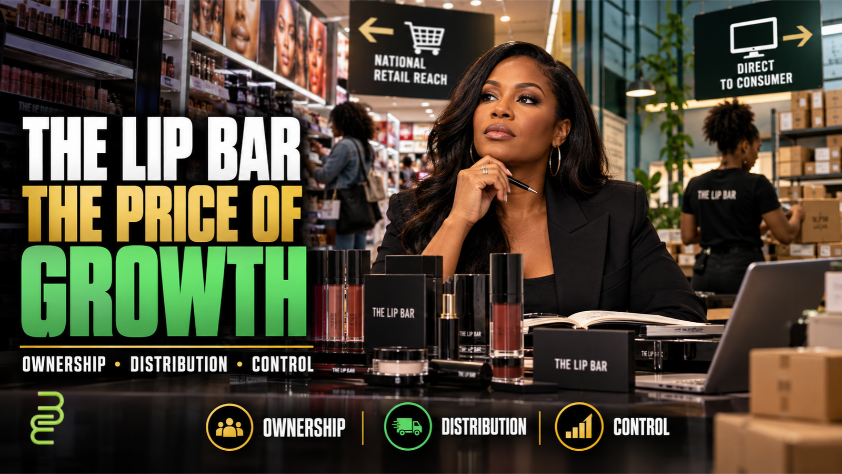
Melissa Butler’s beauty company is facing questions about its evolving customer base and continued relationship with Target. Behind the controversy is a larger economic challenge for Black-owned businesses: how to expand nationally, protect customer trust, and reduce dependence on powerful retail partners.
A Black-owned business can reach millions of customers and still find itself with surprisingly little room to make a major business decision.
That is one of the most important details emerging from the controversy surrounding The Lip Bar, the beauty company founded by Melissa Butler.
The immediate debate concerns the brand’s plans to expand beyond its established audience of millennial Black women.
Some customers questioned whether the company’s evolving marketing strategy meant it was distancing itself from the community that helped build the business.
But another part of the story deserves just as much attention.
Butler says The Lip Bar cannot currently afford to leave Target, even as the retailer continues facing criticism over changes to its diversity, equity and inclusion initiatives.
Those two developments reveal different pressures facing a growing business.
One concerns who the company wants to reach.
The other concerns how much control it has over the channels needed to reach them.
Both matter when the goal is to build a Black-owned company that can survive beyond its founder.
The Lip Bar Was Built Around a Market Others Overlooked
Butler founded The Lip Bar in 2012 after becoming frustrated with a beauty industry that routinely underserved Black women.
The company built its identity around inclusive products, accessible beauty and an understanding of customers whose needs were too often treated as secondary.
That positioning became a commercial advantage.
Black women were not simply an audience the company selected for marketing. They were central to its early growth, product identity and cultural credibility.
The Lip Bar eventually moved beyond direct sales and into national retail distribution, including Target, where its products launched in 2018.
That expansion gave the business access to customers and infrastructure that would have been difficult to build independently.
It also introduced new business obligations.
National retail requires inventory, production capacity, fulfillment, marketing investment and the ability to meet demand across multiple locations.
The opportunity becomes larger. So does the financial exposure.
Why Expanding the Customer Base Became Controversial
The current debate began after comments from The Lip Bar’s vice president of marketing, Yasmine Harema, circulated online.
During an Adweek discussion, Harema described the company’s efforts to reach consumers beyond the millennial Black women who have historically formed its core audience.
The strategy includes making the brand recognizable to additional customer segments, including white millennial women, and responding to different product preferences.
As EBONY reported, some consumers interpreted the remarks as a sign that the company was moving away from Black women.
Butler pushed back on that interpretation while acknowledging that the comments could have been expressed more carefully.
Both reactions deserve consideration.
Customers who helped establish a brand have a legitimate interest in how that brand represents them as it grows. Marketing language can reinforce trust or weaken it.
At the same time, reaching new customers is a normal part of business expansion.
A company founded to serve an overlooked market does not necessarily abandon that market by making its products available to more people.
The more important business question is whether expansion strengthens the company’s position without weakening the relationships that made its growth possible.
Those relationships are not merely sentimental.
Customer loyalty, brand credibility and repeat purchasing are economic assets.
Target Reveals a Different Kind of Dependence
The controversy became more complicated when Butler addressed the company’s continuing relationship with Target.
The retailer has faced consumer boycotts since announcing changes to its diversity, equity and inclusion initiatives in January 2025.
For some consumers, avoiding Target became a way to express dissatisfaction with those decisions.
But Black-owned brands carried by Target have faced consequences of their own.
According to TheGrio’s October 28 reporting, Butler explained that Target remains The Lip Bar’s largest retail partner despite reduced sales through that channel.
Leaving would impose a financial burden the company cannot currently absorb.
That statement exposes a reality many independent businesses understand.
A retailer can provide the access a company needs to grow while also becoming a relationship the company cannot easily replace.
Large retailers control valuable shelf space, established customer traffic and significant portions of the purchasing experience.
Smaller brands gain access to that infrastructure, but they do not control the retailer’s policies, public reputation or broader business decisions.
When controversy affects the retailer, its suppliers can experience the consequences even when they disagree with the decisions that caused the controversy.
The Lip Bar’s predicament illustrates that difference.
The company owns its brand.
It does not own Target.
And ownership of a brand does not automatically create the financial independence needed to walk away from its largest distribution partner.
The Numbers Explain Why Leaving Is Difficult
In October 2025, Butler reported that sales through Target had declined approximately 30% to 40% during the boycott period.
At the time, the company was also projecting overall sales growth as it expanded its products and distribution.
Those figures illustrate why channel performance and total company performance must be evaluated separately.
A business can lose sales through one retailer while growing elsewhere.
It can also remain heavily dependent on a declining channel if that channel continues to generate a substantial share of its revenue.
The company’s current revenue distribution across retailers has not been publicly established in the reporting reviewed.
But Butler’s explanation makes clear that replacing Target is not as simple as making a public announcement.
- A new retail relationship takes time to negotiate.
- Additional inventory requires capital.
- Direct-to-consumer sales require marketing, fulfillment and customer acquisition.
- Moving customers from one channel to another is not guaranteed.
- And a company must finance those transitions while continuing to pay employees, suppliers and operating expenses.
That is why distribution concentration is an economic risk even when a retail partnership has been important to a company’s success.
Customer Expansion and Distribution Expansion Solve Different Problems
The Lip Bar is responding on more than one front.
Butler has described increased marketing investment in the company’s own website and Amazon, continued sales through Walmart, and efforts to gain access to Ulta.
These moves matter because customer expansion and distribution expansion serve different purposes.
Reaching additional customers can increase the size of the potential market.
Selling through additional channels can reduce the financial consequences of losing access to any one retailer.
A brand could successfully attract consumers across several demographic groups and still remain dependent on one retail chain.
It could also expand into multiple retailers without generating enough new customer demand to sustain the additional costs.
Building resilience requires attention to both sides.
A stronger direct-sales business may provide more control over customer relationships and marketing decisions, although it also requires the company to finance more of its own customer acquisition and fulfillment.
Additional retail partners can provide reach while reducing concentration risk.
The objective is not necessarily to eliminate major retail relationships.
It is to make those relationships less likely to determine whether the business survives.
Black Consumers Should Not Have to Choose Between Accountability and Ownership
The controversy also presents a difficult question for consumers.
Black consumers have every right to decide where their money goes.
They can question corporate policies, challenge marketing decisions and withdraw support from companies whose actions conflict with their expectations.
Those choices are part of the economic power consumers exercise.
But the consequences of those decisions do not always fall exclusively on the intended company.
When a national retailer carries independent brands, declining sales can affect the retailer and its suppliers simultaneously.
Those suppliers may include businesses owned by people who share the concerns motivating the boycott.
That does not make consumer protest illegitimate.
It means the economic effects are more complicated than the public debate sometimes acknowledges.
Butler has pointed to The Lip Bar’s HBCU collections, community programming and $40,000 in support for Black-owned businesses as evidence that its commitment to Black communities continues.
Consumers can weigh that record alongside the company’s current decisions.
The useful distinction is between holding a business accountable and requiring that business to remain commercially limited to the audience that first supported it.
Those are not the same expectation.
Supporting Black ownership should include the possibility of Black-owned businesses competing for customers across the wider economy.
It should also include the freedom to question whether those businesses continue serving the communities that helped establish them.
Growth and accountability can coexist.
What It Takes to Become a Legacy Brand
The debate becomes more consequential when the ambition extends beyond building a successful company today.
Butler has raised the question of why Black-owned brands should face a ceiling on their growth.
That question deserves an economic answer.
A legacy brand needs more than visibility.
It needs repeat customers, competitive products, reliable financing, profitable operations, strong management and enough commercial flexibility to adapt when market conditions change.
It also needs relationships that can survive disagreement.
For The Lip Bar, broader customer acquisition may support future revenue growth.
Additional distribution channels may reduce dependence on Target.
Continued investment in Black communities may reinforce the trust that helped establish the company.
Each contributes something different.
None can replace the others.
The company must still compete on product quality, customer experience, pricing and operating performance.
And the business decisions that support growth must eventually produce enough financial strength to make future choices less constrained.
That is the difference between reaching a large market and building a durable enterprise.
The Bigger Economic Question
The Lip Bar’s situation extends well beyond beauty.
Black-owned consumer brands, restaurants, manufacturers, media companies and service providers often depend on larger institutions for access to customers, capital, distribution or contracts.
Those relationships can create enormous opportunities.
They can also concentrate risk.
- A manufacturer may depend on one major buyer.
- A creator may depend on one digital platform.
- A contractor may depend on one corporate customer.
- A beauty brand may depend on one national retailer.
In each case, the entrepreneur can own the company while another institution controls an important part of its economic future.
The answer is not to avoid large partnerships.
It is to build enough financial strength, customer demand and alternative relationships that no single partnership becomes the only viable route forward.
That requires time, investment and business discipline.
It also creates an opportunity for investors, lenders, retailers and economic-development institutions to support Black businesses beyond the initial breakthrough of getting onto a shelf.
The next stage is helping those businesses retain the capacity to make independent decisions.
Why This Matters
The Lip Bar should not have to choose between celebrating Black women and selling products to a broader market.
Its customers should not have to surrender the right to question how the brand represents them.
And the company’s relationship with Target should be understood in the context of the real financial obligations involved in operating a national beauty business.
All three realities can be true.
The deeper lesson is that ownership is a beginning, not the entire measure of economic power.
A business becomes stronger when it can choose its customers, negotiate its partnerships, maintain their trust and withstand changes in the institutions it depends on.
The Lip Bar’s next chapter will be shaped by how successfully it builds that flexibility.
For Black-owned businesses seeking to become the lasting brands of tomorrow, that is the work beyond the headline.
Growth matters. But the ability to make your own decisions as you grow matters just as much.
Subscribe to The Economics Behind It for more reporting on ownership, work, money and control behind the headlines.
Black culture moves markets. We track the economics behind it.

Latest posts by normbond (see all)
- The Lip Bar Wants to Become a Legacy Brand. The Real Challenge Is Owning Its Growth. - October 29, 2026
- Dame Dash’s Life Story Drew a $550,000 Bid. Now Bankruptcy Is Testing Who Controls the Narrative. - October 27, 2026
- Who Owns the Upside From Power? 50 Cent’s Variety Interview Reveals a Bigger TV Economics Story - October 20, 2026