


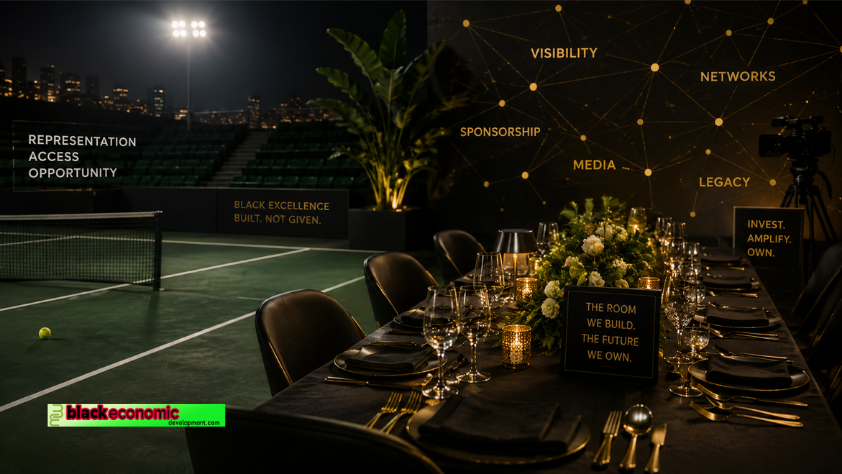
Naomi Osaka’s Black tennis dinner looked like a social moment.
It was also something larger.
In a sport built around individual performance, private coaching, sponsorship access, media visibility, and elite networks, gathering Black players in one room carries meaning beyond the photo.
Naomi Osaka on why she chose to host a party for the black tennis players:
“You know I’m seeing a little bit of-
‘Why can’t you love everyone for all skin tones?’ and ‘what if someone had an all white party?! First of all I do love everyone for who they are no matter their race… pic.twitter.com/Qg824Qsur5— The Tennis Letter (@TheTennisLetter) May 24, 2026
The backlash focused on whether the event was exclusionary.
The more useful question is why Black belonging still unsettles people in spaces where Black excellence has already been proven.
The backlash missed the deeper point
Osaka’s response made clear that the dinner was not about rejecting anyone.
It was about celebrating players who understand what it feels like to move through tennis without always seeing themselves reflected back.
She also connected the moment to lived experience. Growing up in tennis, she did not see many people who looked like her. She also described watching her father face discrimination at tennis courts.
That context matters.
This was not a celebrity defending a party. It was an athlete explaining why recognition still matters inside elite spaces.
The Economic Layer
This story reveals how belonging functions as soft infrastructure in elite sports.
Tennis careers are shaped by more than talent. They are shaped by coaching networks, family resources, sponsorship visibility, media access, institutional support, and informal relationships that help athletes become commercially legible.
A dinner can look symbolic from the outside.
But inside an elite sport, gathering Black players in one room can create visibility, relationship, affirmation, and shared context. Those things may not show up on a balance sheet, but they can shape opportunity.
Why tennis makes this different
Tennis is an individual sport, but no successful tennis career is built alone.
Families pay for training. Coaches open doors. Sponsors attach capital to visibility. Media coverage builds marketability. Private networks influence who gets seen, supported, and remembered.
That is why representation is not only emotional.
In elite sports, visibility can become commercial leverage.
Ownership Question
Who gets to define what Black gathering means inside historically exclusive spaces?
The backlash tried to frame the event as exclusion.
Osaka reframed it as recognition.
That is the power shift.
Black athletes are often celebrated when they perform, but questioned when they build spaces of affirmation, connection and cultural visibility.
That tension carries economic meaning.
Why It Matters
Black athletes have long created value inside sports systems they did not fully control.
They generate attention, ticket sales, media coverage, sponsorship interest, cultural relevance, and global visibility.
But attention alone is not power.
The deeper issue is whether Black athletes have the networks, platforms, ownership pathways, and institutional support needed to convert visibility into long-term economic leverage.
Osaka’s dinner does not solve that.
But it does point to something important.
Sometimes the first move toward power is creating the room.
The larger signal
This was not just about who sat at a dinner.
It was about who gets to gather without apology.
It was about who gets to celebrate presence in a sport where Black excellence has often been visible, but Black belonging has not always been protected.
The internet debated exclusion.
The economics behind it point somewhere else.
Belonging, visibility, and informal networks are part of the infrastructure of opportunity.
Reader question:
Is this culture news, sports news, business news or all three?
Latest posts by normbond (see all)
- Michael Jordan Gave Morehouse $1 Million. Now It Has a Media Production Center. - September 26, 2026
- Nigeria’s Ima Gas Field Sat Underground for 53 Years. A Nigerian Company Will Own 60% When It Finally Produces. - September 24, 2026
- Royal Caribbean Is Paying $3 Billion for Half of Sandals. The Bigger Story Is Who Owns Caribbean Tourism. - September 24, 2026