


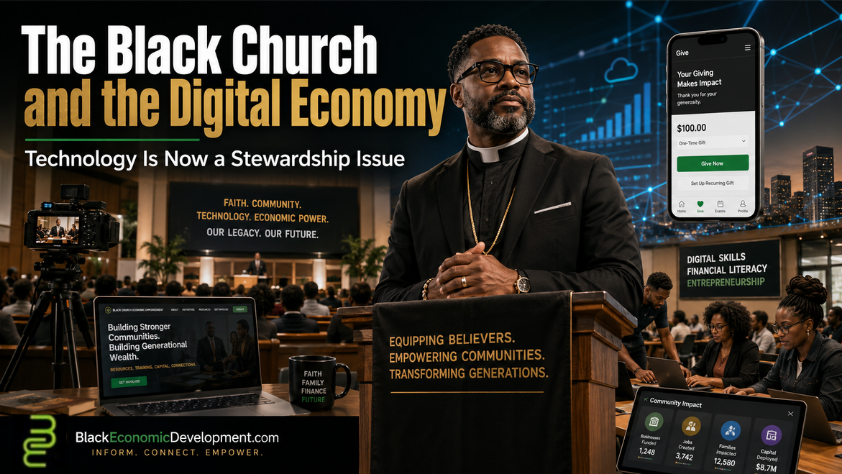
Black churches have long been centers of faith, organizing, education, mutual aid, and economic survival. In the AI era, technology is no longer just a ministry tool. It is a question of access, ownership, labor, data, and community power.
The Black Church has never been only about Sunday morning.
It has been a place of worship.
But also a place of organizing.
A place of education.
A place of mutual aid.
A place of civic power.
A place of leadership development.
A place where people found information, protection, hope and strategy when other institutions failed them.
That history matters in the digital age.
Because technology is no longer separate from economic life.
It shapes who gets information.
- Who gets services.
- Who gets hired.
- Who gets funded.
- Who gets trained.
- Who gets counted.
- Who gets watched.
- Who gets excluded.
- And who gets power.
That means technology is now a stewardship issue.
Not just for corporations.
Not just for schools.
Not just for government.
For Black churches too.
The Black Church is economic infrastructure
For BlackEconomicDevelopment.com, this is not traditional religion coverage.
This is institutional analysis.
The Black Church is part of Black economic infrastructure.
- It holds physical space.
- It has trusted relationships.
- It reaches multiple generations.
- It communicates every week.
- It knows local needs.
- It organizes volunteers.
- It supports families.
It often sits in neighborhoods where digital access, job readiness, financial inclusion, public services and small business support are urgent issues.
That makes the Black Church relevant to the AI economy.
Not because every church needs to become a tech company.
Because every church exists inside a digital economy that is already reshaping opportunity.
Technology is not neutral
A paper by Elonda Clay, Subtle Impact: Technology Trends and the Black Church, frames the issue clearly: the twenty-first century is shaped by who controls information and who owns knowledge. The paper also argues that technology is not governed by neutral values, but is economically driven.
That is the BlackEconomicDevelopment.com lens.
Technology is not just equipment.
It is power.
A church website is not just a website.
It is distribution.
A livestream is not just a broadcast.
It is media infrastructure.
A donor platform is not just convenience.
It is financial data.
A member database is not just administration.
It is community intelligence.
A digital literacy class is not just training.
It is economic access.
The question is not simply whether churches use technology.
The question is whether they use it strategically, ethically and in service of community power.
From livestreaming to digital stewardship
Many churches became more digitally visible during the pandemic.
- Livestreams expanded.
- Online giving grew.
- Social media became a ministry channel.
- Bible studies moved to Zoom.
- Announcements moved to text messages.
That shift mattered.
But the next stage requires more than livestreaming worship.
Digital stewardship means asking deeper questions.
- Who owns the church’s data?
- Who controls the donor platform?
- Who has access to member information?
- Is the livestream archive preserved?
- Can the church communicate during emergencies?
- Are volunteers trained and protected?
- Are systems backed up?
- Is cybersecurity taken seriously?
- Can seniors access online services?
- Can youth learn more than entertainment technology?
- Can small businesses in the congregation learn digital tools?
- Can the church help members navigate AI, benefits, jobs, banking and public systems?
That is where the conversation has to go.
The operational gap is real
Clay’s paper notes that technology use in local churches can become haphazard when there is no strategic planning. It warns that poor planning can lead to overspending, obsolete technology, mishandled volunteers and the loss of important church information.
That is not just an IT problem.
It is an institutional capacity problem.
A church can have equipment and still lack strategy.
It can have a livestream and still lack data security.
It can have online giving and still lack financial analytics.
It can have volunteers and still lack a sustainable media ministry.
It can have social media accounts and still lack an owned audience strategy.
Technology must be governed.
Otherwise, the church becomes dependent on platforms it does not control.
Media ministry is labor
The media ministry often carries more weight than people realize.
- Sound.
- Lighting.
- Cameras.
- Slides.
- Streaming.
- Video editing.
- Social clips.
- Digital announcements.
- Online giving support.
- Website updates.
- Livestream troubleshooting.
That is labor.
Often skilled labor.
Often unpaid labor.
Clay’s paper specifically warns that highly skilled technical volunteers may burn out when no one relieves them, and it recommends rotating teams or considering paid media ministry staffing.
That matters economically.
If a church’s digital presence depends on one or two exhausted volunteers, the institution is vulnerable.
Digital ministry should not run on burnout.
Stewardship includes people, not just equipment.
The digital divide is now an AI divide
For years, the digital divide was framed around access to computers and the internet.
That still matters.
But now the divide is deeper.
- Who knows how to use AI?
- Who knows how to evaluate AI output?
- Who understands data privacy?
- Who can apply online for jobs, grants, benefits and contracts?
- Who can recognize scams?
- Who can use digital tools to start or grow a business?
- Who can protect themselves from biased systems?
- Who can teach seniors, returning citizens, youth, and small business owners how to navigate a digital world?
The AI divide is not just about tools.
It is about power, confidence, access, and trust.
Black churches can help close that gap if they treat digital readiness as part of community development.
Churches can become technology access hubs
This is where the institutional response becomes practical.
The Black Church has historically participated in Black struggles for economic, educational and environmental justice. Clay argues that continuing that mission in the information age requires engagement with technology rather than blind rejection or uncritical acceptance.
That is a blueprint.
Imagine churches hosting:
- AI literacy workshops.
- Job search and resume labs.
- Small business digital tool clinics.
- Online benefits navigation days.
- Cybersecurity basics for seniors.
- Financial technology workshops.
- Youth media and coding programs.
- Digital storytelling projects.
- Grant application support.
- Procurement readiness sessions.
- Creator IP and content ownership workshops.
- Healthcare portal navigation.
- Digital banking education.
These are not side projects.
They are economic development activities.
The grant-access problem
Technology also affects who can access money.
Many public grants, nonprofit opportunities, training programs, and benefits systems now require online applications, digital documentation, portals, logins, uploads, and follow-up emails.
If a church does not have digital capacity, it may miss funding.
If community members do not have digital support, they may miss services.
If small businesses do not understand online procurement systems, they may miss contracts.
Clay’s paper points to the risk that limited technology adoption can hamper access to federally funded programs when applications are online and require electronic responses.
That is a Policy to Pocket issue.
Digital readiness now affects whether resources reach the community.
Data is a stewardship issue
Churches hold sensitive information.
- Names.
- Addresses.
- Giving records.
- Family connections.
- Health updates.
- Prayer requests.
- Youth participation.
- Volunteer roles.
- Event attendance.
- Community needs.
That data has value.
It also carries risk.
If churches use digital tools without clear policies, they may unintentionally expose members to privacy risks, platform dependency, weak security or vendor control.
The question is not whether churches should use digital systems.
They should.
The question is how.
- Who has access?
- How is data stored?
- What gets shared with vendors?
- What happens if an account is hacked?
- Who owns the content?
- Who controls the email list?
- Who can export the data?
- What happens when a volunteer leaves?
In the AI era, data stewardship is part of spiritual and institutional stewardship.
Black churches can shape AI readiness
The AI conversation can feel distant.
But AI is already entering daily life through hiring, banking, healthcare, education, customer service, insurance, benefits, policing and workplace management.
Black churches are trusted spaces where people can ask questions without shame.
That trust is an asset.
Churches can help members understand:
What AI is.
- Where it appears in daily life.
- How to use it responsibly.
- How to protect personal data.
- How to spot misinformation.
- How to use AI for job searches.
- How to use AI for small business operations.
- How to challenge harmful automated decisions.
- How to prepare children and youth for future work.
- How to support seniors who may be locked out of digital services.
This is not about turning the pulpit into a tech seminar.
It is about recognizing that economic life is becoming digitally mediated.
The Black Church should not carry this alone
Churches should not be expected to solve the digital economy by themselves.
They need partners.
- HBCUs.
- Community colleges.
- Libraries.
- Black chambers of commerce.
- Credit unions.
- Workforce boards.
- Tech professionals.
- Local governments.
- Foundations.
- Community development corporations.
- Youth organizations.
- Small business centers.
- Public agencies.
The church can be the trusted convening space.
Partners can bring training, funding, curriculum, equipment, instructors and support.
That is the model.
Institutional trust plus technical capacity.
The ownership question
The Black Church must ask the same ownership questions that BlackEconomicDevelopment.com asks across culture, business, media, sports and technology.
- Who owns the platform?
- Who owns the data?
- Who owns the livestream archive?
- Who owns the donor relationship?
- Who controls the communication channels?
- Who profits from the software?
- Who trains the community?
- Who gets paid for the technical labor?
- Who captures the value when the church’s audience moves online?
- Who protects the vulnerable when digital systems fail?
Those questions are not anti-technology.
They are responsible technology.
The future church is also a digital institution
The Black Church does not have to blindly embrace every new tool.
It also cannot afford to reject technology as someone else’s world.
The digital economy is already shaping jobs, services, banking, healthcare, education, civic participation and community power.
The question is whether Black churches will respond with strategy.
Not just better cameras.
Better capacity.
Not just livestreams.
Digital stewardship.
Not just online giving.
Data responsibility.
Not just social media.
Owned communication.
Not just tech volunteers.
Sustainable labor.
Not just access.
Economic power.
Economic implication
Black churches are trusted institutions inside a digital economy where information, data, access and technology skills increasingly determine economic opportunity.
If churches build digital capacity, they can support workforce readiness, small business growth, AI literacy, grant access, financial inclusion and community resilience.
Why it matters
For Black communities, the digital divide is no longer only about who has internet access.
It is about who can navigate AI, online services, digital finance, automated systems, public benefits, job platforms, and data-driven institutions.
The Black Church can be part of the institutional response.
But it needs strategy, investment, partnerships and stewardship.
The Black Church does not need technology for technology’s sake. It needs digital capacity because economic life is now digitally mediated.
Over to You
Should Black churches become digital economic development hubs in the AI era? What would that require: funding, training, partnerships, staffing, or a new vision of stewardship?
Latest posts by normbond (see all)
- Nairobi Won the 2029 World Athletics Championships. Now Comes the Ownership Test. - September 15, 2026
- Dangote Refinery IPO Opens. Africans Can Buy Shares—Dangote Keeps Control - September 14, 2026
- U.S. Lends Africell Nearly $100M. Africa Faces a Bigger Ownership Question - September 11, 2026