


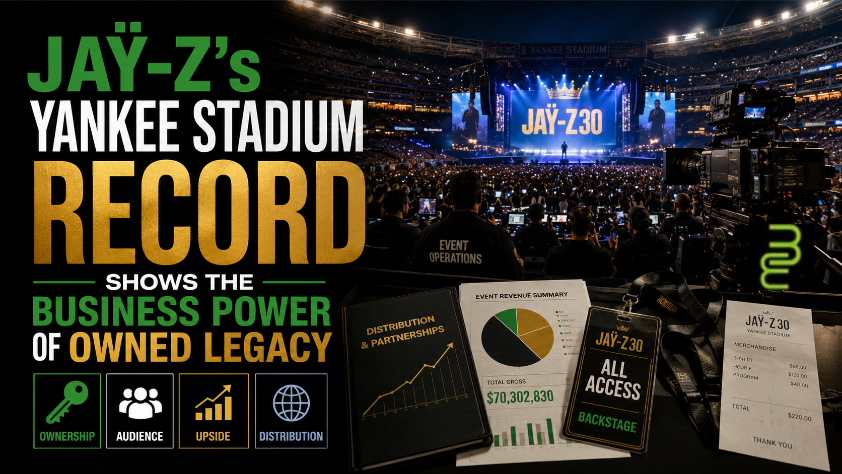
With 44,916 fans reported for night one, JAŸ-Z’s anniversary concert was more than a hip-hop milestone. It was a case study in catalog value, hometown branding, venue economics, and who owns the upside of cultural memory.
JAŸ-Z made history at Yankee Stadium, with multiple social reports saying night one of his anniversary concert series drew 44,916 fans, setting a new record for the highest paid attendance in the venue’s history.
The celebration continued into night two, with the three-night Yankee Stadium event built around the 30th anniversary of Reasonable Doubt and the 25th anniversary of The Blueprint. NBC New York reported that Roc Nation added a third show because of high demand.
That is the cultural headline.
The economics behind it are bigger.
This was not just a concert. It was a monetization event built around legacy, catalog value, hometown identity, live-event scarcity, and control over cultural memory.
Hip-Hop Legacy Is Now A Stadium Asset
JAŸ-Z’s Yankee Stadium moment shows how hip-hop’s most valuable catalogs are entering a new economic phase.
The asset is no longer only the new album, the single, or the tour cycle.
- The asset is the story.
- The catalog.
- The city connection.
- The mythology.
- The ability to turn decades of cultural credibility into premium live-event demand.
WIRED reported that the concerts were designed around Reasonable Doubt and The Blueprint, with surprise appearances from Beyoncé, Blue Ivy, Nas, Alicia Keys, Jaz-O, and others.
The show reportedly drew about 45,000 fans and leaned into a stripped-down, legacy-focused presentation rather than a spectacle built only on special effects.
That matters because it shows the maturity of hip-hop as an economic engine.
Thirty years after Reasonable Doubt, the value is not fading. It is being repackaged, reactivated, and monetized at stadium scale.
The Venue Is Part Of The Business Model
Yankee Stadium is not just a backdrop.
It is a distribution platform.
A stadium this large turns music into an economic system. Tickets, concessions, merchandise, premium seating, security, production labor, transportation, hotels, restaurants, rideshare, parking, media coverage, and social content all become part of the revenue environment.
That is why this story is bigger than attendance.
When a Black artist can command one of the most recognizable sports venues in America, the question becomes: who captures the value created by that demand?
The artist captures part of it.
The venue captures part of it.
Promoters, vendors, ticketing platforms, production companies, local businesses, and media platforms all participate in the upside.
The crowd is the visible proof of demand.
But the value chain around that crowd is where the economics live.
Ownership Is The Real Flex
JAŸ-Z’s advantage is not only that he can sell tickets.
It is that he has spent decades building leverage beyond performance.
He is not just an artist inside someone else’s system. He is a brand owner, investor, producer, executive, and cultural strategist. That position changes the economics of a legacy concert.
A normal nostalgia show sells memories.
A high-control legacy event sells ownership, scarcity, status, and cultural authority.
That is the difference.
The deeper question is not whether fans still care about the music. The deeper question is who owns the story being monetized.
For many Black artists, the catalog, publishing, masters, likeness, tour economics, merchandise, and audience data are split across labels, platforms, promoters, and outside investors.
Culture creates the demand, but ownership determines who gets paid over time.
JAŸ-Z’s Yankee Stadium record points to a different model: build enough ownership and leverage that your cultural legacy remains an appreciating asset.
Who Captures The Upside?
The upside from a moment like this moves in several directions.
JAŸ-Z benefits through performance revenue, brand reinforcement, catalog attention, and long-term cultural positioning.
Yankee Stadium benefits by monetizing a non-baseball night.
Promoters and production partners benefit from the event infrastructure.
Nearby businesses benefit from thousands of fans moving through New York.
Media platforms benefit from clips, coverage, and social conversation.
Streaming platforms may benefit if renewed attention sends listeners back to the albums.
But the largest long-term benefit may be the strengthening of JAŸ-Z’s brand as an owned legacy asset.
That is the wealth lesson.
Black cultural production often creates massive value.
The difference between visibility and wealth is whether the creator controls enough of the asset, audience, distribution, and narrative to keep capturing returns after the original release.
Who Carries The Risk?
The risk also spreads across the system.
- The artist carries brand risk.
- The venue carries operational risk.
- Promoters carry financial risk.
- Production crews carry execution risk.
- Fans carry price and access risk.
Local businesses may benefit from event traffic, but they also depend on a temporary surge they do not control.
That is why stadium entertainment is not just art. It is infrastructure, capital, labor, logistics, and risk management.
A record-setting crowd looks like celebration. Behind the scenes, it is a complex economic machine.
Why This Matters For Black Economic Power
For BlackEconomicDevelopment.com, this is not celebrity news.
It is a Culture Economy story.
JAŸ-Z’s Yankee Stadium record shows what happens when Black cultural memory becomes a premium economic asset.
It also shows why ownership remains the central question.
Black culture can fill stadiums, drive media cycles, move merchandise, revive catalogs, and create citywide economic activity.
But the wealth impact depends on who controls the rights, the deal structure, the venue relationship, the audience connection, the data, and the distribution.
That is the difference between being celebrated and being economically positioned.
JAŸ-Z did more than sell out Yankee Stadium.
He showed how hip-hop legacy can become infrastructure-level business.
And the bigger lesson is clear: culture creates the demand, but ownership decides who captures the upside.
Economic Implication
JAŸ-Z’s Yankee Stadium record shows how mature hip-hop catalogs are becoming high-value live-event assets. The money moves through ticketing, venue economics, merchandise, production labor, media coverage, local spending, and renewed catalog attention.
Why It Matters
This is a model for turning Black cultural legacy into long-term economic leverage. The lesson is not just to build an audience. The lesson is to own enough of the catalog, brand, story, and business infrastructure to keep benefiting when that audience shows up years later.
Ownership Question
Who controls the value chain around hip-hop legacy: the artist, the label, the venue, the promoter, the ticketing platform, the streaming platform, the sponsor, or the media companies monetizing the attention?