


There is a business lesson inside the Air Jordan story that goes far beyond sneakers.
In a resurfaced clip, Larry Miller, former president of Jordan Brand at Nike, explains how the company studied who was actually buying Air Jordans year after year.
The answer was not simply “everybody.”
According to Miller, Michael Jordan had broad appeal across the marketplace. But when Nike looked deeper, the core consumer behind the product was young, Black, urban, and deeply connected to the Jordan logo, the athlete, and the cultural meaning of the shoe.
Then Miller made the point that matters most.
That consumer was not just following trends.
He was setting them.
And not only for his neighborhood. Not only for his peer group. Miller described the young Black consumer in urban communities as a trendsetter for America and, really, the world.
That is the economics behind it.
Black Consumers Were Not Just the Market. They Were the Signal.
For decades, companies have treated Black culture as both inspiration and market intelligence.
The Air Jordan story shows how that works.
A product enters the market. Young Black consumers validate it. The product gains cultural credibility. That credibility spreads through schools, playgrounds, barbershops, basketball courts, sneaker stores, music videos and streetwear circles.
Then the mainstream catches up.
By the time broader America recognizes the trend, the cultural work has already been done.
That is why Miller’s comments are so important. They reveal something many companies have long understood but rarely say plainly: Black youth culture is not a niche audience.
It is often the early-warning system for mainstream demand.
Black consumers are frequently where taste is tested, meaning is created and brand energy is born.
Culture Became Brand Equity
Air Jordans were never just shoes.
They became identity. Aspiration. Status. Memory. Competition. Style. Community. A way to say something without speaking.
That cultural meaning became business value.
Nike reported $46.3 billion in revenue for fiscal 2025. The company also said it returned about $5.3 billion to shareholders through dividends and share repurchases during that fiscal year.
That matters because it shows the scale of the machine around the culture.
Nike’s own annual filing says non-U.S. Nike Brand and Converse sales accounted for about 57% of total revenue in fiscal 2025. It also describes a global business built through wholesale accounts, independent distributors, licensees, sales representatives, and distribution centers around the world.
That is what happens when culture becomes global distribution.
The Jordan Brand sits inside that larger Nike ecosystem. Its value does not come only from product design or athletic performance. It comes from cultural credibility.
Much of that credibility was built through Black consumer adoption, Black athletic excellence, Black urban style, and Black social influence.
The money moved because the meaning moved first.
The Ownership Question
Here is where the story becomes bigger than Nike.
If Black consumers helped make Air Jordans culturally powerful, who captured the upside?
- Nike controlled the brand infrastructure.
- Nike controlled production.
- Nike controlled distribution.
- Nike controlled retail strategy.
- Nike controlled consumer data.
- Nike controlled the shareholder upside.
Michael Jordan, of course, became one of the rare athletes whose name and image became a long-term business engine. His deal with Nike helped redefine athlete endorsement economics and showed what can happen when Black athletic excellence is connected to product royalties, brand strategy, and global distribution.
But the broader Black consumer base that helped validate and amplify the brand did not own the platform.
That is the tension.
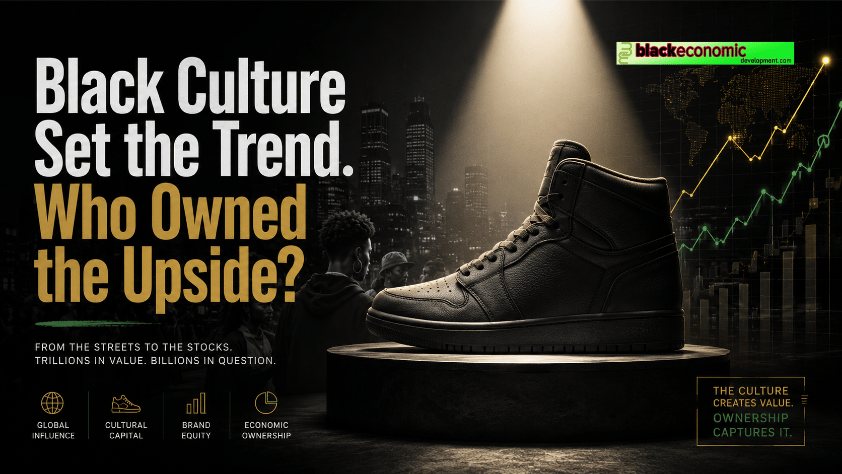
Black culture created value. Corporate ownership captured most of it.
Larry Miller’s Story Adds Another Economic Layer
Miller’s own story adds weight to this moment.
In his memoir, Jump: My Secret Journey from the Streets to the Boardroom, Miller tells the story of his rise from West Philadelphia to the highest levels of sports business. The book’s official site says Miller helped lead Michael Jordan’s $200 million basketball shoe company into a $4 billion global athletic apparel powerhouse.
That detail matters.
Miller was not only inside the Jordan Brand story as an executive. He was also a Black business leader navigating corporate America, reputation risk, second chances, and the question of who gets access to leadership after contact with the criminal justice system.
His career included major roles at Nike, Jordan Brand, and the Portland Trail Blazers. His public story also connects business success to education, redemption, and expanded opportunities for formerly incarcerated people.
That gives this story a second Black economic development layer.
The Air Jordan consumer story is about Black cultural value.
Larry Miller’s personal story is about Black labor, leadership, redemption and access.
Both point to the same larger issue: Black communities create value in places where institutions often fail to recognize the full human and economic potential already present.
Black Taste Operates Like Venture Capital
One way to understand this is to think of Black cultural influence as a kind of venture capital.
Not financial capital.
Cultural capital.
Young Black consumers often invest attention before the mainstream does. They give early credibility to products, sounds, slang, styles, athletes, artists and platforms.
They take the social risk of making something matter before everyone else agrees.
When the bet works, companies can scale it.
- They can raise prices.
- They can build campaigns.
- They can sell globally.
- They can create scarcity.
- They can generate resale markets.
- They can turn community meaning into corporate revenue.
But unlike traditional venture capital, the early cultural investors often do not get equity.
They get recognition, maybe.
They get targeted marketing, definitely.
But they rarely get ownership.
That is the unfinished business.
This Is Bigger Than Sneakers
The same pattern shows up across music, fashion, sports, media, beauty, gaming, language and digital platforms.
Black communities often create the demand signal.
Someone else owns the marketplace.
Black creators build the audience.
Someone else owns the platform.
Black consumers make the product hot.
Someone else owns the data.
Black culture creates the meaning.
Someone else packages, prices, distributes and monetizes it.
This does not mean every brand relationship is exploitation. Consumers buy products for real reasons: identity, quality, status, emotional connection, nostalgia, and belonging.
But economic development requires looking past the purchase.
The deeper question is not only what Black consumers buy.
It is what Black communities own.
From Influence to Ownership
Larry Miller’s comments should not be treated as a throwaway sneaker quote.
They are a window into how global brands study Black consumers, extract meaning from Black culture, and convert cultural credibility into economic power.
They also raise a bigger question for today’s creators, founders, athletes, artists, retailers, designers, and investors.
What would it look like if Black trendsetting came with more Black ownership?
- More Black-owned sneaker retailers.
- More Black-owned streetwear brands.
- More Black-owned licensing deals.
- More Black-owned consumer data platforms.
- More Black-led investment funds tied to culture-driven markets.
- More fair-chance pipelines that allow people with complicated pasts to enter leadership, build companies, and participate in the upside.
That last point matters because Miller’s story is not only about climbing into the boardroom.
It is about how much talent gets wasted when systems decide too early who is disposable.
If one of the executives connected to Jordan Brand’s rise could come from that kind of background, then the economic lesson is clear: opportunity is not charity. It is infrastructure.
Education, second chances, and fair access to leadership are economic development tools.
What BlackEconomicDevelopment.com Sees Here
This is exactly the kind of story BlackEconomicDevelopment.com exists to explain.
- Culture is the entry point.
- Economics is the lens.
- Ownership is the question.
The Larry Miller clip is not just sneaker history. It is a case study in how Black consumer influence becomes market power. And how market power becomes wealth only when it is connected to ownership, equity, distribution, leadership and control.
The takeaway is not that Black consumers should stop buying culturally meaningful products.
The takeaway is that Black communities should better understand the value of the demand they create.
If young Black urban consumers are trendsetters for America and the world, then the opportunity is bigger than being studied by brands.
The opportunity is to own more of the brands, stores, media channels, data, collaborations, licensing deals, and investment vehicles that profit from that influence.
Because being the trendsetter is powerful.
But owning the upside is economic development.
Black culture created the signal. Corporate ownership turned that signal into global brand equity.
Economic Implication
Black consumer culture is not just a spending category. It is a market-making force. The Air Jordan story shows how Black taste, identity, and early adoption can become global brand equity when corporations control the product, distribution, data, and capital structure.
Larry Miller’s personal story adds another layer: Black economic development also depends on leadership access, second chances, and pathways that allow people with lived experience to enter rooms where capital decisions are made.
Why It Matters
Black communities often create cultural value before they own the assets that monetize it. The next phase of Black economic development must move from influence to ownership, and from symbolic inclusion to real control over capital, distribution, and leadership pipelines.
The Ownership Question
What is the ownership question in this story: who bought the product, who made it culturally valuable, who led the business strategy, or who captured the long-term upside?
Latest posts by normbond (see all)
- The Atlanta Dream Built the Demand. The Arena Calendar Still Controls the Opportunity. - October 13, 2026
- Black-Founded Vurt Is Taking Vertical Video to TV. The Bigger Question Is Who Controls Distribution. - October 12, 2026
- Owning the Asset Is Not the Same as Controlling the System - October 10, 2026