



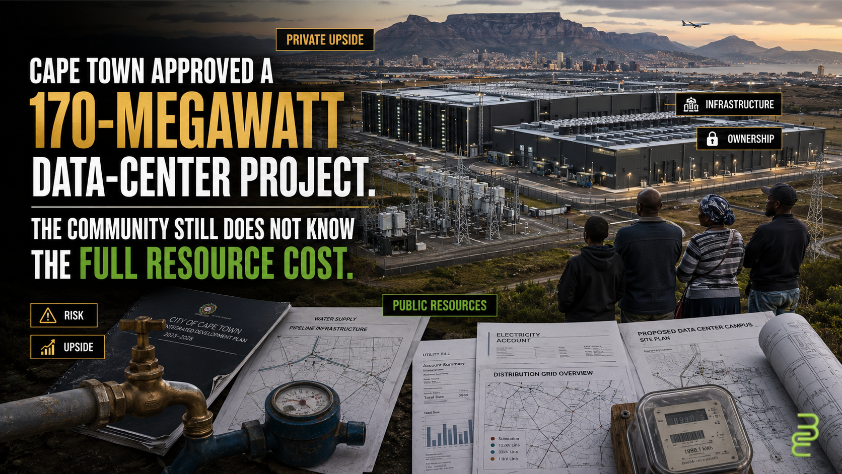
Cape Town has approved a major step toward the development of two Equinix data centers near Cape Town International Airport.
The decision could help expand the physical infrastructure supporting cloud computing, artificial intelligence and digital services across Africa.
It also raises a harder economic question:
When a global technology company depends on local electricity, water, land and government approval, what does the surrounding community receive in return?
Cape Town’s Municipal Planning Tribunal approved the proposal for the King Air Industria area despite objections concerning electricity demand, water use and the lack of detailed environmental information.
The proposed facilities could require approximately 170 megawatts of power capacity.
That would make the project one of South Africa’s largest proposed data-center developments. By comparison, Teraco says it operates approximately 189 MW of critical power capacity across its African campuses.
Equinix has confirmed that it purchased land in Cape Town. The company has not yet submitted a final site-development plan and says that detailed information will be provided should it decide to proceed.
That distinction matters. The tribunal’s decision is a major approval, but it is not the same as a completed facility with fully disclosed operating requirements.
AI does not run in the cloud
Artificial intelligence is often discussed as though it exists somewhere above the physical economy.
It does not.
AI systems depend on servers, cooling systems, fiber connections, backup generators, substations, water infrastructure and enormous amounts of electricity.
Before a company can sell computing capacity to banks, technology firms, retailers, government agencies and other enterprises, it must secure the physical inputs that make computing possible.
That is where the economics of the Cape Town decision begin.
Equinix would control the resulting data-center infrastructure and the commercial relationships built around it. Its customers would gain access to locally available computing, storage and interconnection capacity.
The city, meanwhile, controls planning approval and plays a role in determining access to public infrastructure.
Residents can participate in hearings and submit objections. They do not automatically receive control over the project’s commercial terms, operating data, resource allocation or revenue.
Who captures the upside?
Equinix is one of the world’s major digital-infrastructure companies. A Cape Town expansion could strengthen its position in the growing African market for cloud services, data storage and enterprise connectivity.
The facilities could generate recurring revenue because customers pay for space, power, connectivity and access to a network of businesses and technology providers.
Banks, telecommunications companies, cloud platforms and other large enterprises may also benefit from increased local computing capacity.
Construction companies, equipment suppliers, land interests and some workers could gain from development activity.
But the distribution of benefits matters.
Data centers require significant capital during construction but generally do not employ workforces comparable to factories, hospitals or other developments with a similar physical footprint and utility demand.
The available material does not establish how many permanent jobs the Equinix project would create, how many would be reserved for local workers or Black-owned contractors, or what supplier-development commitments would apply.
Those unanswered questions should be central to the next phase of public review.
Who carries the resource risk?
The Housing Assembly, Foxglove and the Legal Resources Centre objected to the proposal, arguing that the available information did not adequately explain its potential water use, electricity demand, emissions, cooling systems, diesel generation and other environmental effects.
The Housing Assembly represents communities in a city shaped by deep inequality in housing, employment and access to reliable services.
Cape Town also experienced an extreme water crisis during the 2017–2018 drought, making questions about large industrial water users particularly sensitive.
The concern is not that every megawatt allocated to a data center is directly taken from a household.
Electricity systems are more complicated than that.
The economic concern is that a high-demand private development can require new generation, transmission, substations, backup systems and municipal coordination. Someone must finance, maintain and absorb the risk associated with that infrastructure.
Without firm disclosures, the public cannot easily determine whether the developer will cover the full cost of its demand or whether some pressure could be transferred to utilities, taxpayers and ratepayers.
Water presents a similar issue.
The amount required will depend on the cooling technology, operating conditions, recycling systems and design of the facilities. Those details have not yet been publicly established in the material supporting the approval.
That uncertainty is precisely why community groups demanded more information before the project advanced.
The ownership question underneath the approval
The proposed facilities would be located in Cape Town, but their economic value could flow through a global corporate network.
Equinix would own or control the computing infrastructure.
Its customers would control the software, platforms, commercial data and AI systems running through that infrastructure.
The community would supply the geographic location, public approvals, utility environment and surrounding labor market.
That arrangement is not automatically exploitative. Digital infrastructure can support investment, productivity, connectivity and new business formation.
But proximity to infrastructure does not guarantee ownership of it.
A data center can sit inside a Black community without materially expanding Black ownership, procurement, technical capacity or long-term wealth.
That is why the debate should move beyond a simple choice between development and opposition.
The better question is whether Cape Town can negotiate measurable public value from the project.
What should the community receive?
Community benefits should not depend entirely on voluntary corporate promises.
Before final development proceeds, public authorities could require clear reporting on projected power demand, water consumption, backup generation, emissions and infrastructure costs.
They could also seek measurable commitments covering:
- Local hiring and paid technical apprenticeships
- Procurement from Black-owned and locally based suppliers
- Investment in grid or water infrastructure
- Public reporting of actual electricity and water consumption
- Renewable-energy sourcing with credible additional capacity
- Support for local schools, universities and technical-training institutions
- Affordable computing or cloud access for local businesses and public-interest organizations
- Emergency plans that prevent residential users from carrying the consequences of resource shortages
The exact package would require negotiation and technical review.
The principle is simpler:
The company capturing the commercial upside should bear the full cost of the infrastructure and resource demand required to produce it.
Why this matters to Black communities
Africa’s role in the AI economy cannot be limited to supplying land, energy, minerals, labor and consumers.
The continent also needs ownership, computing access, technical capabilities, local procurement and influence over how digital infrastructure is developed.
For Black communities in Cape Town, the Equinix decision is therefore about more than one development.
It reveals a broader struggle over how the AI economy will be built.
Will communities be asked to supply scarce resources while global companies own the infrastructure and capture the recurring revenue?
Or will public authorities use planning permission and utility access as leverage to secure enforceable local benefits?
The project may create significant economic value.
The unresolved issue is who gets to own that value, who gets paid from it and who carries the cost of producing it.

Latest posts by normbond (see all)
- Michael Jordan Gave Morehouse $1 Million. Now It Has a Media Production Center. - September 26, 2026
- Nigeria’s Ima Gas Field Sat Underground for 53 Years. A Nigerian Company Will Own 60% When It Finally Produces. - September 24, 2026
- Royal Caribbean Is Paying $3 Billion for Half of Sandals. The Bigger Story Is Who Owns Caribbean Tourism. - September 24, 2026